

Despite repeated warnings of the threat that data centers pose to electric system stability, grid reliability is dangling between old fenceposts that separate hyperscale data centers from effective oversight.
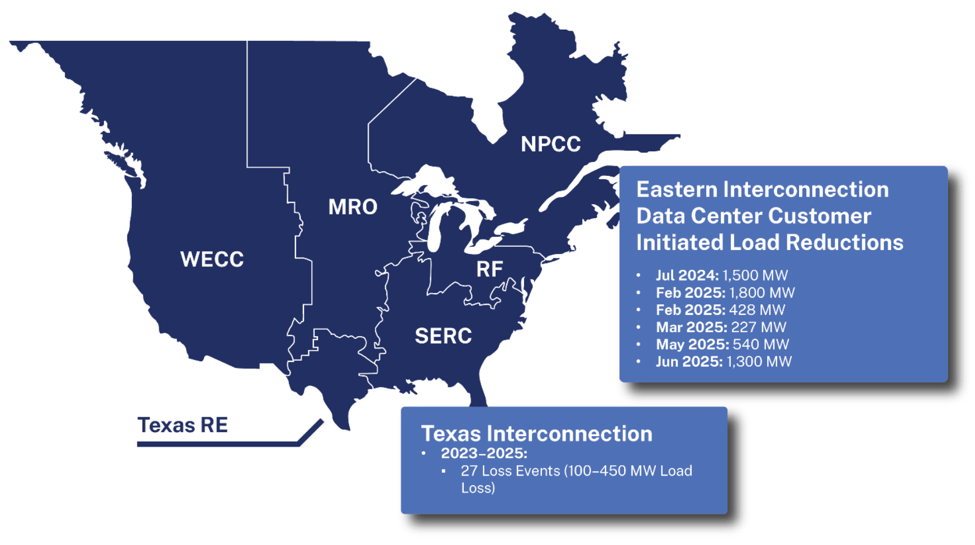
Two weeks ago, over three gigawatts (GW) of data centers disconnected themselves from the grid in response to a minor transmission fault in Virginia and switched to their own polluting backup power. This sudden drop in load—equivalent to millions of homes—caused fluctuations in the grid’s voltage and frequency that could be detected as far away as Illinois and took nearly 10 minutes to resolve. While grid fluctuations are common, most are resolved automatically in seconds. Such massive, extended fluctuations create a risk of cascading disturbances which can eventually lead to blackouts—and since data centers are connected to the transmission system, the impact can be felt states away.
If this feels like déjà vu, you might be remembering a very similar incident which occurred in July 2024, when 1.5 GW of data centers disconnected from the grid in response to a transmission fault. (And that’s not to mention the 26 documented loss of load events in Texas over the last two years.) In between these two events, regulators have been busily drafting standards and making recommendations—but because this keeps happening, it’s clear that not enough is being done. To address the growing risk, immediate action is needed from state regulators and utilities to transparently apply robust requirements, and make plans to implement upcoming standards.
The rapid growth of data centers causes reliability risks
The technical name for the two events in Virginia is “customer initiated load reduction,” or CILR. In both cases, major damage to the grid was avoided, although utilities did field complaints about flickering lights and strange noises coming from refrigerators and air conditioners, caused by the grid’s voltage and frequency going outside of normal ranges.
Shortly after the 2024 event, the president of the North American Electric Reliability Corporation (NERC) described it as a “five-alarm fire when it comes to reliability.” NERC is responsible for developing and enforcing grid reliability standards. NERC’s authority, and approval of its standards, comes from FERC, the Federal Energy Regulatory Commission, which governs the bulk power system—the large wires which move power between states and which most hyperscale data centers are seeking to connect to.
Despite NERC’s best efforts, data centers continue causing problems on the grid. I’m going to provide an overview of what FERC and NERC have been doing, but the truth is that their efforts alone are not enough— state regulators will need to step up to the plate, too.
What have NERC and FERC been up to?
Here’s a brief timeline of key actions by NERC and FERC, bookended by these two events:
- January 2025: NERC published an incident review covering the 1.5 GW CILR event in 2024, recommending actions that transmission planners and operators “should start taking to avoid significant issues in the future.”
- September 2025: NERC issued a level two alert with specific recommendations to address reliability risks caused by data centers. NERC’s later summary of responses to the alert found that very few utilities are following the recommendations or developing plans to implement them.
- October 2025: The Secretary of Energy issued an “advanced notice of proposed rulemaking”, directing FERC to develop rules to “ensure the timely and orderly interconnection of large loads to the transmission system.”
- May 2026: NERC published reliability guidelines, a precursor to enforceable standards, and issued a level three alert (NERC’s highest), including seven “essential actions” which utilities must take “to address the risks posed by existing and new computational loads interacting with the bulk power system.”
- June 2026: In response to the October directive, FERC issued “show cause” orders to each of the regional grid operators, finding that none of them were doing enough to address the reliability concerns of data centers.
Finally, in July FERC ordered NERC to issue reliability requirements by the end of the year (a timeline NERC had proposed earlier). This answered one of the key questions that had been swirling around all of NERC’s activity: whether the organization actually had the authority to require data centers to register (and thus be subject to reliability standards). NERC’s CEO had raised this concern earlier in a letter to members, noting that “registering load-side assets is unprecedented.”
Data centers are coming online even as standards evolve
While this may seem like a lot of movement, key gaps remain. NERC noted as much in a March 2026 whitepaper, finding that the lack of coordination between regulators, utilities, and data centers “can result in inefficiencies, misalignment, and increased risk to system reliability.”
A critical challenge is that data centers are already online, with even more being built now, while enforceable standards won’t be published for several more months. A recent report from Berkeley Lab estimates that from 2024, when NERC documented the first data center CILR, to 2027—the earliest that data center reliability standards will be enforceable—total load from data centers is expected to nearly double.
This growth wouldn’t be quite so challenging for grid reliability if utilities were taking it more seriously by implementing sufficient requirements on their own in the meantime, or if regulators were planning to make any future standards retroactive. However, neither of these are happening.
This is especially egregious given that a constant excuse from utilities about why they aren’t moving faster to connect clean energy is a lack of confidence in existing standards for things like rooftop solar. But now, utilities are rushing to interconnect data centers without any applicable standards.
The Midwest grid operator takes a step backward on enforcing reliability standards
MISO, the Midcontinent Independent System Operator, is one of the grid operators under FERC jurisdiction which is responsible for building NERC standards into its interconnection policies and practices. In a June presentation, MISO shared a plan to phase in any NERC requirements by late 2027, with standards retroactive to data centers built after October 2026, or existing data centers which expand by over 25 MW.
But just a month later, MISO changed course, saying that existing data centers will be “managed,” with the full standards only applying to new data centers. In sharing the update, MISO mentioned feedback from un-named stakeholders. On a call announcing this change, MISO estimated that there are up to 30 GW of data centers in its territory that would thus be exempt from these standards. While the individual utilities that serve them may have their own standards, there is no transparency into these standards to understand whether they are sufficient or how they will be enforced.
Just 1.5 GW of data center load in Virginia triggered an event that NERC referred to as a “five alarm fire.” The risk in MISO’s territory is potentially 20 times greater.
State regulators must fill this gap
While FERC and NERC are active at the federal level, progress is slow. At the regional level, FERC’s show cause orders spared no one, finding that none of the six grid operators are doing enough, allowing for a massive lapse in regulation. This makes it imperative that state regulators—public service commissions and public utility commissions—step in.
Across our state-level advocacy, UCS has been pushing for such efforts.
When Michigan utility I&M submitted a large load tariff for approval, I recommended that the state create a working group to address the data center reliability risks even as NERC and regional requirements are pending. The administrative law judge supported this recommendation; a decision by the commission may come later this month.
I built on this testimony when Michigan utility DTE filed for approval to interconnect a 1 GW Google data center. Our brief argued that because standards are still under development, greater scrutiny of DTE’s confidential requirements is needed.
This week, I filed additional testimony in Michigan calling on the Commission to ensure that any NERC and MISO standards are applied retroactively.
In a Louisiana docket to develop large load guidelines, UCS submitted extensive comments documenting the reliability risks from data centers and recommending formation of a workgroup similar to what we recommended in Michigan.
UCS also submitted excerpts from these comments in a Maine docket to investigate the impacts of data centers.
Next steps
This is a crowded landscape, and I haven’t even touched on the work of industry-expert groups, developments from other regional grid operators, or what’s happening in Europe. However, the rapid pace of development in this area underscores the point: regulators must require more transparency from data centers and utilities, and as standards are developed, lay plans to apply them retroactively.
The 3 GW loss of load incident that I opened with demonstrates exactly why: data centers are impacting the grid’s reliability even as experts scramble to develop standards and requirements. We can’t simply wait until those standards are ready. Doing so allows the stress from data centers to build up on the grid, inevitably leading to wide-scale grid damage and blackouts.


