
The 2026 Textile Exchange Conference saw more than 1,300 participants join either in person in Vancouver or online, bringing together brands, innovators, farmers, nonprofit organizations, academics, and more from all around the globe to listen with curiosity, share real-world experiences, and seek out positive approaches to drive meaningful change at the start of the supply system.
Under the theme The Implementation Era, the agenda explored how we can scale what works across businesses, supply systems, and landscapes. Here are some of the key takeaways from across the three days.
Day one plenaries
Day one focused on recognizing and engaging with the diverse realities that shape sustainability decision-making—from policy and targets to on- the-ground experience. The agenda was dedicated to deepening understanding of different contexts and priorities across supply systems, building the shared awareness needed to move forward in greater alignment.

Opening plenary: The unifying power of textiles in polarizing climates
Our first morning opened with a territorial welcome by Chief Janice George, Master Weaver and Co-Founder, L’hen Awtxw Weaving House, and Debra Sparrow, Co-Founder and Owner, Salish Blanket Co. They shared their work to revive traditional Indigenous weaving practices, and highlighted the importance of passing on ancestral knowledge, preserving cultural identity, and honoring their connection to the land. Reflecting on the day’s theme of finding common ground across different contexts, they spoke of weaving as a shared thread across cultures, reminding us that wherever we come from, our ancestors used weaving to express their identities and traditions.
The opening was followed by a powerful keynote from Professor Gail Whiteman, Hoffmann Impact Professor for Accelerating Action on Nature and Climate at the University of Exeter and Founder of Arctic Basecamp, drawing on the latest data to illustrate the scale and urgency of the challenges ahead.
While discussions on climate can often be polarizing, Professor Whiteman suggested that textiles can be a unifying narrative. Through their ability to create and shape culture, unite people and influence our lives, she highlighted their potential to act as a “Trojan horse” to a better world.
Her closing message was a call to attendees to show “micro, ordinary, everyday courage” to drive the level of change we urgently need.
CEO Claire Bergkamp on balancing supply and demand to scale what works
Following Professor Whiteman, Claire Bergkamp, CEO, Textile Exchange, welcomed attendees, reflecting on her personal experiences of regenerative agriculture in Patagonia, Argentina, and the importance of connecting on-the-ground knowledge with industry-wide change. Bergkamp acknowledged the significant challenges ahead but emphasized that the systems that are collectively being built are already delivering progress. The challenge is now to scale that impact, which requires both a stronger supply of materials and fibers produced through preferred production systems and consistent market demand.
Looking forward, Bergkamp highlighted how Textile Exchange’s new Materials Matter Standard can be a key driver of progress, bringing together decades of learning and multistakeholder input to help translate ambition into meaningful change on the ground.
Closing plenary: Investing in resilience and creating shared value
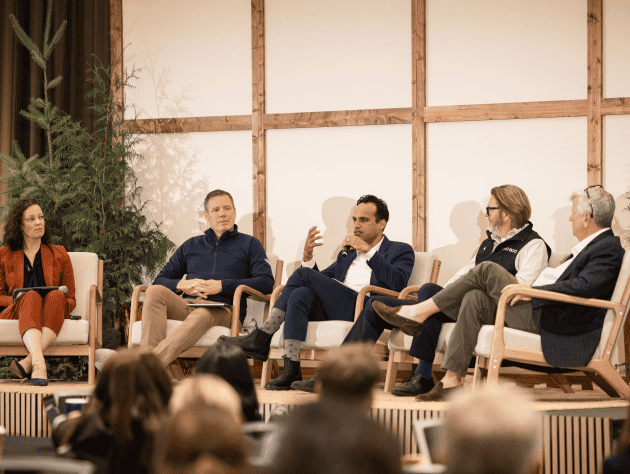
In the day’s final session, Beth Jensen, Chief Impact Officer, Textile Exchange, Ashley McKeon, President and CEO, Soil Health Institute, Lewis Perkins, President/CEO, Apparel Impact Institute, and Shyla Raghav, Board Member, Global Fashion Agenda discussed what it will take to keep producing the materials our industry depends on.
The panel emphasized that building resilience through regenerative agriculture benefits both farmers and producers over the long term, reducing input costs, strengthening farm profitability, and supporting more resilient supply systems. The challenge is overcoming the “commitment Catch-22,” with funders reluctant to invest until producers reach commercial scale, yet producers needing funding to get there. The panel said the answers lied in catalytic capital, innovative financing, and sustained collaboration to share costs, risks, and long-term benefits.
“I have hope because of nature. Nature never gives up. In every polluted land or ecosystem that we’ve seen around the world, nature finds a way to come back, always. Hope is an integral part of nature’s life force and also part of our life force.”
Professor Gail Whiteman, Hoffmann Impact Professor for Accelerating Action on Nature and Climate at University of Exeter and Founder of Arctic Basecamp

Insights from our day one breakout sessions
Resilience requires planning for constant disruption
A session on sourcing strategies during geopolitical unrest highlighted how ongoing geopolitical and supply system uncertainty is changing the way companies need to prepare. Panelists discussed the need for long-term planning over reactive decisions, from diversifying sourcing and investing in alternative materials to using AI and scenario planning to identify vulnerabilities. Sean Cady, VP Global Product Stewardship, Sustainability and Government Affairs, VF Corporation, highlighted VF’s investment in recycled polyester as an example of mitigating oil price volatility.
With supply chains often opaque, panelists highlighted the need for better data and closer collaboration across the value chain to identify emerging risks and make strategic decisions that strengthen resilience.
Brands and producers should align on monitoring needs, data requirements, and shared responsibilities upfront
Panelists discussed how effective regenerative agriculture monitoring needs to work for both farmers and brands, considering context and intended use of the data, with practical on-the-ground methods not always meeting reporting requirements. They highlighted the importance of establishing baselines and using transparent, repeatable methods to track progress over time, with indicators tailored to local landscapes, stakeholder needs, and reporting requirements.
By improving communication and co-creating feasible approaches, brands and farmers can strengthen data collection and use findings, both successes and setbacks, to support continuous learning. Sharing methodologies, responsibilities, and costs is vital to ensure monitoring is credible, proportionate, and meets the needs of all parties.

Context determines what a realistic and appropriate transition to preferred production systems looks like
The session brought together producers and brands to explore the opportunities and challenges of moving away from fossil-based inputs across different production systems. They discussed how producers can learn from one another’s approaches to continuous improvement, navigating real-world trade-offs, and moving from pilots to scale. Recognizing commonalities can help producers and brands identify the pathways best suited to their context, strengthening producer–brand partnerships and aligning on investment and key changes to accelerate wider systems change.
Setting company targets is a critical step toward industry-wide progress
The panel, representing both brands and producers, discussed the importance of establishing company targets that are both ambitious and credible, and that align with a shared direction of travel. They discussed Textile Exchange’s Action Cohort aggregate targets, highlighting that it is crucial for the industry to have a shared vision and transparent communication. By setting clear, actionable goals at a company level that align with targets shared across the industry, companies can help drive demand while aligning efforts throughout the supply chain to support positive outcomes.
Start preparing now for forthcoming EU policy
Speakers, including from the European Commission, shared insights on the key EU policy developments coming up in the months ahead. Panelists highlighted the importance of preparing now to comply with and implement upcoming ecodesign requirements, including engaging suppliers early on data collection and transfer, mapping existing data and identifying gaps against current ecodesign proposals, and testing whether product information can be linked to product identifiers. They also emphasized the need to distinguish publicly available data from restricted compliance information and advised on monitoring delegated acts, registry developments, standards, and legislation changes.




Day two plenaries
The second day of the conference saw executives, farmers, investors, and innovators come together to discuss how we can create tangible incentives that make doing the right thing for people and planet easier. From boardrooms to balance sheets, from regeneration to recycling, the agenda explored the idea of leveraging existing systems and solutions to evolve progress. We discussed funding mechanisms, existing policy models, the availability of different types of data, and more, looking across industries and systems to explore how we can evolve progress using what is already out there. Every session served as a reminder that the conversations had when people from different daily disciplines that touch our global textile industry come together are some of the most valuable ones to shape the next phase of solutions.
Opening plenary: Finding the intersection of incentives to build sustainable business resilience
The day opened with Noel Kinder, SVP of Sustainability, lululemon, discussing how to navigate an increasingly complex operating environment. Kinder reflected on how corporate sustainability priorities have evolved, from a focus on responsibility, to ambitious target setting, and now to resilience, as businesses respond to a rapidly changing global landscape.
Against a backdrop of geopolitical instability, energy price volatility, and growing regulatory pressures, he emphasized the need for stronger, more adaptable supply systems. Embedding sustainability into business strategy, Kinder said, requires finding the intersection of incentives at the highest level of an organization to build the business resilience the moment demands.
Kinder added that rising expectations and uncertainty create an opportunity to refocus on what really drives meaningful progress. By aligning incentives around measurable outcomes and investing in scalable innovation, businesses can position sustainability as a driver of resilience, competitiveness, and long-term business performance.
Closing plenary: Make the right thing the easy thing
Closing the day, Dr. Ahmed Zaidi, CEO, Hyran Technologies, argued that meaningful impact requires more than ambition—it demands new ways of working. While the textile industry has driven some of the world’s great technological advances, today’s challenge is not a lack of innovation, but systems that can discourage it.
Zaidi called for incentives that reward supplier innovation and greater trust and transparency between brands and suppliers, enabling them to improve by sharing knowledge, challenges, and mistakes. As AI and digital tools advance, they can help in multiple ways, including reducing the administrative burden that often stands in the way of progress. But technology alone is not enough. We must first define what “good” is and create shared incentives to support the shift.
Creativity, Zaidi said, often happens with a clash of paradigms. AI’s potential to transform fashion depends not just on what technology can achieve, but on who benefits from that transformation. As Zaidi challenged, any vision of a technological utopia must first ask: “a utopia for whom?”
Innovations such as on-demand manufacturing and factory automation may improve efficiency across the industry, but can also shift risk onto suppliers and affect workers’ livelihoods. The real opportunity is to rethink the industry’s systems so that innovation creates value for the wider industry and society, rather than simply optimizing outcomes for those who already hold the most power. Ultimately, the challenge is not just to ask what AI can make possible, but what kind of future we want it to create.
“As we commit to lowering our impact, we’re also realizing the benefit of a more resilient supply chain. Not just with our manufacturing partners, but in our material supply chain as well.”
Noel Kinder, SVP of Sustainability, lululemon

Day two breakout sessions insights
New approaches to financing can help unlock the transition to preferred production systems
Panelists highlighted the need to match financial instruments to specific investment needs. As Textile Exchange’s Drummond Lawson emphasized, conventional production should not be treated as a stable, low-cost baseline. Its increasing volatility must also be considered when assessing the value of investing in resilience and supply security.
While premiums for certified materials can support producer livelihoods, they are often diluted or delayed along the supply chain and may not be enough to incentivize action alone. A broader range of approaches is needed, and while the market cannot finance the transition alone, it can help create the conditions for investment by providing demand signals, engaging suppliers early, sharing information, aggregating demand, and connecting producers with appropriate funding. Clear outcomes, credible data, certification, and measurable impact can strengthen funding cases, reduce uncertainty, and help match opportunities with the right sources of capital.
A stronger understanding of global textile waste availability can help us to scale textile-to-textile recycling
Nin Castle, Co-Founder and CPO, Reverse Resources, presented theTextile-to-Textile Recycled Fiber: Availability Data for Apparel and Home Textiles report, recently published by Textile Exchange along with Reverse Resources, TEXroad, and Fashion for Good. The report provides an initial baseline for future supply, with conservative estimates suggesting 3–5 million tonnes of spinnable recycled textile fiber could be available by 2030. Following the discussion on the report, the panel highlighted that scaling requires more than available feedstock: investment, efficient sorting, consistent policy, and stronger brand demand are essential. Panelists discussed regional strengths, including the innovation opportunities and regulatory frameworks in Europe, and China’s collection infrastructure and scale. Key opportunities to scale textile-to-textile recycling include improving textile design for circularity, using innovative sorting technologies, sharing data across the industry, and prioritizing achieving the investment needed to scale the necessary infrastructure.

For regeneration to reach its full potential, we need "brandscapes" based on landscape-level collaboration
Attendees heard how the intent to scale up regenerative agriculture is becoming universal, but alignment on how to make it a reality is not. They agreed that a collective approach to regeneration requires a shift from fragmented, brand-led projects to “brandscapes”—landscape-level collaborations that see brands, stakeholders, and farmers align around shared science-based goals while allowing regenerative practices to reflect local contexts.
Panelists discussed solutions such as pre-competitive collaboration, long-term sourcing commitments, collective investment in transition costs, and economic models that reward regenerative outcomes. They emphasized the need for clear “common sense” communication that connects on-the-ground monitoring and biodiversity and nature outcomes to tangible farmer benefits, including stronger business performance and reduced risks.
Start learning more about Extended Producer Responsibility (EPR) approaches from different regions and industries
In today’s dedicated session on EPR, panelists highlighted the importance of aligning data and reporting requirements across different regional EPR schemes to reduce complexity, improve consistency, and enable stakeholders to navigate evolving regulations more effectively. At the same time, they emphasized that EPR implementation must reflect local realities, recognizing that waste management infrastructure, collection systems, and recycling capabilities vary significantly across different contexts. Looking to other sectors, such as packaging and electronics, where EPR schemes are already established, can offer valuable lessons on navigating these differences and identifying opportunities for greater alignment.
Consider the value traceability creates for producers from the outset
A panel from across the industry discussed how brands can build buy-in for monitoring and data collection by involving farmers and producers early in the system design and ensure data collection delivers tangible benefits for them, rather than just adding administrative burden.
The panel emphasized that data is never free—all data collection has real cost and time impacts for producers, often working on thin margins. Harmonizing data requests, investing in strong relationships, and sharing costs fairly can reduce duplication and improve participation. Clear data ownership, privacy safeguards, and appropriate levels of disclosure are essential to protect sensitive farm-level information.




Day three plenaries
The final day of sessions explored how we can activate progress through collaboration. Partnership can look different to each of us—it could be a shared project, a commitment of shared risk, or a relationship built over years of trust and consistency. By taking time to understand different perspectives on what partnership means, we can avoid misunderstandings and create a foundation for meaningful progress.
Opening plenary: Implementation is a movement, not a moment
In the opening plenary, Brenna Atnikov, Systems Practice, Multi-Stakeholder Collaboration, Strategic Foresight and Transformation, Marcela Navarro Parra, International Advisor and Board Director, Transitions and Systems Funding, and Ashley Gill, Chief Standards Officer, Textile Exchange, explored how cross-industry collaboration can scale preferred production systems and overcome economic barriers.
The panel emphasized that effective partnerships are built on a clear understanding of language and purpose. Bringing all affected stakeholders together around common goals, rather than forcing a consensus, create space for the diverse perspectives that are essential for the industry to successfully transition to preferred production systems. This approach enables established assumptions to be challenged and opens the door to shared solutions that work for all stakeholders.
Moving beyond experimentation requires effective long-term partnerships that understand implementation is a movement, not a static moment in time, adapting as needs and incentives evolve. They stressed that trust was the foundation for such partnerships, and that is earned through our actions. With trust established, it creates an environment where deep questions can be asked that challenge current thinking and explore new possibilities.
Ultimately the innovation needed from the industry can come from a combination of already existing ideas, resources, and relationships. Creating convening spaces for dialogue and conversation allows these ideas to develop and then be piloted at the level needed to implement at scale.
Afternoon plenary: Convergence around real intention to act
The closing plenary brought together Samata, CEO of Black Pearl, and Textile Exchange’s Ashley Gill, Chief Standards Officer; Beth Jensen, Chief Impact Officer; and Sarah Needham, Chief Engagement and Partnerships Officer, to reflect on the standout learnings, trends, and takeaways that have emerged over the last three days.
The discussion highlighted how continuous improvement is being driven by the community in the room and strengthened by a growing convergence around a shared intention to act. As participants demonstrated progress in practice, one message was clear: the implementation era is here.
The executive team explored the complementary roles of Textile Exchange’s new action-oriented membership structure and the Materials Matter Standard in pushing this industry transformation forward—from the Action Cohort’s aggregate targets, which align efforts around shared outcomes, to the standard’s criteria, which translate ambition into practical action on the ground. Closing the conference, Textile Exchange CEO Claire Bergkamp reflected on the energy of the three days and the clear opportunities to drive toward shared outcomes together.
“One of the great themes we’ve seen this week is interdisciplinarity. We’ve taken so much learning from different sectors, from food, from merchandising, from sourcing. We are creating the space for the collective, the space for us to be able to work together.”
Sarah Needham, Chief Engagement and Partnerships Officer, Textile Exchange

Day three breakout sessions insights
Bring teams together early to develop sustainability communications that are educational
As regulations increasingly shape what brands can say and sustainability language becomes harder to follow, a panel discussed how early collaboration between sustainability, communications, and legal teams is crucial to develop claims that are both credible and meaningful. The panel also spoke about the shared responsibility to educate consumers to help people understand more nuanced, context-specific information and empower them to make choices aligned with their values. They emphasized that saying less isn’t the answer. Instead, new legislation should be viewed as an opportunity to develop clear, evidenced-based claims that build trust.
Strengthening collaboration between the food and fiber industries can scale regenerative agriculture and farmers’ livelihoods
Panelists, representing the supply system from growers to brands, highlighted the close agronomical and economical connection between food and fiber production. They discussed the opportunities this presents to improve resource efficiency and resilience in both sectors by sharing knowledge and approaches to soil health, diversified farming, and farmer livelihoods. They encouraged greater collaboration between the industries to help accelerate the uptake of regenerative practices, while creating opportunities in the textile supply system to increase the use of co- and by-products from the food industry that might otherwise have gone to waste. Supporting farmers through the transition, including ensuring fair returns, making certification accessible, and investing in soil health, is essential to delivering lasting environmental and economic benefits.
The post Discover the Key Insights from the 2026 Textile Exchange Conference in Vancouver, Canada appeared first on Textile Exchange.


