

Europe’s split grid infrastructure and lack of central planning mean it fails to use its renewables. It is stuck in volatile prices driven by reliance on imported fossil fuels. Treating the system as one network rather than separate national grids would unlock PV, storage and wind, says Christian Kjaer, executive director at Supergrid Europe.
For Europe to convert its abundant renewable energy resources into secure, sustainable, and affordable energy for industry and households, policymakers need to break the tie between electricity prices and the high cost of imported gas, and they need to invest in grid infrastructure and centralized planning.
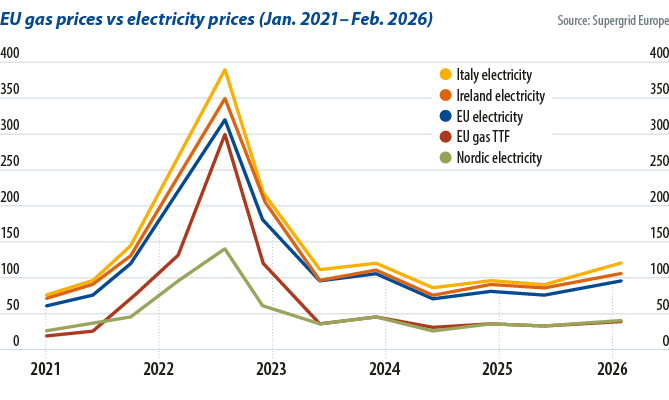
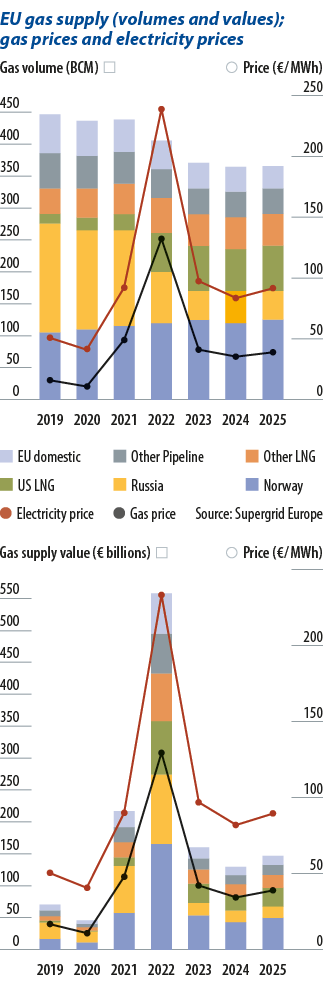
Although Europe has accelerated renewables and diversified its gas supplies since the shock caused by Russia’s invasion of Ukraine in February 2022, it is still spending twice as much on gas, much of it now imported from Qatar. In 2025, the European Union paid €145 billion ($168.5 billion) for its gas, compared to €70 billion in 2019. These figures do not even reflect the additional €30 billion in fossil fuel costs incurred since the outbreak of the Iran-US war, with no corresponding increase in supply.
Gas prices dictate electricity prices in Europe, making it vulnerable to supply disruptions. Electricity prices in nations with a relatively high share of gas in electricity (Ireland at 48% and Italy at 47%) are more vulnerable to gas price increases than nations using less gas (Sweden at 0%, Finland at 1.1%, Denmark at 2.4%) and more renewables.
Better use of existing grids, new grids, more storage and increased flexibility are vital for Europe to escape the straitjacket of energy insecurity and price volatility caused by imported fossil fuels.
Wind and solar grew from 20% to 30% of Europe’s energy mix in under five years, but grid and storage upgrades have not kept pace. In 2024, €7.2 billion worth of renewable electricity was curtailed across seven EU countries, according to Beyond Fossil Fuels, a coalition of civil society organizations. Grid operators association ENTSO-E forecasts that grid congestion costs could reach €26 billion per year by 2030 if bottlenecks persist.
Current limits
Right now, European transmission planning remains largely national. Each member state’s transmission system operator (TSO) develops projects based on domestic assessments, which are consolidated by ENTSO-E into the Ten-Year Network Development Plan (TYNDP).
This process has enabled important cross-border projects, but it remains bottom-up. Assumptions about demand, electrification and cross-border exchanges differ between countries, meaning the EU-wide plan reflects an aggregation of national priorities rather than an optimized view of the European grid as a single system.
Grid build-out follows assumptions embedded in planning models. If demand growth is underestimated, reinforcements are delayed. If cross-border flows are modeled conservatively, interconnectors are undersized. A framework designed for a slower, more nationally bound system now operates in a context of rapid electrification, large offshore wind development, and massive deployment of low-cost solar.
Grids Package
The European Commission’s Grids Package proposes a long-term centralized scenario to guide energy infrastructure planning across the continent. TSOs would continue to build and operate infrastructure on a national level, but planning for the grid’s future needs would be consolidated based on a shared view of Europe’s energy future.
EU Energy Commissioner Dan Jorgensen has called the European Grids Package “a major step toward building a 21st century European Supergrid.”
Done properly, it could mitigate many of the inefficiencies, transparency shortcomings, and conflicts of interest that have characterized the existing EU governance framework for cross-border energy networks. It would improve poor investment signals and ensure greater coherence between cross-border grid planning and broader EU policy goals on energy independence, energy security, renewable energy, energy efficiency and climate.
Interconnection and security
Grid investment is not just an added expense. With proper planning, it can lower total system costs, support more stable electricity prices, and improve European competitiveness.
The EU Grids Package is not a radical centralization of Europe’s electricity system, as some have suggested. It is an essential and pragmatic governance reform that maintains TSOs in charge of building and operating their national grids, while ensuring coherence with EU policy objectives. Moving from fragmented national assumptions toward a shared, transparent European scenario reflects the reality of an interconnected market, determined to address its century-long dependence on foreign supplies of fossil fuel at unpredictable cost to its businesses and citizens.
In a system where electricity flows freely across borders, planning cannot remain fragmented. Aligning infrastructure planning with Europe’s objectives of decarbonization, affordability and security of supply is ultimately a matter of effective EU coordination and governance.
About the author

Christian Kjaer is executive director at Supergrid Europe, a Brussels-based non-profit organization promoting the implementation of a pan-European electricity supergrid. Kjaer leads efforts to advocate for governance reform, grid planning, and market mechanisms to deliver a modern, interconnected grid fit for Europe’s decarbonized future. His previous positions include chief public affairs officer of SuperNode, senior adviser at Nordic Energy Research, and CEO of WindEurope.
The post Escaping the energy straitjacket appeared first on pv magazine Global.


