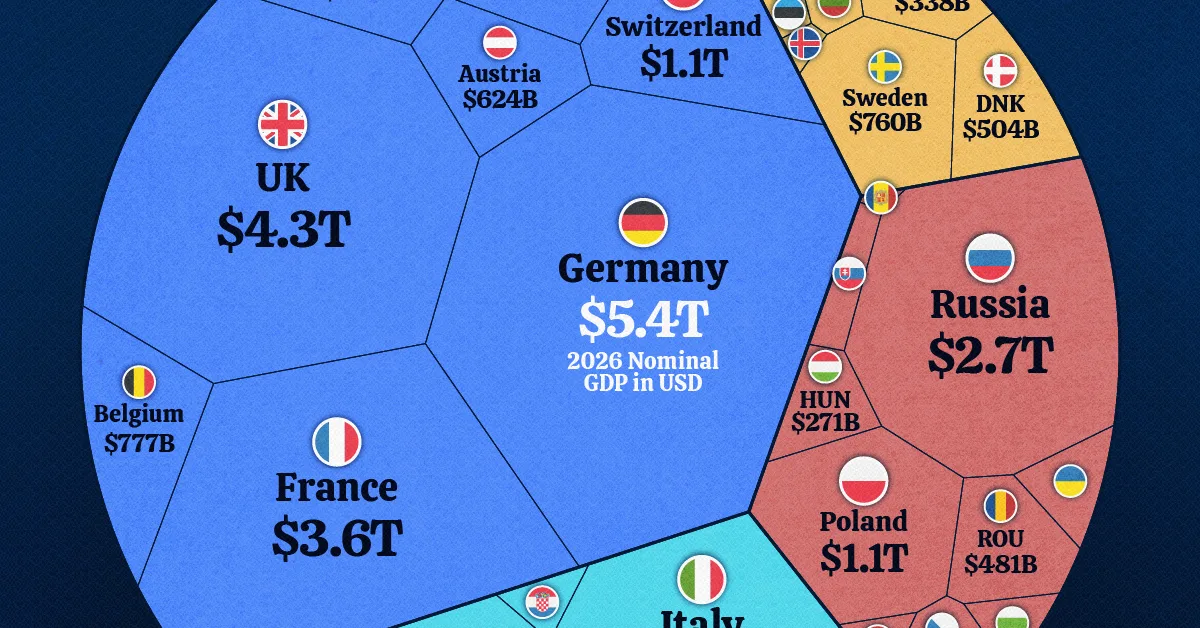
Europe’s $32 Trillion Economy, by Country
See visuals like this from many other data creators on our Voronoi app. Download it for free on iOS or Android and discover data-driven charts from a variety of trusted sources.
Key Takeaways
- Germany leads Europe’s economy in 2026 with $5.4 trillion in projected GDP.
- The UK ($4.3 trillion) and France ($3.6 trillion) rank second and third, respectively.
- Europe’s six largest economies account for over $20 trillion in output.
Europe’s economy is projected to reach $32.3 trillion in nominal GDP in 2026, but a large share of that output is concentrated in just a handful of countries.
This graphic breaks down each European country by its projected 2026 nominal GDP, using data from the April 2026 update of the International Monetary Fund’s World Economic Outlook.
Germany is the continent’s largest economy, followed by the UK and France, while Italy, Russia, and Spain complete the group of Europe’s six biggest economies.
Europe’s Biggest Economies Are Still in the West
Europe’s economic core remains firmly in the west, where Germany, the UK, and France together generate over $13 trillion in output.
| Rank | Country | 2026 Nominal GDP (billions $) |
|---|---|---|
| 1 |  Germany Germany |
5,453 |
| 2 |  United Kingdom United Kingdom |
4,265 |
| 3 |  France France |
3,596 |
| 4 |  Italy Italy |
2,738 |
| 5 |  Russia Russia |
2,656 |
| 6 |  Spain Spain |
2,091 |
| 7 |  Netherlands Netherlands |
1,450 |
| 8 |  Switzerland Switzerland |
1,147 |
| 9 |  Poland Poland |
1,134 |
| 10 |  Ireland Ireland |
779 |
| 11 |  Belgium Belgium |
777 |
| 12 |  Sweden Sweden |
760 |
| 13 |  Austria Austria |
624 |
| 14 |  Norway Norway |
599 |
| 15 |  Denmark Denmark |
504 |
| 16 |  Romania Romania |
481 |
| 17 |  Czechia Czechia |
433 |
| 18 |  Portugal Portugal |
381 |
| 19 |  Finland Finland |
338 |
| 20 |  Greece Greece |
308 |
| 21 |  Hungary Hungary |
271 |
| 22 |  Ukraine Ukraine |
225 |
| 23 |  Slovakia Slovakia |
169 |
| 24 |  Bulgaria Bulgaria |
148 |
| 25 |  Croatia Croatia |
117 |
| 26 |  Serbia Serbia |
112 |
| 27 |  Luxembourg Luxembourg |
110 |
| 28 |  Lithuania Lithuania |
106 |
| 29 |  Belarus Belarus |
102 |
| 30 |  Slovenia Slovenia |
87 |
| 31 |  Latvia Latvia |
54 |
| 32 |  Estonia Estonia |
52 |
| 33 |  Cyprus Cyprus |
45 |
| 34 |  Iceland Iceland |
44 |
| 35 |  Bosnia & Herzegovina Bosnia & Herzegovina |
37 |
| 36 |  Albania Albania |
33 |
| 37 |  Malta Malta |
31 |
| 38 |  Moldova Moldova |
22 |
| 39 |  North Macedonia North Macedonia |
22 |
| 40 |  Kosovo Kosovo |
14 |
| 41 |  Montenegro Montenegro |
10 |
| — | All of Europe | 32,323 |
France, Germany, and the UK built their economic strength through early industrialization and decades of diversification across manufacturing, finance, and services.
The UK’s economic transformation then spread to neighboring Western European countries, which became industrial heavyweights of their own. The three Benelux countries of Belgium, Luxembourg, and the Netherlands, for example, have a combined GDP of over $2.2 trillion.
The Energy Giants of Europe
In contrast to the role played by industry in Britain and Germany, or agriculture in France, energy is a major driver of Russia’s large economy ($2.7 trillion).
Russia is a major energy producer, with hydrocarbons like oil and natural gas making up over half of the country’s exports. Despite not being part of OPEC, which helps regulate oil prices, Moscow is often an active participant in discussions shaping oil markets.
The second-largest economy in Northern Europe is also a major oil and gas player. Despite having a population of around 5 million people, Norway’s economy is just shy of $600 billion, supported by its impressive energy reserves.
The Rise of Southern Europe
While northwestern Europe still dominates overall output, growth momentum is shifting south, where economies like Spain and Portugal are expanding faster than their larger peers.
Today, Southern Europe hosts dynamic economies like Spain ($2.1 trillion) and Portugal ($381 billion), which are projected to grow by roughly 2% each in 2026, more than double the rates of peers like France and Germany.
This shift has been supported by the post-COVID recovery in tourism, greater energy self-sufficiency, and higher public investment.
Learn More on the Voronoi App 
If you enjoyed today’s post, check out Since 1960, Singapore has risen from 3x poorer than Western Europe to twice as rich on Voronoi.Use This Visualization