
Systemic barriers are causing Canadian agriculture to lag numerous countries and industries in adopting artificial intelligence tools. However, producers aren’t likely to adopt at scale until the tech is governed and verified on a foundation of trust.
That’s the conclusion of a Farm Credit Canada analysis of AI adoption in the Canadian farm sector. It identifies four foundational barriers to AI adoption: capital constraints, talent shortages, patchy rural connectivity and questions of governance.
The report, AI in Canadian Agriculture: Present Challenges and Future Prospects, was prepared by FCC’s Thought Leadership Team to explore these barriers.
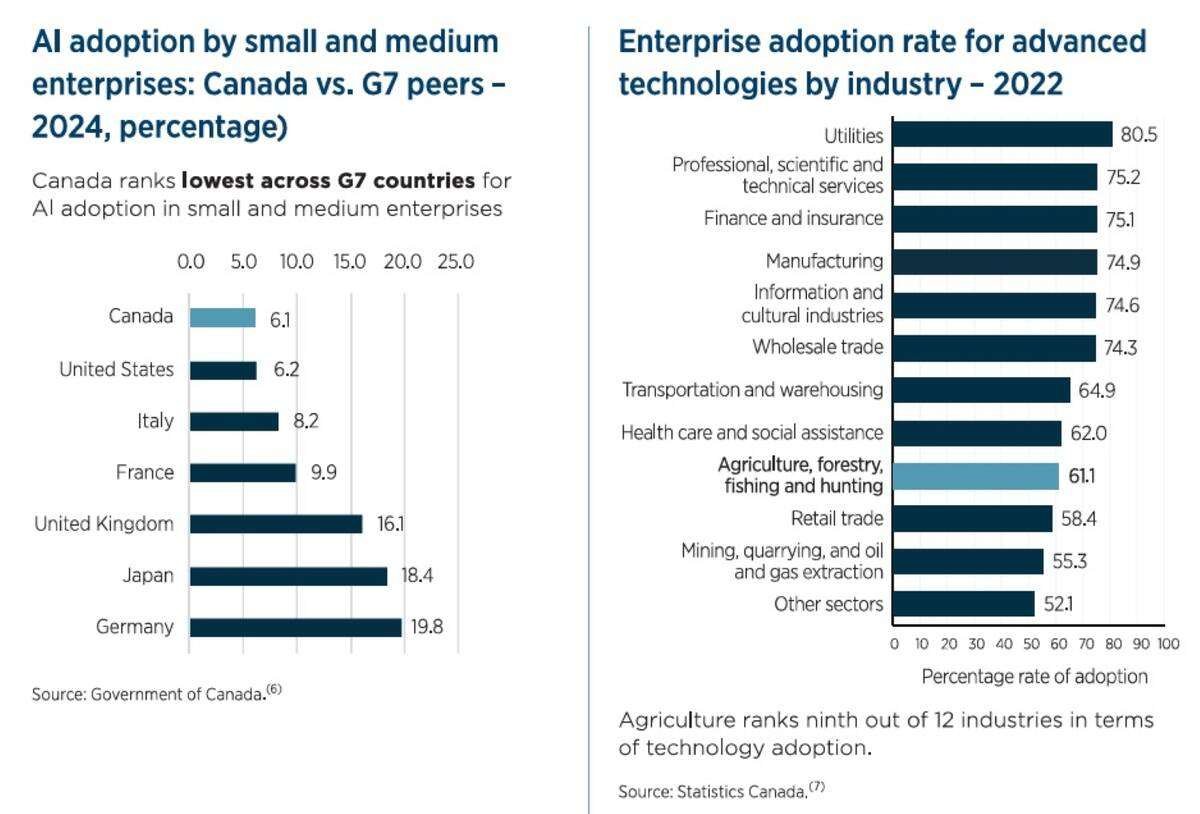
Based on federal data, it reveals AI adoption among small and medium enterprises in Canada is the lowest of all G7 countries regardless of sector.
Meanwhile, agriculture, forestry, fishing and hunting comes up as the fourth grouping from the bottom when advanced technology adoption is measured by industry.
“In the near term, efforts should focus on overcoming barriers to AI adoption by producers,” wrote Darren Baccus, executive vice-president of agri-food, alliances and FCC capital, in the report.
“This involves validating and demonstrating AI tools in real-world settings to build trust, provide credible evidence of value and showcase tangible benefits.”
Canada is already an agri-food powerhouse but it’s selling itself short by not embracing a technology that is fast becoming universal, said Baccus in a follow-up interview.
“The ambition of the industry participants that we’ve talked to use AI to drive productivity, to help in decision making, to really realize that potential that the Canadian food and ag industry has to be that global powerhouse.”
Baccus outlined the four predominant challenges.
Capital constraints — This has become less of a barrier, said Baccus. Investment in ag tech research and development (R&D) dropped off in recent years but has bounced back since AI entered the picture.
“We absolutely are seeing a flow of capital towards Canadian food and agriculture,” he said, pointing out an FCC initiative that saw more than 20 private sector investors commit up to five billion dollars for ag innovation over three-and-a-half years.
Talent shortages and skills gaps — The recency of AI means it has few dedicated career pathways. This is creating skill gaps in data literacy, AI integration and cybersecurity.
FCC is helping to close these gaps by educating producers, said Baccus.
“Having seminars, being able to be out there and leveraging our trusted relationship that we have with primary producers and industry participants provides them with training, with access to information around artificial intelligence.”
Digital infrastructure fragmented — The ag industry has experienced rural internet connectivity gaps almost from day one.
Although gaps have been closing incrementally — creating a mosaic of tech haves and have-nots in the process, said Baccus — a question remains on how to bring dead zones in underserved rural communities online.
Progress has been slow because internet service providers (ISPs) have not found a sufficient value proposition to invest in rural connectivity, he explains.
Some are saying it’s time ag brought the business case to the ISPs. Baccus likes the framing of rural broadband as an industry responsibility.
“This is a conversation where it’s not as simple as saying we need rural broadband connectivity to improve.”
Trust drives governance solutions — A lack of clear, established governance causes producers to lose trust in a product or system, said Baccus.
“Rising cybersecurity risks underscore the need for stronger, more consistent governance frameworks,” reads the report.
That means questions need to be asked about what that governance looks like and who develops it.
Validation will play a crucial role in governance and will likely be something producers will demand. Growers are becoming “tech fatigued” from numerous tech solution pitches. Often, it’s up to them to validate the products themselves.
That’s where the AIVA network — a joint project by FCC, EMILI and the Wabash Heartland Innovation Network — may help, noted Baccus.
AIVA — the Agriculture Innovation, Validation and Adoption Network — is a national initiative kicked off by FCC and partners to test and validate ag tech on Canadian farms.
“The ability through this AIVA network to actually look and say, ‘Oh, four other potato farmers in similar geographies with similar soil challenges have actually validated that this technology has increased productivity’ — that’s a big step towards adoption.”
Producers already skeptical
Getting producers on board with AI will probably not be an easy task. A 2021 survey of 1,000 growers across Canada by the University of Regina’s Emily Duncan revealed varying degrees of comfort with who sees and uses the data accumulated by ag tech platforms, concerns that may evolve as AI continues to emerge.
Regionally, about 15 per cent of Quebec farmer respondents said they were “extremely uncomfortable” with data sharing, said Duncan. In Saskatchewan, those numbers climbed to 30 per cent.

Respondents also trusted some ag tech stakeholders more than others. Service providers, for example, were trusted with data less than research institutions. They also tended to frown on companies making profits from farm data without compensation.
Said Duncan, “It’s not to say that those things are right or wrong, but if farmers feel uncomfortable with these things, how transparent are the data governance policies that are enabling these things to occur and are there other options out there for farmers?”
The hotter topic
There’s an elephant in the proverbial room where ag-related AI decisions are made: should the industry adopt it at all?
According to a report by United Nations University, the water used to train GPT-5 — a member of a large family of AI-based large language models — is estimated at one billion litres, enough to meet the annual domestic water needs of more than 135,000 people in sub-Saharan Africa.
Some opposition has formed to the development of AI data centres on the Prairies, disagreement based largely on the high water use of data centres — water that could theoretically be used to grow food.
There is ongoing discussion about this within FCC as well. Baccus said all stakeholders — including municipalities, industry associations and primary producers — need to be brought into these discussions.
On the other hand, Baccus said analysis has revealed the capacity of AI adoption in driving productivity, in turn making water use more efficient.
“We don’t necessarily see it as zero sum,” he said.
“We see AI actually driving better usage and better efficiency with those underlying resources.”
The post Farm Credit Canada sizes up barriers to AI adoption in farming appeared first on Farmtario.


