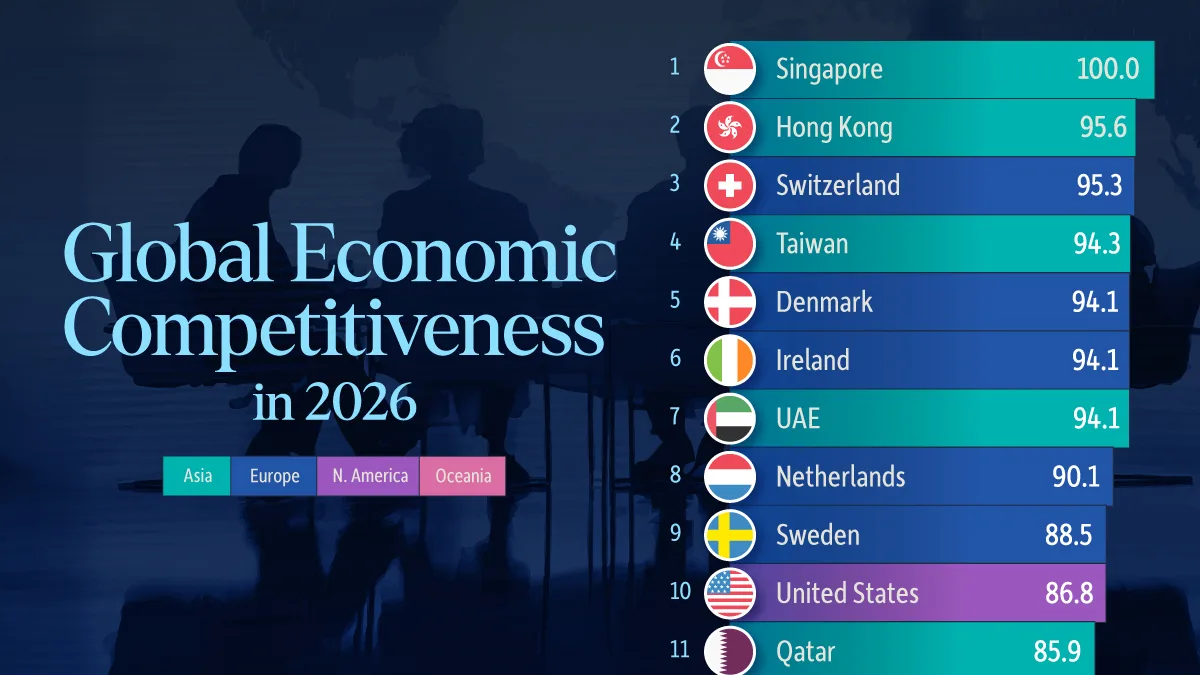
Ranked: The World’s Most Competitive Economies in 2026
Key Takeaways:
- Singapore ranks as the world’s most competitive economy in 2026, followed by Hong Kong and Switzerland.
- Asia accounts for three of the top five economies, while European countries take five of the top 10 spots.
- IMD evaluates competitiveness across economic performance, government efficiency, business efficiency, and infrastructure.
The 2026 IMD World Competitiveness Ranking compares 70 economies on how effectively they create conditions for businesses to compete and generate long-term value.
Vietnam joins the ranking for the first time in 2026.
Singapore Leads the World’s Most Competitive Economies
The following table shows the 2026 rankings from IMD:
| Rank | Country | Economic Competitiveness Score |
|---|---|---|
| 1 |  Singapore Singapore |
100.0 |
| 2 |  Hong Kong SAR Hong Kong SAR |
95.6 |
| 3 |  Switzerland Switzerland |
95.3 |
| 4 |  Taiwan (Chinese Taipei) Taiwan (Chinese Taipei) |
94.3 |
| 6 |  Denmark Denmark |
94.1 |
| 7 |  Ireland Ireland |
94.1 |
| 5 |  UAE UAE |
94.1 |
| 8 |  Netherlands Netherlands |
90.1 |
| 9 |  Sweden Sweden |
88.5 |
| 10 |  United States United States |
86.8 |
| 11 |  Qatar Qatar |
85.9 |
| 12 |  China China |
84.4 |
| 13 |  Saudi Arabia Saudi Arabia |
84.0 |
| 14 |  Luxembourg Luxembourg |
82.1 |
| 15 |  Malaysia Malaysia |
81.9 |
| 16 |  Canada Canada |
81.0 |
| 17 |  Australia Australia |
79.2 |
| 18 |  Norway Norway |
78.1 |
| 19 |  Finland Finland |
76.8 |
| 20 |  Bahrain Bahrain |
76.3 |
| 21 |  Korea Rep. Korea Rep. |
75.6 |
| 22 |  Iceland Iceland |
75.1 |
| 23 |  Germany Germany |
73.6 |
| 24 |  United Kingdom United Kingdom |
72.5 |
| 25 |  Oman Oman |
71.7 |
| 26 |  Thailand Thailand |
71.1 |
| 27 |  Vietnam Vietnam |
70.6 |
| 28 |  Estonia Estonia |
70.5 |
| 29 |  Austria Austria |
70.4 |
| 30 |  Japan Japan |
70.1 |
| 31 |  Kuwait Kuwait |
70.1 |
| 32 |  Belgium Belgium |
69.0 |
| 33 |  Czech Republic Czech Republic |
67.3 |
| 34 |  Lithuania Lithuania |
67.3 |
| 35 |  Latvia Latvia |
67.2 |
| 36 |  France France |
66.7 |
| 37 |  New Zealand New Zealand |
66.7 |
| 38 |  Kazakhstan Kazakhstan |
65.4 |
| 39 |  Spain Spain |
65.0 |
| 40 |  Portugal Portugal |
64.8 |
| 41 |  Poland Poland |
64.1 |
| 42 |  Cyprus Cyprus |
63.2 |
| 43 |  Chile Chile |
63.1 |
| 44 |  India India |
62.0 |
| 45 |  Italy Italy |
61.7 |
| 46 |  Jordan Jordan |
59.3 |
| 47 |  Philippines Philippines |
59.1 |
| 48 |  Indonesia Indonesia |
57.6 |
| 49 |  Slovenia Slovenia |
55.2 |
| 50 |  Greece Greece |
53.3 |
| 51 |  Hungary Hungary |
51.3 |
| 52 |  Puerto Rico Puerto Rico |
51.1 |
| 53 |  Croatia Croatia |
51.0 |
| 54 |  South Africa South Africa |
50.2 |
| 55 |  Kenya Kenya |
50.0 |
| 56 |  Bulgaria Bulgaria |
47.6 |
| 57 |  Türkiye Türkiye |
47.2 |
| 58 |  Argentina Argentina |
46.9 |
| 59 |  Colombia Colombia |
45.9 |
| 60 |  Peru Peru |
43.3 |
| 61 |  Romania Romania |
43.1 |
| 62 |  Mexico Mexico |
42.8 |
| 63 |  Slovak Republic Slovak Republic |
42.5 |
| 64 |  Ghana Ghana |
41.5 |
| 65 |  Brazil Brazil |
40.1 |
| 66 |  Botswana Botswana |
39.9 |
| 67 |  Mongolia Mongolia |
39.0 |
| 68 |  Nigeria Nigeria |
38.8 |
| 69 |  Namibia Namibia |
28.5 |
| 70 |  Venezuela Venezuela |
22.4 |
Singapore takes first place with a normalized score of 100, ahead of Hong Kong (95.6) and Switzerland (95.3). Taiwan ranks fourth, while Denmark, Ireland, and the UAE each score 94.1, placing fifth through seventh.
Singapore is also the only economy to rank among the global top five across all four competitiveness factors. Its business efficiency improved to first place in 2026, helping it reclaim the overall top position from Switzerland.
How Economic Competitiveness Is Measured
IMD’s framework spans 341 criteria organized into 20 sub-factors and four pillars: economic performance, government efficiency, business efficiency, and infrastructure. Hard data account for two-thirds of the final ranking, while an executive opinion survey accounts for one-third.
Economic size and competitiveness are not the same thing. The U.S., for example, is the world’s largest economy, but ranks 10th in IMD’s 2026 ranking.
Instead, IMD’s framework captures a broader set of conditions that shape how effectively businesses can operate, invest, and compete.
Why Europe and Asia Lead the Ranking
Europe and Asia account for nine of the top 10 positions. Many leading economies combine productive businesses, sophisticated infrastructure, skilled workforces, and institutions that make investment and commerce more predictable.
The 2026 IMD report places particular emphasis on institutional credibility and the rule of law. Predictable regulations, enforceable contracts, and effective government can help businesses make longer-term investments amid geopolitical uncertainty.
Innovation also matters. Several leading economies are home to or closely connected with the world’s major innovation clusters, strengthening their ability to commercialize technology, attract talent, and improve productivity.
Still, the rankings show that there is no single formula. The UAE ranks seventh and the U.S. 10th, showing that highly competitive business environments can emerge from very different economic models.
Learn More on the Voronoi App
To see economic scale from another perspective, check out How Similarly-Populated Countries Compare in Economic Strength on the Voronoi app.