

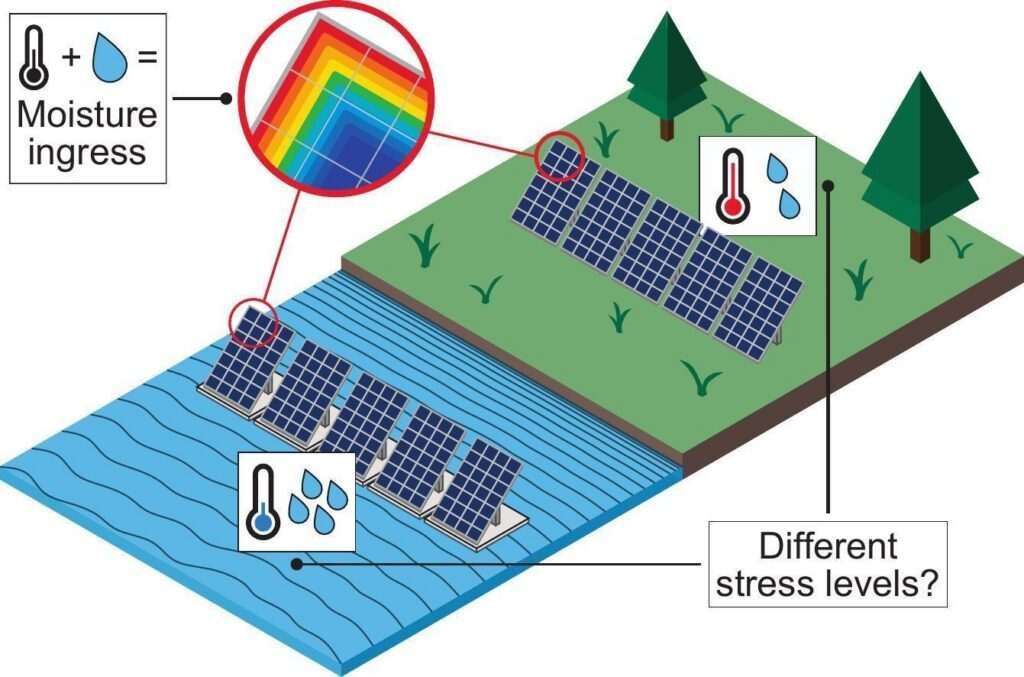
A global research team led by scientists from Norway has compared humidity-induced stress levels in floating and ground-mounted PV systems. The researchers analyzed multi-year meteorological datasets from seven inland water bodies and nearby land sites, using the data to calculate module temperatures, relative humidity (RH), and moisture ingress profiles.
“This work is the first study that systematically compares humidity-induced stress levels over water and land across different climates,” said corresponding author Nathan Roosloot to pv magazine. “In doing so, it addresses the existing knowledge gap on humidity-induced stress and degradation in floating PV (FPV) modules, and how these compare to humidity-induced stress and degradation in ground-mounted PV (GPV) modules.”
Roosloot added that such a study can “advance the understanding of FPV module reliability, providing important scientific background needed to develop FPV-specific testing protocols and/or material selection criteria – both imperative for the continued growth of the FPV market.”
The study covered lakes Stortjärn, Erssjön and Erken in Sweden; Lake Almbergasjön in Norway; Lake Washington in the United States; Harp Lake in Canada; and Lake Taupō in New Zealand. For each site, the researchers analyzed field data on air temperature, relative humidity, wind speed, and water temperature, which they combined with ERA5 irradiance data.
Using these datasets, the researchers modeled PV module temperatures and humidity conditions with the Faiman PV temperature model. They then used a three-dimensional finite-element diffusion model to simulate 25 years of moisture ingress in glass-glass and glass-backsheet modules. The study also assessed how FPV system design parameters, including module height above the water surface and heat-transfer efficiency, influence humidity-induced stress.
“The most surprising result of this research is that humidity-induced stress levels are not necessarily worse over water than over land,” Roosloot said. “Instead, the climate zone of deployment, as well as several factors in floating PV system design, including module height above the water and the degree of module cooling, often have a larger effect on humidity-induced stress levels than whether a PV module is deployed over water or land.”
The results showed that ambient and module temperatures over water and land were similar, with absolute mean differences of less than 2 C. Relative humidity (RH) over water surfaces, however, could be either higher or lower than over land, with absolute mean differences of up to 9 percentage points depending on the location. Over land, daily temperature and RH variations were greater than over water, which the researchers attributed to the stabilizing effect of water bodies.
The modeled internal moisture content was also almost always higher in ground-mounted PV (GPV) modules than in floating PV (FPV) modules, with mean concentrations up to 37% higher. The researchers found that FPV system design had an even greater impact on moisture ingress, with variations in module height above the water surface changing mean moisture concentrations by up to 47%, while differences in system heat-transfer efficiency altered them by up to 42%.
“The results suggest that FPV modules may not always require adapted designs or testing schemes to address enhanced humidity-induced degradation, as is commonly suggested,” the scientist noted. “The work also highlights that FPV reliability research outcomes can depend strongly on climate zone and system design, making it difficult to transfer reliability findings between different FPV systems or to define ‘the floating environment’ as a single concept in this context.”
The research work presented in “Comparison of humidity-induced stress levels between floating and ground-mounted photovoltaics,” published in Solar Energy. Researchers from Norway’s Institute for Energy Technology, University of Oslo, the Norwegian Institute for Water Research, the United States’ King County, University of Wisconsin-Madison, Macalester College, State University of New York at Oneonta, University at Albany, the Swedish University of Agricultural Sciences, New Zealand’s Victoria University of Wellington, Canada’s Ministry of the Environment, Conservation and Parks, Queen’s University, University of Saskatchewan and Italy’s Edmund Mach Foundation have participated in the study.
The post Floating PV systems may face lower humidity stress than ground-mounted counterparts appeared first on pv magazine Global.


