
Editor’s Note: NSAC has been shaped for decades by creative, joyful, and smart leadership from hundreds of advocates and farmers. Today we mourn the recent loss of our longtime colleague Michael Sligh and are proud to celebrate his life and contributions to building a better world for farmers. This guest post was written by Kiki Hubbard, who is a researcher at the University of Wisconsin–Madison, where she studies the market dynamics shaping the seed industry. Kiki is the former Advocacy and Communications Director of the Organic Seed Alliance, an NSAC member. The team at RAFI-USA, another NSAC member and Michael’s longtime professional home, also published this remembrance.
The first time I met Michael Sligh, I was working as an intern for the Center for Food Safety (CFS) in Washington, DC. It was 2002, and he walked past my desk where I was organizing a mailing for a new book that my boss had edited, called Fatal Harvest. I remember his steady gait and stoic face under a Kerry cap. He wore a trench coat. I felt a jolt of recognition as I thought to myself, That’s Michael Sligh. I was a bit starry-eyed after reading his chapter in the book sitting in front of me.
My time at CFS led me down the seed policy path, and if you’re doing that work through a lens of justice, fairness, and public benefit, you inevitably find yourself in room after room with Michael Sligh. In the years that followed, Michael became a close colleague and friend – ultimately the most impactful mentor of my career. He was a treasured and deeply dedicated collaborator, and he had a way of keeping me grounded and hopeful, even when the work felt downright discouraging. As a true connector and skilled organizer, he brought people together, including many of the colleagues I now consider dear friends.
Michael came from a family of farmers and ranchers in west Texas and left home in the 1970s to farm himself in Tennessee, Florida, and other places, ultimately landing in North Carolina. During the farm crisis of the 1980s, he became acutely aware of the obstacles family farmers face and began protesting at farm foreclosures and standing up for farmers in other ways. He told me and other colleagues that he left the farm to be an organizer, thinking he’d return to farming full-time once the problems were “fixed.” His legacy shows that his work at that time had only begun. It’s no wonder he would refer to policy work as “watching a tractor rust.”
The throughline of his career was ensuring that policies related to food and farming, antitrust and competition, and intellectual property rights worked for family farmers, farm workers, and the communities they feed, not extractive firms. And that commitment to fairness, and to farmers, permeates the many groundbreaking initiatives he helped to create. He was a founder of the Southern Sustainable Agriculture Working Group, National Organic Coalition, and Domestic Fair Trade Association; a founding partner of the Agricultural Justice Project and co-creator of the Food Justice Certified label. For nearly 30 years, Michael served as a program director for the Rural Advancement Foundation International – USA. During his tenure there, he served leadership roles in various coalitions, including the National Sustainable Agriculture Coalition. He helped to establish Southern SARE, and in every Farm Bill debate he served as a voice for farmers in the South and organic farmers, specifically. Michael was active in international circles as well, regularly participating in the International Federation of Organic Movements’ Organic World Congress and serving on the International Organic and Sustainable Accreditation Board.
Michael was steady but not rigid. He was diplomatic but bold. His southern drawl, gentlemanly manners, and facilitation skills helped to put people at ease, including farmers visiting Capitol Hill for the first time and even congressional staff members themselves. He embraced a participatory approach to policy solutions, evidence that he practiced what he preached: A decentralized and diverse agricultural system required a diversity of decision-makers. Indeed, the root of just about every problem he tackled lay in concentrated power.
While Michael could push the envelope by offering big, seemingly unachievable ideas, he also took the long-view, understanding that incremental progress toward solving the biggest challenges of our time – climate change, market consolidation, biodiversity loss – was the pragmatic path. In so doing, Michael proved that incrementalism could achieve systemic change.
For example, the National Organic Program (NOP) continues to be the strongest food production standard available to consumers today, and Michael played no small part in making that so. We should all be thankful that he was the founding chair of the USDA’s National Organic Standards Board (NOSB) from 1992 to 1997, since the first order of business was creating the NOP and making significant decisions about what should and should not be allowed in certified organic production, such as whether transgenic organisms were compatible with organic farming, and who would benefit most if they were allowed.
Michael remained a consistent presence and voice at NOSB meetings long after his tenure ended. His dedication to the success of organic farmers and the integrity of the label spanned 40 years. As the organic program matured, and regulations necessarily evolved, Michael advocated for the concept of continuous improvement as a touchstone of policy decisions. He would acknowledge that the concept may be difficult for regulators to understand, but that farmers live it every day.
Michael was the vision and heart behind the National Organic Action Plan, a 10-year blueprint for organic food and farming that was derived from grassroots input spanning farmers, farm workers, regional processors and retailers, and other community members. The charge was clear: create a policy platform for ensuring that the rapidly expanding organic market supports family farmers, protects human health, and benefits the environment. Embedded in this blueprint was Michael’s uncompromising commitment to the founding principles of organic agriculture. I can still hear him asking: “Does this pass the fairness test?” He was like a moral compass for the organic movement.
Michael was vocal about the need for improving regulations on agricultural biotechnology so that farmers weren’t pitted against each other – those who used the technology versus those across the fence who didn’t. He was one of the few people who would provide testimony to the USDA’s Advisory Committee on Biotechnology and 21st Century Agriculture, which was charged with looking at coexistence challenges and policy needs between different production systems, such as biotech and organic. He also advocated regularly for more financial support of our public seed collections, be it in the Farm Bill or through the work of the USDA’s National Genetic Resources Advisory Council. And he always organized others to do the same.
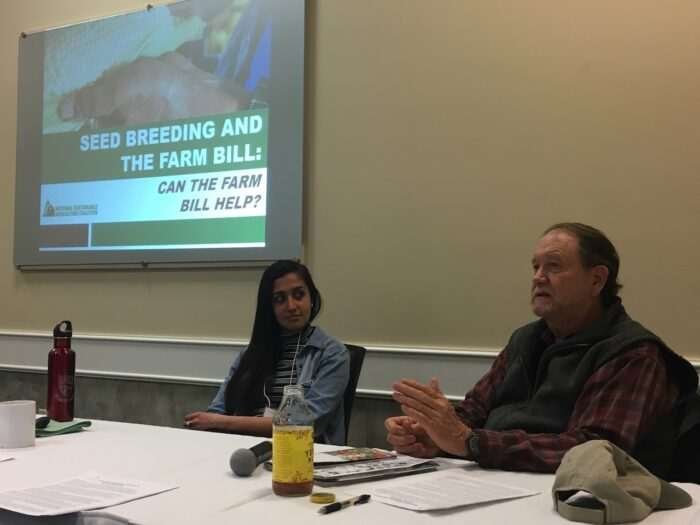
As a co-founder of the Seeds & Breeds Coalition for 21st Century Agriculture, Michael was dogged in his commitment to our nation’s plant breeders. This initiative began in the early 2000s as public plant breeding programs continued to experience budget and staff cuts. Seeds & Breeds brought together – and still brings together – plant breeders, small seed companies, farmers and seed growers, and policy experts to identify ways to reinvigorate our public plant breeding infrastructure to help meet the regional seed needs of farmers. A major focus of the coalition’s work were the increasingly restrictive forms of intellectual property rights on seeds, especially utility patents, and the egregious contracts that accompany them, which strip a farmer’s right to save seed and a breeder’s right to innovate. This ultimately led to a 2016 summit on Intellectual Property Rights and Public Plant Breeding. This important event resulted in a set of best practices that universities still rely on to ensure new varieties remain publicly accessible while also generating revenue to sustain breeding programs.
Michael was a broken record in congressional and USDA offices: the department’s competitive grant programs should prioritize breeders developing “farmer-ready” varieties, as he called them. Michael would explain the urgency by underscoring three things: First, public breeding programs were increasingly important in the face of market consolidation, where a handful of firms control much of the commercial seed supply, narrowing seed options and increasing prices for farmers. Second, changing climates required access to more regionally adapted and resilient varieties tailored to specific environmental conditions, production practices (e.g., organic), and pest and disease pressures. And third, data showed that most plant breeding grants were favoring molecular biology and genomics projects as opposed to field-based, conventional plant breeding. We can learn a lot from lab-based techniques, Michael would say, but we can’t adapt the crops that feed us in a lab. We need to breed them in the open environments of their intended use.
It took a decade of advocacy, but in 2014, the USDA’s Agriculture and Food Research Initiative created a separate program for Conventional Plant Breeding and Public Cultivar Development. In 2024, more than $2.7 million was put toward proposals in this program area, and thanks to Michael, Seeds & Breeds policy work remains a priority for influential coalitions, like the National Organic Coalition and National Sustainable Agriculture Coalition.
In the current political climate, it’s easy to forget how much progress the organic and sustainable agriculture movement has made toward embedding fairness, health, ecology, and stewardship into our food and farming policies and practices. And while, as Michael said, “A good organizer doesn’t look for credit,” boundless credit is now due. We applaud you, Michael, for helping us inch that much closer to a more livable and just planet. And we thank you.
In addition to this legacy, Michael will live on in the form of his favorite refrains, which I find myself repeating on the regular. As an organizer, he’d ask: “Are they on our side of the river?” As a meeting facilitator closing out a meeting: “Shall we declare victory?” And as a friend: “We must find rest in our work.”
On November 7, 2025, Michael left this world peacefully after a short battle with cancer. I trust he can now rest, knowing that he helped to seed movements that are alive and growing – movements that remind us that concentrating our own power as advocates is our greatest strength. Because when we’re on the same side of the river, we have the ability to make waves.
The post Guest Post: Remembering Michael Sligh, a champion for farmers and food justice appeared first on National Sustainable Agriculture Coalition.


