
Although the idea of using poultry litter as a fertilizer isn’t new, injecting it below the surface of the soil is, even though the concept has been discussed for many years. The benefits of getting the poultry litter below the surface of the soil are clear, but injecting dry poultry litter is a technical challenge. Subsurfers have been employed to get the job done, but they suffer from a variety of problems included overheating and bending and/or breaking of augers.
Despite these setbacks, a group of industry pioneers are working on the challenge as they look forward to a future where injecting solid poultry manure becomes more mainstream.
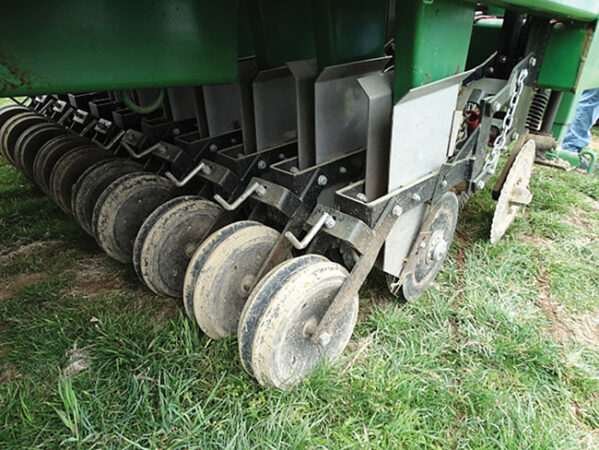 Currently, dry poultry litter is spread on the soil surface as a fertilizer. The problem with this approach is that valuable nutrients can be lost in the process. Volatilization is an issue, the nutrients can be washed off the soil surface by rain, potentially resulting in water quality issues if waterways are nearby, and fine poultry litter dust can be carried off by the wind. Surface application also results in odor issues, which can annoy nearby neighbors.
All these problems disappear when you inject the dry poultry litter below the surface. The only question, of course, is how to do so effectively, and that’s a question Kristen Hughes Evans, executive director, Sustainable Chesapeake has been working on for a long time.
“Going back more than 15 years,” she says, “our land grant university nutrient management specialists were really interested in trying to make poultry litter injection work, because we know that when we inject manure, we capture more of the nitrogen, we capture more of the phosphorus, and we have a better nitrogen phosphorus balance. So it’s good for crops. It’s good for the environment.”
While the benefits are clear, Hughes Evans knows that injecting dry poultry litter is easier said than done. “What the team found is that it’s very difficult to do,” she says. “Poultry litter doesn’t flow well, it’s not homogenous, it’s chunky, and it often has trash in it.”
Reinventing the wheel
Clearly, traditional liquid manure injection methods won’t work, which is why it has been necessary to reinvent the proverbial wheel and figure out how to overcome this challenge. “There has been a significant investment in trying to make the poultry litter injection equipment work well,” says Hughes Evans. “There were a number of different designs and redesigns, and my sense is that the team was not able to overcome some of the technical and engineering challenges.”
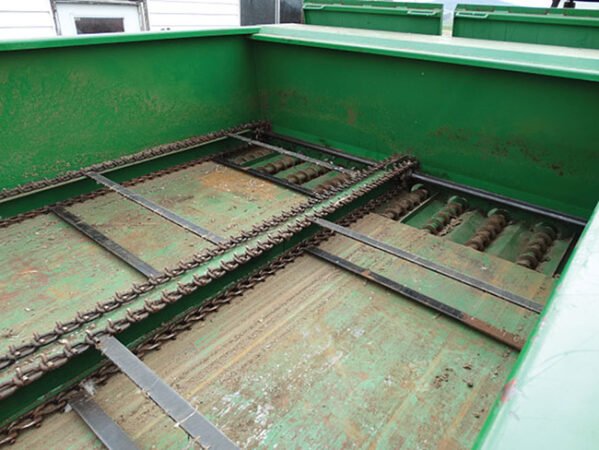
Solid litter is loaded onto trucks like the one pictured here to be applied.
Naturally, if the dry poultry litter could be processed in advance in order to clean it up, remove the debris and make it more homogenous, then some – but not all – of the challenges could be overcome. However, this would simply complicate the process, which is something that proponents of injecting dry poultry litter are trying to avoid.
The question some may ask is, “Why not stick with liquid manure injection?” Dr. Wesley Porter, associate professor and extension specialist covering precision agriculture and irrigation at the University of Georgia explains that it all comes down to time and money.
“The benefits of the solid is we’re taking litter from a poultry house, into trucks, and taking it out to apply it,” he says. “If we’re going to turn it into liquid, we’re going to have to put money and time and effort into processing it. If we invest money into processing it, then we’re taking what was an affordable fertilizer source and making it equivalent to that of processed fertilizer, and so it’s not as attractive anymore.”
Porter and his team have been working on ways to inject the solid poultry litter beneath the soil surface, and they’ve been experimenting with a machine that can process the material and send it out to four rows at a time. “With pretty good success, we were able to get over the non-uniformity of the materials,” he says, “but if we found a rock, then the machine would get stopped-up. There was no way to crush some of that material.”
This is definitely a work in progress, and Porter says that they also need to figure out a way to measure the amount of manure that’s being injected. “I’ve had a grad student working on it for a few years,” he says. “We’re working on designing a system that will capture the litter that’s moved to the four-row unit, and we’re developing a metering system for that too.”
While that may sound like a big job, Porter says that the pieces of the puzzle seem to be coming together. “We’re lab-testing a system that we hope we can take to the field in the very near future, within a year or less, and test at the field level,” he says.
Slow progress
Once the material handling system can be perfected, Porter says that injecting dry poultry litter would work well with any row crop. “We’re assuming that it’s good for all major row crops,” he says. “We apply poultry litter to almost all of our major row crops in the state of Georgia.”

Farm owner Mike Phillips experiments with injecting dry poultry litter.
One of the pioneers spearheading this effort is Mike Phillips, owner and operator of two farms in Rockingham County, Virginia. Phillips also works with the USDA’s Natural Resources Conservation Service (NRCS).
“My heart is in this,” he says, “And I know it can work. The way I see it, it’s the mechanical part of it that’s problematic, but I have an idea of how we can do this, and I’d like to try to have an application where it will work very efficiently.”
Phillips is already experimenting with injecting dry poultry litter into his fields using a subsurfer, and believes wholeheartedly that with the right equipment and methodology, this approach could be successful. “I know it will work,” he says. “We just gotta give it some time. We gotta just put our nose to the grindstone, put our egos aside, you might say, and let’s get this thing done, because it can be done.”
Not only is Phillips convinced, he’s also thinking outside the box as he comes up with innovative ways to save time and money. “We mixed poultry manure with rye, triticale and barley in different plots, and subsurfaced it,” he says. “It was successful, to a certain degree, which excited me because people said that the grain would be burned up, but it wasn’t. And I’m excited because you could plant your seeds and add manure in one pass, and you’re done. How do you like that idea”
While all these possibilities are truly exciting, and could potentially save a lot of time, money and effort, Hughes Evans paints a clear picture of how far manure injection technology has come, and how far the industry still has to go. “Liquid manure injection equipment has come a long way,” she says, “but when it comes to poultry litter injection, we’re still stuck in the R&D phase.” •


