Ranked: The Most Commonly Broken Bones
This was originally posted on our Voronoi app. Download the app for free on iOS or Android and discover incredible data-driven charts from a variety of trusted sources.
Key Takeaways:
- Lower leg fractures were the world’s most common broken bones, with 32.7 million cases in the most recent year of data available.
- Men account for more fractures across nearly every anatomical site, while women experience more hip fractures.
- The four most common fracture groups accounted for more than 100 million new cases worldwide.
Broken bones are among the world’s most common injuries, with an estimated 178 million new fractures occurring in 2019 alone.
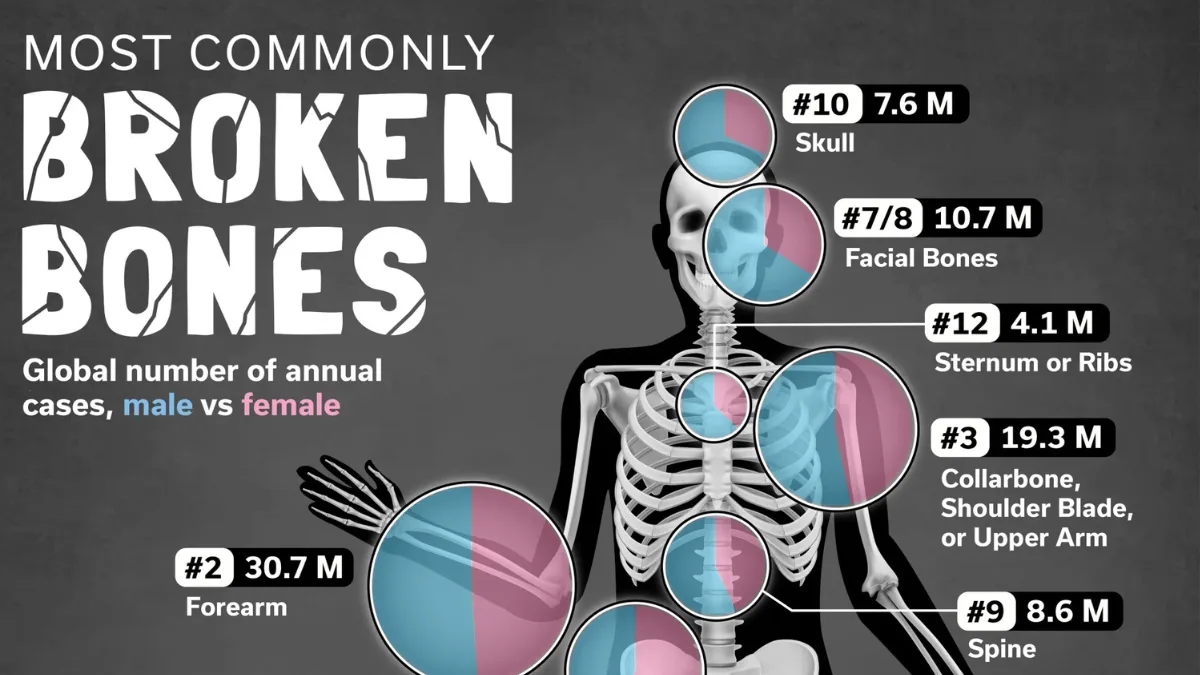
This visualization, created by Julie R. Peasley using data from the Global Burden of Disease Study 2019, shows where fractures occur most often across 204 countries and territories and compares annual cases between men and women.
The data also reveal how fracture patterns vary by sex and age, reflecting differences in physical activity, trauma exposure, and bone health.
The World’s Most Frequently Broken Bones
The table below ranks the world’s most common fracture sites based on estimated annual cases in 2019.
| Bone | Total incidences (million) | Incidences, male (million) | Incidences, female (million) |
|---|---|---|---|
| Knee/Shinbone/Calf Bone/Ankle (Patella/Tibia/Fibula/Ankle) | 32.7 | 19.3 | 13.4 |
| Forearm (Radius/Ulna) | 30.7 | 15.7 | 15.0 |
| Collarbone/Shoulder Blade/Upper Arm (Clavicle/Scapula/Humerus) | 19.3 | 10.8 | 8.5 |
| Hand/Wrist | 19.0 | 12.3 | 6.7 |
| Thigh (Femur, not femoral neck) | 14.6 | 7.9 | 6.8 |
| Hip | 14.2 | 6.1 | 8.1 |
| Foot Bones (not Ankle) | 10.7 | 6.8 | 3.9 |
| Facial Bones | 10.7 | 7.1 | 3.5 |
| Spine (Vertebral Column) | 8.6 | 4.9 | 3.7 |
| Skull | 7.6 | 5.2 | 2.4 |
| Pelvis | 6.0 | 3.2 | 2.9 |
| Sternum/Ribs | 4.1 | 2.6 | 1.5 |
Lower leg fractures ranked first at 32.7 million cases, only slightly ahead of forearm fractures at 30.7 million. The four most common fracture groups were all concentrated in the limbs and together accounted for more than 100 million new cases.
Although age-standardized fracture rates have declined slightly since 1990, population growth and aging have pushed the total number of fractures substantially higher.
Why Men Break More Bones. Until They Don’t.
Across nearly every fracture type, men experience more injuries than women. Lower leg fractures affected approximately 19.3 million men compared with 13.4 million women, while forearm fractures were split more evenly at 15.7 million versus 15.0 million.
The largest sex gaps appear in fractures linked to trauma. Men sustain more than twice as many skull fractures, at 5.2 million versus 2.4 million, while facial bone fractures affected 7.1 million men compared with 3.5 million women. These differences reflect greater male exposure to road accidents, contact sports, occupational hazards, and other high-risk activities.
These trends help explain why males have higher fracture rates throughout adolescence and early adulthood. Injury patterns can also vary alongside broader factors such as healthcare access and prevention.
Why Hip Fractures Become a Women’s Health Issue
Hip fractures are the clearest exception to the broader pattern. Women experienced roughly 8.1 million hip fractures globally compared with 6.1 million among men, making the hip the only fracture category in this ranking where women clearly outnumber men.
The reason lies largely in age. Men accumulate more fractures during their teens through middle age because of greater exposure to high-impact activities. After menopause, however, declining estrogen accelerates bone loss, increasing the risk of osteoporosis and fragility fractures.
Women begin to surpass men in fracture incidence after roughly age 65, with the gap widening dramatically among the oldest age groups.
As Populations Age, Fracture Prevention Matters More
Although women have a higher likelihood of developing osteoporosis, outcomes can be especially severe for men. Research suggests men are less likely to be screened for osteoporosis and often experience higher mortality following hip fractures, partly because diagnosis and treatment tend to occur later than in women.
With populations living longer, preventing fractures is becoming an increasingly important public health challenge. Clinical studies consistently show that maintaining muscle strength and balance is just as important as preserving bone density in reducing fracture risk. Bone density, muscle mass, balance, nutrition, and fall prevention all become increasingly important with age for both sexes.
Learn More on the Voronoi App
Want to explore more healthcare data Check out The World’s Top Hospitals in 2026 on the Voronoi app, where you can discover more data-driven visualizations covering global health, medicine, and longevity.