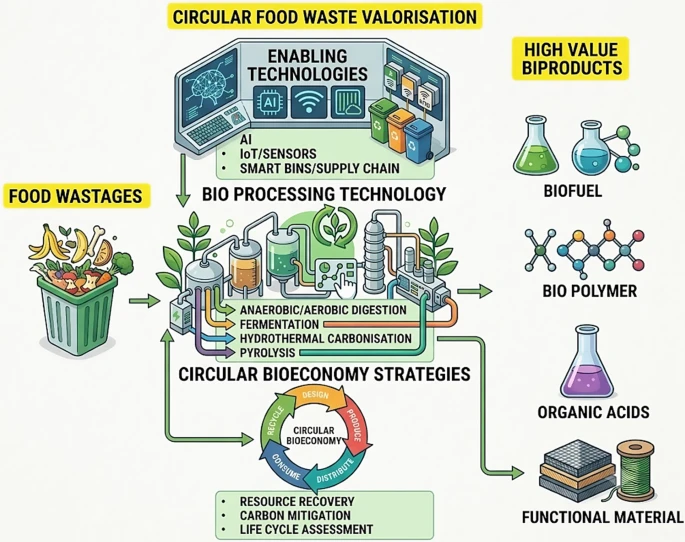
A new systematic review argues that food waste should be treated as a bio-based feedstock rather than a disposal problem. The Food and Agriculture Organization estimates that about 1.3 billion tonnes of food are lost or wasted every year.
Published in Green Technology, Resilience, and Sustainability, the review by Abhijeet Das, Satchidananda Mishra and Krishna Pada Bauri followed the PRISMA framework and drew on 94 publications. It maps biochemical and thermochemical routes, life cycle assessment, digital tools and barriers within a single circular bioeconomy framework.
The main finding is that no single technology wins everywhere. Integrated biorefineries, which combine several process types, recover more resources than single-technology systems, with outputs that include biofuels, biochemicals, biofertilizers, biopolymers and enzymes.
The best route depends on the feedstock. Wet, biodegradable waste suits anaerobic digestion, while carbohydrate-rich residues such as fruit peels and bakery waste fit enzymatic hydrolysis and fermentation. Dry, lignocellulosic biomass is better matched to pyrolysis, gasification or hydrothermal carbonization.
Yeast fermentation of citrus peels and banana pulp gave good bioethanol yields, and spent coffee grounds were turned into D-mannose, a functional sugar, at a 46 percent yield. Fermentation-based bioplastics need about 57 megajoules per kilogram, compared with about 77 for fossil plastics. Single-cell protein is another bio-based option: microbes grown on molasses, whey or spent grains can supply feed for aquaculture and livestock.
Scaling remains difficult. The review lists inconsistent feedstock quality, limited infrastructure, fragmented regulation and weak sustainability assessment as key barriers. Digital tools such as sensors, machine learning and blockchain traceability can help, but they work best alongside supportive governance.
The authors acknowledge limits: the studies were too varied for direct comparison, and the review includes no meta-analysis or modelling. They call for mass-balance modelling, standardized sustainability metrics and context-specific biorefinery designs.
The post Integrated biorefineries recover more from food waste, systematic review finds appeared first on World Bio Market Insights.