
Sharing the road with farm equipment comes with real risks — for farmers as well as the motoring public.
As farm equipment continues to get larger and road traffic moves faster, those risks only increase. One of the most important tools we have to manage that risk is something we use every day: our lighting.
It’s easy to take road safety for granted, especially if we’ve never been involved in a close call or an accident. When nothing has gone wrong, it’s natural to assume things will continue that way. But that mindset can lead us to underestimate how important it is to be clearly seen and understood by other drivers.
Most drivers don’t spend much time thinking about farm equipment. When they come up behind a tractor or meet one on the road, they often see it as an inconvenience rather than a potential hazard. They don’t always recognize how wide the equipment is, how slowly it’s moving, or how difficult it can be for the operator to react quickly. At the same time, farmers are often focused on getting work done and moving efficiently between fields, which can reduce our awareness of how others are seeing us on the road.
Since our equipment is larger and slower than other vehicles, the responsibility falls heavily on us to make sure we are as visible and predictable as possible. Proper lighting plays a critical role in that.
Different lighting for different situations
Modern farm equipment is equipped with powerful lighting systems, including multiple light modes for different situations. These lights are a major improvement for working in low light conditions, but they can create new risks if not used properly on the road. High-intensity work lights can be extremely bright, and when they are left on during road travel, can temporarily blind oncoming drivers. In those moments, a driver may not be able to judge how wide your equipment is or how quickly they are approaching you.
The same issue can occur for vehicles coming up behind you. Bright rear-facing work lights can make it difficult for a driver to see past your equipment or notice oncoming traffic if they are considering passing. It can also make it harder for them to see the full width of towed implements, especially if reflectors or lights on the implement are less visible than the tractor’s lights.
In some cases, lighting intended to improve safety can actually increase risk if it is not used appropriately. Choosing the correct lighting mode for road travel is just as important as using lights in the first place. Lighting is meant to communicate with other drivers and standards are set in law to ensure that the message communicated is consistent. When operating farm vehicles on public roads, remember these important points:
- White lights forward – to illuminate the road and signal the front of the vehicle
- Solid red lights to the rear – to clearly mark the back of the vehicle
- Amber lights for warning and signaling – including turn signals, hazard lights, and beacons
Any other coloured lights are not permitted on farm or other standard vehicles, as they are reserved for specific vehicles such as police, fire, ambulance, snow plows and other emergency responders.
There are magnetically attached aftermarket warning lights that some farmers have been purchasing to put on their equipment. If it’s flashing they have to be amber coloured. If you choose red lens, they must not be flashing, only be steady on. There are newer Bluetooth options for the rear of implements with multiple setting options. Ensure they meet the requirements as highlighted above.
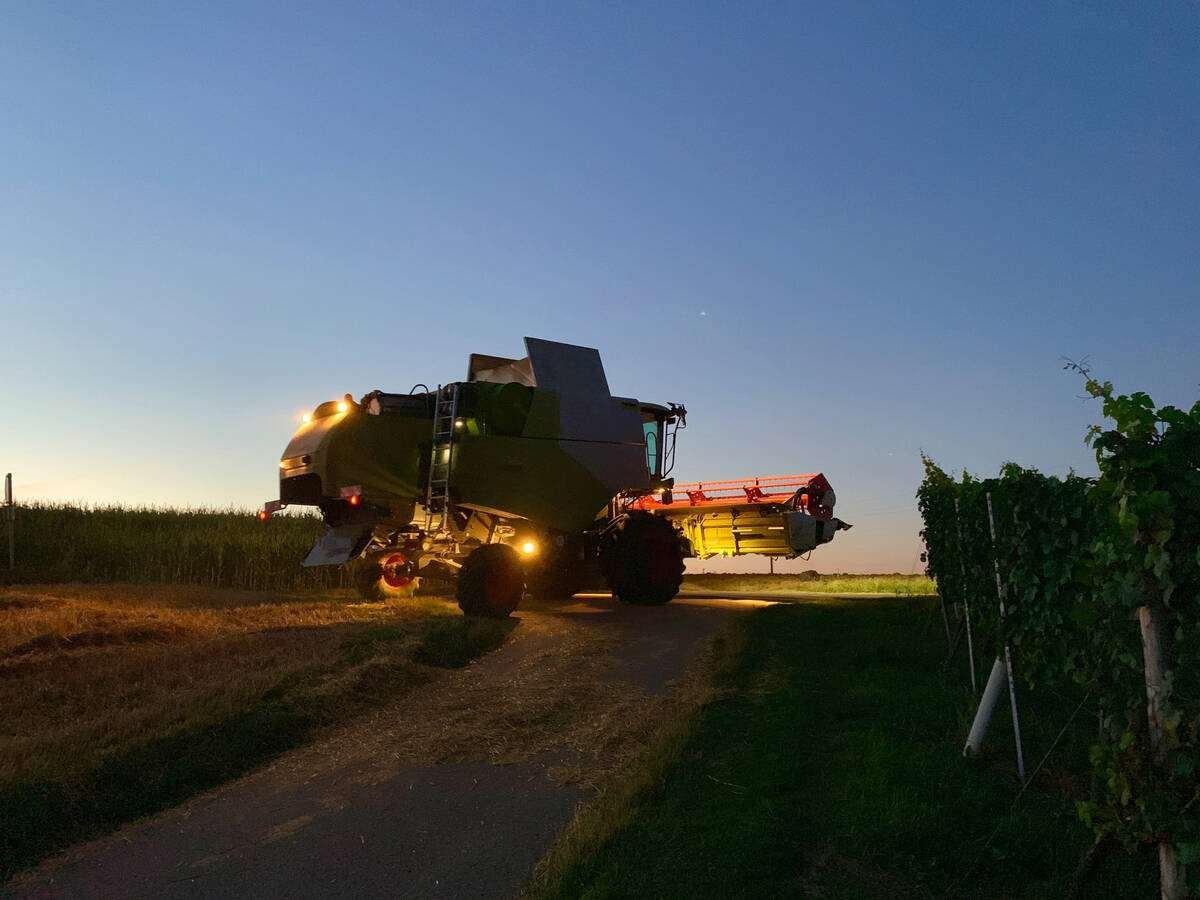
Choosing the correct lighting mode for road travel is just as important as using lights in the first place. Photo: Clu/iStock/Getty Images
Using proper lighting ensures that your vehicle is clearly visible and easily understood by other road users, helping to reduce confusion and prevent accidents.
At the other end of the spectrum, there are still too many situations where farm equipment is not properly lit at all when it should be. This is especially true at dusk/dawn, at night, or during poor weather conditions, but it can also be an issue during the day. Given the difference in speed and size between farm equipment and typical road traffic, drivers need as much advance warning as possible to react safely.
Towed implements can add another layer of risk. Wagons and other equipment can block the tractor’s lights, making it harder for drivers approaching from behind to see what is ahead of them. Without proper lighting or reflectors on the implement itself, drivers may not realize how large or wide the equipment really is until they are much too close.
Maintain and inspect
Lighting maintenance is another piece of the puzzle that is often overlooked. Burnt-out bulbs, damaged fixtures, or dirty lenses all reduce visibility and create confusion for other road users. A single flashing light instead of two can even make it look like you are signalling a turn when you are not. That kind of mixed message can frustrate other drivers and lead to poor decisions. Ensure all lighting is clearly visible, clean and working to ensure everyone’s safety.
Taking a few minutes each day to check your lighting can make a big difference. A quick walk-around of your equipment before heading onto the road can help catch issues early and ensure that everything is working the way it should. Compared to the potential consequences of a collision, it is a small investment of time.
At the end of the day, road safety comes down to clear communication. Other drivers need to be able to see you, understand what you are doing, and react in time to share the road safely. Proper lighting — used correctly, adjusted for the situation, and well maintained — is one of the most effective ways to make that happen.
By paying attention to how we use our lights, we can reduce confusion, improve visibility, and help prevent accidents and close calls. It’s a simple but important part of operating safely, and it helps ensure that both farmers and the motoring public can get home safely at the end of the day.
Be and stay aware to stay safe!
Ian McDonald is OMAFA’s crops innovations specialist.
The post Lighting critical to farm vehicle road safety appeared first on Farmtario.


