
Turning manure into sugar? It’s not the alchemy-sounding experiment the uninitiated might envision.
Traditional thinking has told even the savviest of growers that manure is no boon for growing sugarbeets. It tends to release nitrogen (N) throughout a growing season, but sugarbeets need high soil nitrogen content early in the growing season, but low soil nitrogen later on to improve sugar quality.
But Melissa Wilson is challenging conventions. The University of Minnesota’s Department of Soil, Water, and Climate Extension Specialist has been running trials to determine the efficacy of liquid-separated dairy manure in a three-year crop rotation with sugarbeets.
It’s important work: with greater liquid-separated manure availability thanks to the rise of large-scale dairy operations in Minnesota and North Dakota, sugarbeet producers could conceivably reduce their input costs without cutting yields or sugar purity.
The Red River Valley region of western Minnesota and eastern North Dakota is a sugarbeet producing powerhouse, with approximately 60 per cent of U.S. sugarbeet output being grown along that corridor, covering about 500,000 acres. That accounts for the greatest output in the nation, where 50 percent of the sugar consumed derives from sugarbeets.
Trials
Identical experiments were run at two separate research sites – one in west central Minnesota, south of Murdock, and the other near Nashua, Minnesota, near the border of North Dakota – with each site having corn, soybean, and sugarbeet plots every year.
Treatments in the first year included a high manure rate of around 14,000 gallons per acre, a low manure rate – about 9,500 gallons per acre – and no manure (fertilizer only). Commercial fertilizers were then used to balance N, Phosphorus (P), and Potassium (K) needs of each specific crop for each treatment, if needed.
“So, in the first round of this research, we applied manure in the fall prior to corn or soybean or sugarbeet and compared it to a similar N rate of commercial fertilizer, applied in spring,” says Wilson. “Then, for the next two seasons, we just rotated the crops and only used fertilizers in all plots. We didn›t apply manure again.”
At the first site, manure was applied in fall 2019, followed by fertilizer in spring 2020. In 2021, only fertilizer was applied, but manure N credits were subtracted from total N rates. Exclusively fertilizer applications went down for the 2022 growing season. The same pattern occurred at the second site, but it was offset by one year.
After completing the first three years of the corn-sugarbeet-soybean rotation, the experiment was repeated.
“Very little research has been done with sugarbeets on land with a manure history, so that’s why we decided to run the experiment again on the same fields,” says Wilson. “We only have one more growing season left of this second round.”
In the second round of this research, Wilson’s research team applied manure again to the same manured plots as before, and compared it to a similar rate of commercial fertilizer. Then, they rotated each crop for the next two years.
The second round of experiments at the first site began in 2023 growing season. The 2026 trials (the last year at the second site) are still pending.
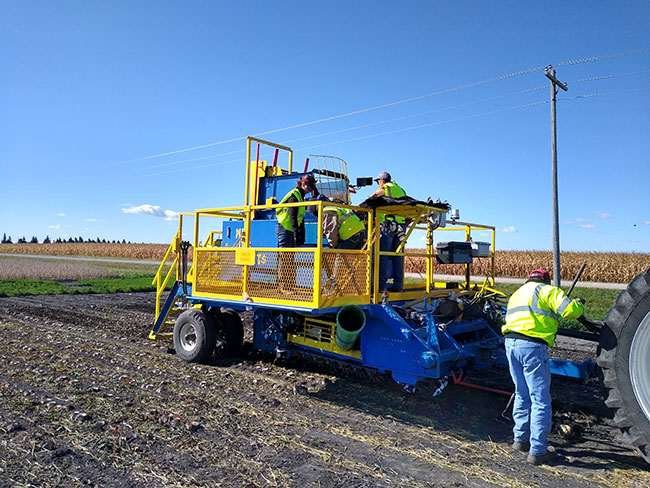
The U of M team is one of the first to do research with sugarbeets on land with a manure history.
Lessons learned
Wilson’s research found that liquid separated dairy manure can be applied anywhere in rotation and not affect sugarbeet yield.
“We thought that sugar yield would decrease if manure was used in the rotation, and it did not,” Wilson says. “So, farmers can feel confident adding liquid separated dairy manure into the rotation.”
Sugar purity, however, may be slightly lower the first year after manure is applied in a field without a manure history, she says.
“We did not see that when manure was applied a second time,” Wilson says.
When sugarbeets were topped and harvested during the first round, they yielded from 32.7 to 35.8 tons per acre in the first year. Extractable sugar ranged from 9,710 to 10,380 pounds per acre.
Sugar purity differences were negligible: Using fertilizer only yielded 91.2 per cent purity, while the low and high rates of manure application produced 90.8 per cent purity. Beet tonnage was higher in the manured plots, though, offsetting the slight decline in purity.
OTHER LESSONS LEARNED
Liquid separated dairy manure tended to increase corn yields, even in years where manure wasn’t applied.
At one site, applying manure the fall before soybean was not a good idea, says Wilson. “The site had high pH soils, so we think the manure affected incidence of iron deficiency chlorosis. After that year, we applied a product to help reduce that issue and it seemed to help. The other site did not have this issue.”


