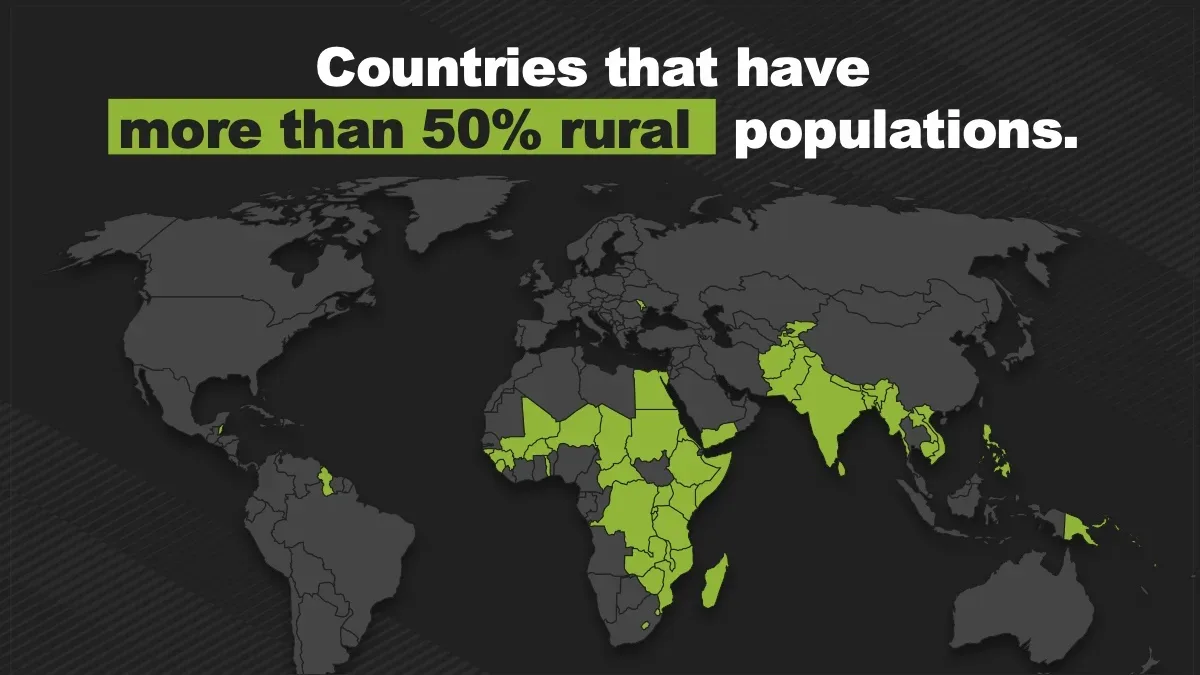
Mapped: Only 36 Countries Are Still Majority Rural
Key Takeaways:
- Only 36 countries still have more than half of their population living in rural areas.
- Nearly two-thirds of these countries are in Sub-Saharan Africa.
- The global rural population share has fallen from roughly two-thirds in 1960 to about 43% today.
Today, most people live in cities, but that wasn’t always the case. Decades of industrialization and economic development have steadily shifted populations toward urban centers, making majority-rural countries increasingly uncommon.
The map above highlights the 36 countries where more than half of the population still lives in rural areas, using the latest available World Bank data. While most are concentrated in Sub-Saharan Africa, a handful remain across South Asia, Southeast Asia, Oceania, and the Caribbean.
The Most Rural Populations
Below, we show all countries sorted by rural population share:
| Rank | Countries | Rural population (%, 2024) |
|---|---|---|
| 1 |  Papua New Guinea Papua New Guinea |
86.12 |
| 2 |  Liechtenstein Liechtenstein |
85.29 |
| 3 |  Burundi Burundi |
84.84 |
| 4 |  Niger Niger |
82.77 |
| 5 |  Samoa Samoa |
82.58 |
| 6 |  Rwanda Rwanda |
81.92 |
| 7 |  Malawi Malawi |
81.40 |
| 8 |  Saint Lucia Saint Lucia |
80.69 |
| 9 |  Sri Lanka Sri Lanka |
80.58 |
| 10 |  Nepal Nepal |
77.63 |
| 11 |  Tonga Tonga |
76.79 |
| 12 |  Micronesia Micronesia |
76.44 |
| 13 |  Ethiopia Ethiopia |
76.34 |
| 14 |  Chad Chad |
75.31 |
| 15 |  Swaziland Swaziland |
74.99 |
| 16 |  Cambodia Cambodia |
73.96 |
| 17 |  Vanuatu Vanuatu |
73.85 |
| 18 |  Solomon Islands Solomon Islands |
73.51 |
| 19 |  Afghanistan Afghanistan |
72.74 |
| 20 |  Guyana Guyana |
72.68 |
| 21 |  Uganda Uganda |
72.61 |
| 22 |  Tajikistan Tajikistan |
71.48 |
| 23 |  Kenya Kenya |
69.95 |
| 24 |  Comoros Comoros |
69.58 |
| 25 |  Lesotho Lesotho |
69.10 |
| 26 |  Barbados Barbados |
68.45 |
| 27 |  Burma Burma |
67.53 |
| 28 |  Zimbabwe Zimbabwe |
67.33 |
| 29 |  Burkina Faso Burkina Faso |
66.83 |
| 30 |  Sudan Sudan |
63.25 |
| 31 |  India India |
63.13 |
| 32 |  Grenada Grenada |
62.73 |
| 33 |  Tanzania Tanzania |
61.86 |
| 34 |  Kyrgyzstan Kyrgyzstan |
61.83 |
| 35 |  Pakistan Pakistan |
61.63 |
| 36 |  Guinea Guinea |
61.48 |
| 37 |  Laos Laos |
61.09 |
| 38 |  Mozambique Mozambique |
60.67 |
| 39 |  Vietnam Vietnam |
59.81 |
| 40 |  Yemen Yemen |
59.52 |
| 41 |  Mauritius Mauritius |
59.06 |
| 42 |  Bangladesh Bangladesh |
58.77 |
| 43 |  Madagascar Madagascar |
58.77 |
| 44 |  Maldives Maldives |
57.59 |
| 45 |  Faroe Isl. Faroe Isl. |
56.79 |
| 46 |  Egypt Egypt |
56.74 |
| 47 |  Moldova Moldova |
56.40 |
| 48 |  Eritrea Eritrea |
56.09 |
| 49 |  Central African Republic Central African Republic |
55.87 |
| 50 |  Aruba Aruba |
55.53 |
| 51 |  Sierra Leone Sierra Leone |
55.22 |
| 52 |  Bhutan Bhutan |
55.00 |
| 53 |  Togo Togo |
54.94 |
| 54 |  Guinea-Bissau Guinea-Bissau |
54.11 |
| 55 |  Belize Belize |
53.16 |
| 56 |  Zambia Zambia |
53.09 |
| 57 |  Mali Mali |
53.07 |
| 58 |  Democratic Republic of the Congo Democratic Republic of the Congo |
51.94 |
| 59 |  Somalia Somalia |
51.48 |
| 60 |  Philippines Philippines |
51.39 |
| 61 |  Senegal Senegal |
49.92 |
| 62 |  Uzbekistan Uzbekistan |
49.37 |
| 63 |  Benin Benin |
49.33 |
| 64 |  Bosnia & Herzegovina Bosnia & Herzegovina |
49.29 |
| 65 |  Guatemala Guatemala |
46.46 |
| 66 |  Trinidad & Tobago Trinidad & Tobago |
46.44 |
| 67 |  Ivory Coast Ivory Coast |
46.36 |
| 68 |  Liberia Liberia |
45.92 |
| 69 |  Slovakia Slovakia |
45.83 |
| 70 |  Thailand Thailand |
45.68 |
| 71 |  Turkmenistan Turkmenistan |
45.48 |
| 72 |  St. Vincent & the Grenadines St. Vincent & the Grenadines |
45.28 |
| 73 |  Romania Romania |
45.12 |
| 74 |  Nigeria Nigeria |
44.97 |
| 75 |  Namibia Namibia |
44.21 |
| 76 |  Slovenia Slovenia |
43.56 |
| 77 |  Serbia Serbia |
42.63 |
| 78 |  Jamaica Jamaica |
42.24 |
| 79 |  Azerbaijan Azerbaijan |
42.00 |
| 80 |  Syria Syria |
41.96 |
| 81 |  Kazakhstan Kazakhstan |
41.61 |
| 82 |  Kiribati Kiribati |
41.55 |
| 83 |  Mauritania Mauritania |
41.54 |
| 84 |  Croatia Croatia |
41.06 |
| 85 |  Fiji Fiji |
40.81 |
| 86 |  Indonesia Indonesia |
40.80 |
| 87 |  Seychelles Seychelles |
40.76 |
| 88 |  Austria Austria |
40.18 |
| 89 |  Ghana Ghana |
40.15 |
| 90 |  North Macedonia North Macedonia |
40.13 |
| 91 |  Cameroon Cameroon |
40.11 |
| 92 |  Nicaragua Nicaragua |
39.85 |
| 93 |  Poland Poland |
39.67 |
| 94 |  Haiti Haiti |
39.53 |
| 95 |  Honduras Honduras |
39.18 |
| 96 |  Georgia Georgia |
38.84 |
| 97 |  Paraguay Paraguay |
36.51 |
| 98 |  North Korea North Korea |
36.50 |
| 99 |  Armenia Armenia |
36.07 |
| 100 |  Ireland Ireland |
35.24 |
| 101 |  Ecuador Ecuador |
34.97 |
| 102 |  Gambia Gambia |
34.92 |
| 103 |  Albania Albania |
34.62 |
| 104 |  China China |
34.46 |
| 105 |  Morocco Morocco |
34.36 |
| 106 |  Suriname Suriname |
33.47 |
| 107 |  Tuvalu Tuvalu |
33.07 |
| 108 |  Cyprus Cyprus |
32.92 |
| 109 |  Cape Verde Cape Verde |
31.59 |
| 110 |  Portugal Portugal |
31.58 |
| 111 |  Latvia Latvia |
31.18 |
| 112 |  Montenegro Montenegro |
31.16 |
| 113 |  Lithuania Lithuania |
31.06 |
| 114 |  Mongolia Mongolia |
30.74 |
| 115 |  Angola Angola |
30.72 |
| 116 |  South Africa South Africa |
30.70 |
| 117 |  Republic of Congo Republic of Congo |
30.36 |
| 118 |  Panama Panama |
30.11 |
| 119 |  Estonia Estonia |
29.98 |
| 120 |  Ukraine Ukraine |
29.72 |
| 121 |  Tunisia Tunisia |
29.12 |
| 122 |  Bolivia Bolivia |
28.45 |
| 123 |  Iraq Iraq |
28.15 |
| 124 |  Italy Italy |
27.71 |
| 125 |  Dominica Dominica |
27.69 |
| 126 |  New Caledonia New Caledonia |
26.89 |
| 127 |  Hungary Hungary |
26.82 |
| 128 |  Botswana Botswana |
26.51 |
| 129 |  Switzerland Switzerland |
25.67 |
| 130 |  Czechia Czechia |
25.26 |
| 131 |  Equitorial Guinea Equitorial Guinea |
25.13 |
| 132 |  Russia Russia |
24.45 |
| 133 |  Algeria Algeria |
24.25 |
| 134 |  El Salvador El Salvador |
24.00 |
| 135 |  Bulgaria Bulgaria |
22.96 |
| 136 |  Iran Iran |
22.3 |
| 137 |  Palestine Palestine |
22.12 |
| 138 |  Turkey Turkey |
22.11 |
| 139 |  Germany Germany |
22.10 |
| 140 |  Djibouti Djibouti |
21.27 |
| 141 |  Peru Peru |
20.86 |
| 142 |  Malaysia Malaysia |
20.8 |
| 143 |  Brunei Brunei |
20.56 |
| 144 |  Greece Greece |
19.02 |
| 145 |  Belarus Belarus |
18.88 |
| 146 |  South Korea South Korea |
18.50 |
| 147 |  Spain Spain |
18.20 |
| 148 |  Mexico Mexico |
18.14 |
| 149 |  Libya Libya |
18.09 |
| 150 |  Canada Canada |
18.02 |
| 151 |  France France |
17.96 |
| 152 |  Colombia Colombia |
17.35 |
| 153 |  Palau Palau |
17.16 |
| 154 |  Costa Rica Costa Rica |
16.83 |
| 155 |  USA USA |
16.49 |
| 156 |  Bahamas Bahamas |
16.24 |
| 157 |  Norway Norway |
15.68 |
| 158 |  United Kingdom United Kingdom |
15.12 |
| 159 |  Dominican Republic Dominican Republic |
14.99 |
| 160 |  Saudi Arabia Saudi Arabia |
14.83 |
| 161 |  Finland Finland |
14.13 |
| 162 |  Australia Australia |
13.25 |
| 163 |  New Zealand New Zealand |
12.91 |
| 164 |  Andorra Andorra |
12.25 |
| 165 |  UA Emirates UA Emirates |
11.99 |
| 166 |  Brazil Brazil |
11.98 |
| 167 |  Chile Chile |
11.88 |
| 168 |  Venezuela Venezuela |
11.49 |
| 169 |  Denmark Denmark |
11.37 |
| 170 |  Sweden Sweden |
11.02 |
| 171 |  Oman Oman |
11.00 |
| 172 |  Lebanon Lebanon |
10.4 |
| 173 |  Bahrain Bahrain |
10.00 |
| 174 |  Gabon Gabon |
8.69 |
| 175 |  Japan Japan |
7.87 |
| 176 |  Jordan Jordan |
7.79 |
| 177 |  Luxembourg Luxembourg |
7.73 |
| 178 |  Argentina Argentina |
7.42 |
| 179 |  Israel Israel |
7.05 |
| 180 |  Netherlands Netherlands |
6.55 |
| 181 |  Iceland Iceland |
5.91 |
| 182 |  Malta Malta |
4.99 |
| 183 |  Uruguay Uruguay |
4.15 |
| 184 |  San Marino San Marino |
2.07 |
| 185 |  Belgium Belgium |
1.78 |
| 186 |  Qatar Qatar |
0.61 |
| 187 |  Bermuda Bermuda |
0 |
| 188 |  Gibraltar Gibraltar |
0 |
| 189 |  Hong Kong Hong Kong |
0 |
| 190 |  Kuwait Kuwait |
0 |
| 191 |  Macao Macao |
0 |
| 192 |  Monaco Monaco |
0 |
| 193 |  Singapore Singapore |
0 |
Africa dominates the ranking, with countries like Burundi, Malawi, Niger, and South Sudan among the world’s most rural. Outside Africa, Nepal, Timor-Leste, Papua New Guinea, and Cambodia also remain predominantly rural.
The World Has Become Increasingly Urban
Urbanization has been one of the defining demographic shifts of the past century. As countries develop, employment opportunities, education, healthcare, and infrastructure often become concentrated in cities, drawing millions of people away from rural communities.
According to Our World in Data, about two-thirds of the global population lived in rural areas in 1960. Today, that share has fallen to roughly 43%, with urban residents now accounting for the majority of humanity.
The transition has been particularly rapid across East Asia, Latin America, and the Middle East, where urban populations have grown dramatically over the past several decades.
Why Africa Still Has So Many Rural Countries
Sub-Saharan Africa accounts for the overwhelming majority of countries on this list. Although many African cities are among the fastest-growing in the world, agriculture remains a major employer across the continent, and a significant share of the population continues to live in villages and smaller communities.
Many of these nations also have relatively young populations and lower levels of industrialization compared to more urbanized regions, meaning rural livelihoods remain central to their economies.
Many majority-rural countries also feature prominently in our ranking of the countries with the most agricultural land, reflecting the continued importance of farming and rural industries.
Will Majority-Rural Countries Become Rarer?
Current demographic projections suggest the answer is yes. Global population growth over the coming decades is expected to be concentrated in urban areas, with cities continuing to absorb most new residents.
That said, the pace of urbanization differs widely across countries. In many lower-income nations, especially across Africa, rural populations are expected to remain substantial for years to come, even as cities continue to expand.
The result is a world that is steadily becoming more urban, while rural communities continue to play a vital role in feeding populations, supporting livelihoods, and shaping national economies.