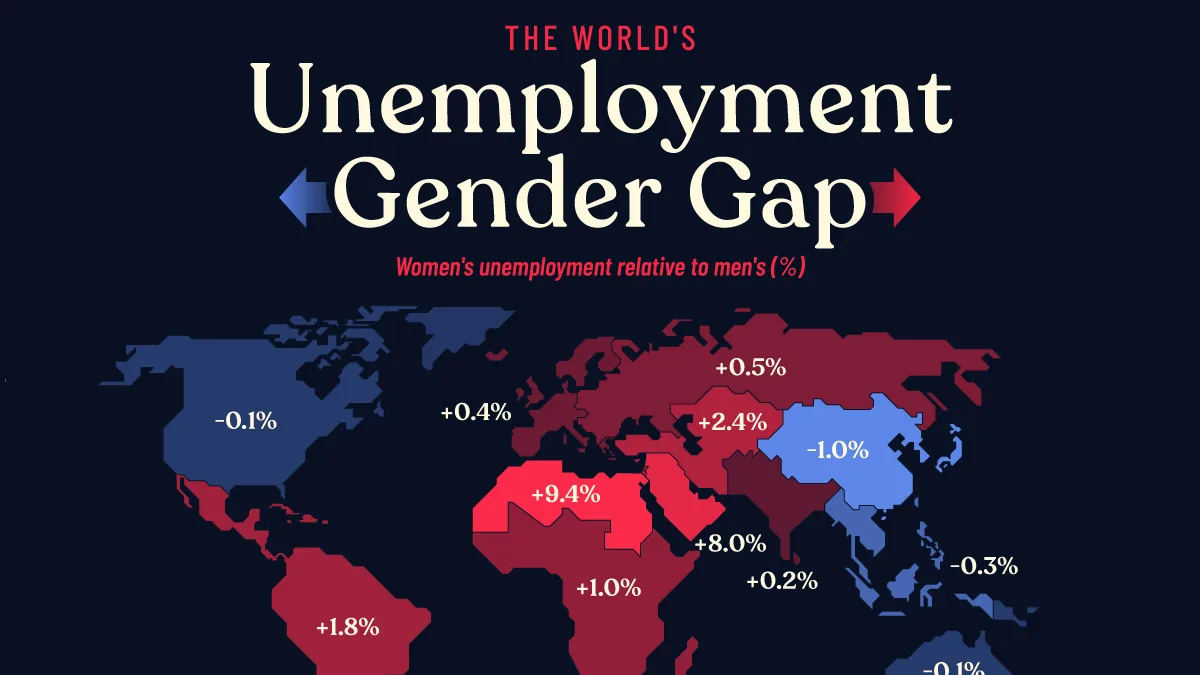
Mapped: The World’s Unemployment Gender Gap
See visuals like this from many other data creators on our Voronoi app. Download it for free on iOS or Android and discover incredible data-driven charts from a variety of trusted sources.
Key Takeaways
- Women have higher unemployment rates than men across most world regions, but the size of the gap varies widely.
- North Africa (+9.4%) and the Arab States (+8.0%) have by far the largest gender gaps in unemployment.
- North America and several Asia-Pacific regions are among the few places where male unemployment exceeds female unemployment.
Across most of the world, women are more likely to be unemployed than men, though the gap differs dramatically by region.
This graphic maps out the difference between unemployment rates for men and women across various world regions. Data is incorporated from the International Labour Organization (ILO)’s Employment and Social Trends 2026 report, specifically modelled ILOSTAT estimates from November 2025.
The higher the percentage, the higher the female unemployment rate is compared to its male counterpart. Globally, the female unemployment rate is 0.2 percentage points higher than the men’s.
The Unemployment Gender Gap in the Arab World
This resulting “unemployment gender gap” varies widely between regions.
Across most of the developing world, women have a higher unemployment rate than men. Nowhere is the gender gap starker than in the Middle East (+8%) and North Africa (+9.4%).
The following table lists various world regions and subregions based on the difference between male and female unemployment rates.
| Region/Subregion | Female unemployment rate minus male unemployment rate (%) |
|---|---|
| Northern Africa | 9.4 |
| Arab States | 8.0 |
| Central and Western Asia | 2.4 |
| Latin America and the Caribbean | 1.8 |
| Sub-Saharan Africa | 1.0 |
| Eastern Europe | 0.5 |
| Northern, Southern and Western Europe | 0.4 |
| World | 0.2 |
| Southern Asia | 0.2 |
| Northern America | -0.1 |
| Pacific | -0.1 |
| South-Eastern Asia | -0.3 |
| Eastern Asia | -1.0 |
A few factors help to explain the significant gender gap in unemployment rates throughout the Middle East and North Africa (MENA) region.
To start, cultural and legal barriers continue to limit women’s employment opportunities in some countries. Some countries, such as Saudi Arabia and the United Arab Emirates, have had labor regulations and restrictions on women working in certain industries, though reforms in recent years have sought to gradually reduce these limitations.
Limited private-sector opportunities have also coincided in some cases with a slowdown in the historically large public-sector employment of many women. Family and childcare responsibilities can further make it more difficult for women who are seeking work to find and retain employment.
Where Men Have Higher Unemployment
In contrast, in certain developed regions, women have a slightly lower unemployment rate than men. This includes North America and the Pacific region (both -0.1%), Southeast Asia (-0.3%), and particularly East Asia (-1%).
While defying global trends, this difference in unemployment rates can be attributed in part to education levels and the economic sectors attracting men and women. Women now outperform men educationally across many advanced economies, improving their employment prospects.
The industries in question also matter. A rise in service-sector jobs in industries like healthcare and education has benefitted women more, in contrast to the more cyclical nature of male-dominated industries like construction, manufacturing, or mining.
Unemployment Gender Gap Around the World
The contrast between regions like North America and East Asia on one end and MENA on the other would seem to imply that regional development level is the crucial factor at play.
Indeed, developing regions such as Sub-Saharan Africa (1%), Latin America and the Caribbean (1.8%), and Central and West Asia (2.4%) all have sizable gaps between the male and female unemployment rates.
However, women in Northern, Southern, and Western Europe have an unemployment rate that is 0.4% higher than the male rate, roughly equal to the gap seen in Eastern Europe (0.5%) and above the gap seen in South Asia (0.2%). This indicates that economic development does not fully explain regional trends.
Learn More on the Voronoi App 
For more on how one continent has brought down unemployment over time, check out Unemployment has fallen across most of Europe since 2013 on Voronoi, the new app from Visual Capitalist.