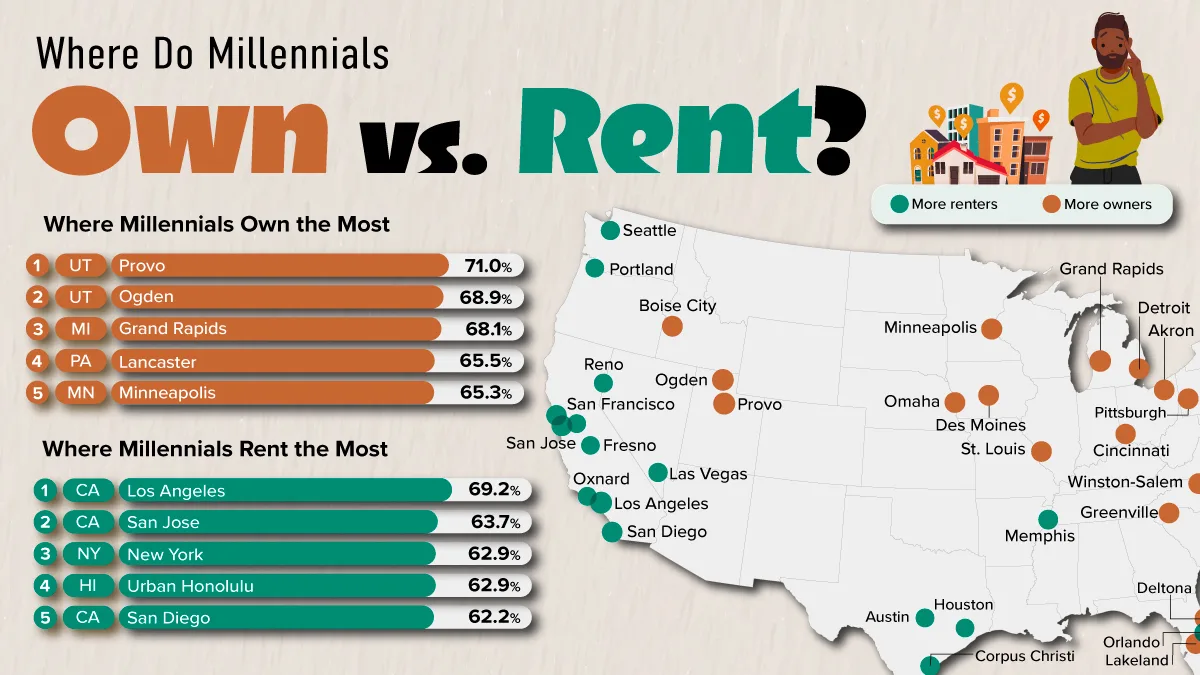
Where Are Millennials Buying Homes or Renting?
Key Takeaways
- A majority of millennial households nationwide (54%) owned their homes in 2024, while 46% rented.
- Provo, Utah, had the highest millennial homeownership rate among the metros analyzed (71.0%), while Los Angeles, California, had the highest rental rate (69.2%).
For millennials, the likelihood of owning a home varies dramatically depending on where they live. In some U.S. metro areas, roughly seven in 10 millennial households own their homes. In others, nearly seven in 10 rent.
This visualization maps the U.S. metro areas where millennials are most likely to own or rent, using data from IPUMS USA and the University of Minnesota’s harmonized 2024 American Community Survey (ACS) 1-Year microdata.
The analysis covers 108 U.S. metro areas with at least 50,000 millennial households, comparing ownership and rental rates rather than the total number of homeowners or renters.
Utah and the Midwest Lead in Millennial Homeownership
Utah claims the top two spots for millennial homeownership. In Provo, 71.0% of millennial households own their homes, followed by nearby Ogden at 68.9%. Grand Rapids, Michigan, ranks third at 68.1%.
| Rank | Metro area | State | Millennial households that own (2024) |
|---|---|---|---|
| 1 | Provo | UT | 71.0% |
| 2 | Ogden | UT | 68.9% |
| 3 | Grand Rapids | MI | 68.1% |
| 4 | Lancaster | PA | 65.5% |
| 5 | Minneapolis | MN | 65.3% |
| 6 | Boise City | ID | 63.8% |
| 7 | Palm Bay | FL | 63.8% |
| 8 | Des Moines | IA | 63.5% |
| 9 | Pittsburgh | PA | 63.4% |
| 10 | Omaha | NE | 63.1% |
| 11 | Winston-Salem | NC | 63.1% |
| 12 | St. Louis | MO | 62.9% |
| 13 | Akron | OH | 62.6% |
| 14 | Deltona | FL | 62.3% |
| 15 | Greenville | SC | 62.2% |
| 16 | Charleston | SC | 62.0% |
| 17 | Detroit | MI | 61.7% |
| 18 | Lakeland | FL | 61.3% |
| 19 | Cincinnati | OH | 61.2% |
| 20 | Anchorage | AK | 61.2% |
Utah’s high millennial homeownership rates may partly reflect the state’s tendency toward earlier marriage and family formation, alongside strong employment growth.
Historically more attainable housing prices in places like Ogden may also have helped younger households enter the market. However, rising home prices and elevated mortgage rates have made buying increasingly difficult for prospective homeowners.
Other high-ranking metros include Lancaster, Pennsylvania (65.5%), Minneapolis, Minnesota (65.3%), and Des Moines, Iowa (63.5%), highlighting a strong showing across parts of the Midwest.
These markets contrast sharply with rental-heavy coastal metros, although local incomes, household composition, and the timing of home purchases can also shape homeownership rates.
Millennials Are More Likely to Rent in Coastal Cities
Los Angeles is nearly the mirror image of Provo. While roughly seven in 10 millennial households own their homes in Provo, nearly seven in 10 rent in Los Angeles (69.2%).
San Jose follows with a 63.7% rental rate, while New York and Urban Honolulu are tied at 62.9%.
| Rank | Metro area | State | Millennial households that rent (2024) |
|---|---|---|---|
| 1 | Los Angeles | CA | 69.2% |
| 2 | San Jose | CA | 63.7% |
| 3 | New York | NY | 62.9% |
| 4 | Urban Honolulu | HI | 62.9% |
| 5 | San Diego | CA | 62.2% |
| 6 | San Francisco | CA | 60.9% |
| 7 | Memphis | TN | 56.9% |
| 8 | Miami | FL | 56.6% |
| 9 | Corpus Christi | TX | 56.0% |
| 10 | Orlando | FL | 54.5% |
| 11 | Las Vegas | NV | 54.1% |
| 12 | Seattle | WA | 53.3% |
| 13 | Reno | NV | 52.1% |
| 14 | Austin | TX | 51.6% |
| 15 | Modesto | CA | 51.2% |
| 16 | Oxnard | CA | 51.1% |
| 17 | Houston | TX | 51.0% |
| 18 | Boston | MA | 50.8% |
| 19 | Portland | OR | 50.7% |
| 20 | Fresno | CA | 50.3% |
San Diego (62.2%) and San Francisco (60.9%) also rank near the top, making high-cost coastal markets especially prominent among the most rental-heavy metros.
Expensive housing and the challenge of saving for a down payment may help explain this pattern. However, these figures measure whether households own or rent, not the reasons behind their housing decisions.
In Los Angeles, for example, a typical home costs around $860,000, putting homeownership out of reach for many households without substantial savings or high incomes.
The South Shows a More Mixed Picture
Unlike the more pronounced patterns in Utah and coastal California, the South has metros near the top of both rankings.
Palm Bay, Florida, has a 63.8% millennial homeownership rate, while Winston-Salem, North Carolina (63.1%), and Greenville, South Carolina (62.2%), also rank among the leading ownership markets.
Meanwhile, renting is more common in Memphis, Tennessee (56.9%), Miami, Florida (56.6%), and Orlando, Florida (54.5%).
While wages tend to be lower across much of the South, relatively affordable housing has historically made homeownership more accessible in many markets.
However, population growth in states like Florida has increased housing demand, contributing to rising prices and making homeownership less attainable for some younger households.
Learn More on the Voronoi App 
If you enjoyed today’s post, check out Ranked: U.S. Wealth by Generation in 2026 on Voronoi.