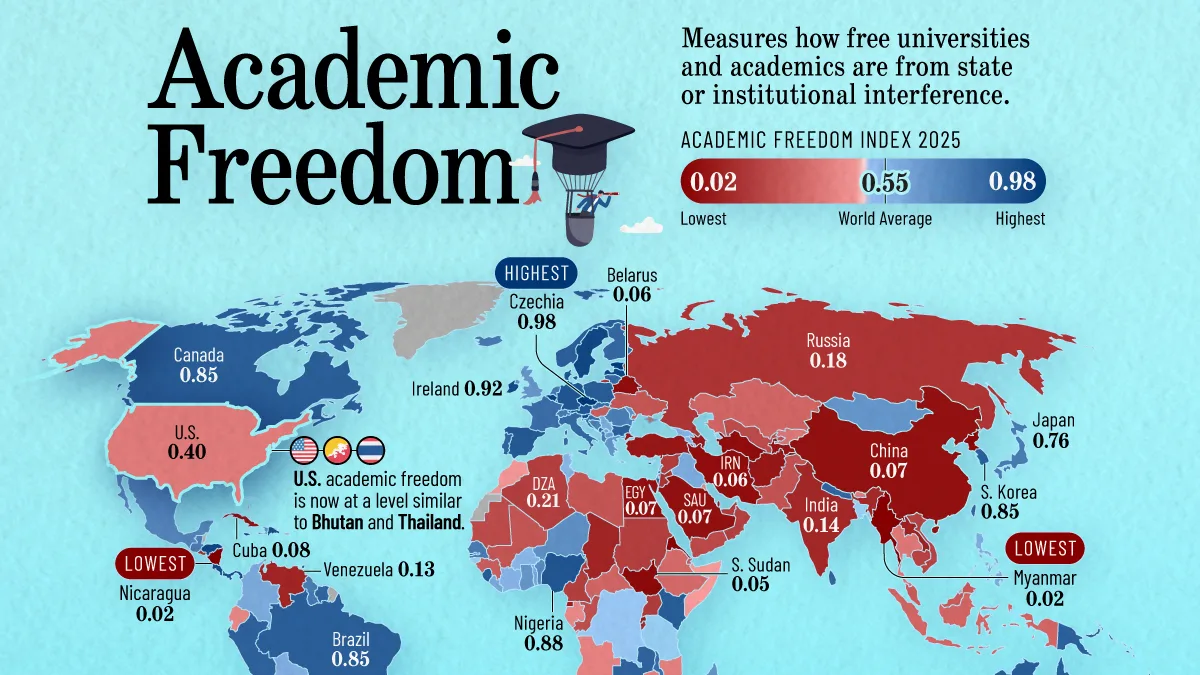
Mapped: Which Countries Have the Most Academic Freedom?
Key Takeaways
- Czechia ranks first globally for academic freedom, while Myanmar and Nicaragua rank last.
- The U.S. scores 0.40, placing it at a level similar to Bhutan and Thailand.
- India has recorded one of the world’s sharpest declines in academic freedom since 2010.
Globally, university autonomy is eroding. Since 2015, academic freedom has declined in 50 countries, while just nine have recorded improvements.
This map uses V-Dem’s 2025 Academic Freedom Index, via Our World in Data, to show where universities and academics are most free from state and institutional interference.
Czechia Ranks Ahead of Every Other Country
With a near-perfect score of 0.98, Czechia leads the ranking, followed by Estonia (0.97), Belgium (0.95), and Slovenia (0.94).
Europe dominates the top of the ranking, but Chile and Costa Rica are among the biggest surprises, outperforming many of the world’s richest nations. In much of Latin America, constitutions explicitly protect university autonomy from political control.
| Country | Academic Freedom Index 2025 | Change (2015–2025) |
|---|---|---|
 Czechia Czechia |
0.98 | +4% |
 Estonia Estonia |
0.97 | 0% |
 Belgium Belgium |
0.95 | -2% |
 Slovenia Slovenia |
0.94 | -2% |
 Jamaica Jamaica |
0.94 | -1% |
 Latvia Latvia |
0.93 | -4% |
 Sweden Sweden |
0.93 | -2% |
 Honduras Honduras |
0.93 | +4% |
 Seychelles Seychelles |
0.93 | +26% |
 Chile Chile |
0.92 | -5% |
 Luxembourg Luxembourg |
0.92 | -2% |
 Costa Rica Costa Rica |
0.92 | -1% |
 Ireland Ireland |
0.92 | 0% |
 Uruguay Uruguay |
0.91 | -5% |
 Panama Panama |
0.91 | +1% |
 Vanuatu Vanuatu |
0.91 | +3% |
 Solomon Islands Solomon Islands |
0.90 | 0% |
 Barbados Barbados |
0.90 | +1% |
 Dominican Republic Dominican Republic |
0.90 | +6% |
 Cyprus Cyprus |
0.89 | -7% |
 Austria Austria |
0.88 | -9% |
 Germany Germany |
0.88 | -9% |
 Denmark Denmark |
0.88 | -8% |
 Nigeria Nigeria |
0.88 | -4% |
 Spain Spain |
0.87 | -9% |
 Malta Malta |
0.87 | -3% |
 Cape Verde Cape Verde |
0.87 | 0% |
 Trinidad and Tobago Trinidad and Tobago |
0.87 | +1% |
 Poland Poland |
0.86 | -11% |
 Australia Australia |
0.86 | -3% |
 Sierra Leone Sierra Leone |
0.86 | +1% |
 Kenya Kenya |
0.86 | +4% |
 Bulgaria Bulgaria |
0.85 | -7% |
 Canada Canada |
0.85 | -6% |
 Norway Norway |
0.85 | -5% |
 New Zealand New Zealand |
0.85 | -5% |
 Brazil Brazil |
0.85 | -4% |
 Papua New Guinea Papua New Guinea |
0.85 | +5% |
 South Korea South Korea |
0.85 | +9% |
 Israel Israel |
0.84 | -11% |
 Peru Peru |
0.84 | -10% |
 Zambia Zambia |
0.84 | +18% |
 Portugal Portugal |
0.83 | -14% |
 Taiwan Taiwan |
0.83 | -5% |
 Botswana Botswana |
0.83 | -4% |
 South Africa South Africa |
0.83 | 0% |
 Nepal Nepal |
0.83 | 0% |
 Suriname Suriname |
0.83 | +1% |
 Sri Lanka Sri Lanka |
0.83 | +26% |
 Lithuania Lithuania |
0.82 | -14% |
 Italy Italy |
0.82 | -14% |
 Finland Finland |
0.82 | -13% |
 Montenegro Montenegro |
0.82 | +29% |
 Gambia Gambia |
0.82 | +56% |
 Slovakia Slovakia |
0.81 | -15% |
 Croatia Croatia |
0.81 | -5% |
 France France |
0.80 | -10% |
 Malawi Malawi |
0.80 | +4% |
 Switzerland Switzerland |
0.77 | -17% |
 Iceland Iceland |
0.76 | -17% |
 Senegal Senegal |
0.76 | -14% |
 Netherlands Netherlands |
0.76 | -13% |
 Albania Albania |
0.76 | -12% |
 Guyana Guyana |
0.76 | -1% |
 Japan Japan |
0.76 | +12% |
 Romania Romania |
0.75 | -18% |
 Bosnia and Herzegovina Bosnia and Herzegovina |
0.75 | +3% |
 Guatemala Guatemala |
0.74 | -8% |
 East Timor East Timor |
0.73 | -2% |
 Namibia Namibia |
0.72 | -1% |
 Mexico Mexico |
0.71 | -23% |
 Benin Benin |
0.71 | -19% |
 Somaliland Somaliland |
0.71 | +3% |
 Paraguay Paraguay |
0.70 | -3% |
 Moldova Moldova |
0.69 | -15% |
 Niger Niger |
0.69 | -9% |
 Haiti Haiti |
0.69 | -1% |
 Greece Greece |
0.68 | -21% |
 Madagascar Madagascar |
0.68 | -14% |
 United Kingdom United Kingdom |
0.67 | -28% |
 Mongolia Mongolia |
0.67 | -22% |
 Ghana Ghana |
0.67 | -17% |
 North Macedonia North Macedonia |
0.66 | +4% |
 Sao Tome and Principe Sao Tome and Principe |
0.64 | -9% |
 Lesotho Lesotho |
0.64 | -4% |
 Fiji Fiji |
0.64 | +71% |
 Argentina Argentina |
0.63 | -34% |
 Kosovo Kosovo |
0.62 | -25% |
 Lebanon Lebanon |
0.62 | -8% |
 Togo Togo |
0.61 | -29% |
 Liberia Liberia |
0.61 | -24% |
 Serbia Serbia |
0.60 | -28% |
 Colombia Colombia |
0.60 | -16% |
 Iraq Iraq |
0.60 | +42% |
 Philippines Philippines |
0.59 | -26% |
 Mauritius Mauritius |
0.59 | -9% |
 Georgia Georgia |
0.58 | -33% |
 Bolivia Bolivia |
0.58 | -30% |
 Armenia Armenia |
0.58 | -13% |
 Cote d’Ivoire Cote d’Ivoire |
0.57 | -8% |
 Burkina Faso Burkina Faso |
0.56 | -36% |
 Tunisia Tunisia |
0.56 | -23% |
 Maldives Maldives |
0.56 | +51% |
 Tanzania Tanzania |
0.52 | -25% |
 Guinea-Bissau Guinea-Bissau |
0.52 | -20% |
 Bangladesh Bangladesh |
0.52 | +121% |
 Democratic Republic of Congo Democratic Republic of Congo |
0.51 | +32% |
 Somalia Somalia |
0.49 | +3% |
 Morocco Morocco |
0.48 | -23% |
 Singapore Singapore |
0.47 | +1% |
 Gabon Gabon |
0.43 | -49% |
 Ecuador Ecuador |
0.43 | -37% |
 Kuwait Kuwait |
0.42 | -13% |
 Angola Angola |
0.42 | +4% |
 Mozambique Mozambique |
0.41 | -37% |
 United States United States |
0.40 | -57% |
 Bhutan Bhutan |
0.40 | +3% |
 Kyrgyzstan Kyrgyzstan |
0.38 | -39% |
 Thailand Thailand |
0.38 | +224% |
 Ethiopia Ethiopia |
0.34 | +4% |
 Indonesia Indonesia |
0.33 | -56% |
 Central African Republic Central African Republic |
0.33 | -47% |
 Kazakhstan Kazakhstan |
0.33 | +40% |
 Comoros Comoros |
0.30 | -53% |
 Hungary Hungary |
0.30 | -43% |
 Guinea Guinea |
0.30 | -20% |
 Djibouti Djibouti |
0.30 | +9% |
 Malaysia Malaysia |
0.29 | -29% |
 Mali Mali |
0.28 | -67% |
 Ukraine Ukraine |
0.28 | -49% |
 Libya Libya |
0.28 | -35% |
 Pakistan Pakistan |
0.27 | -52% |
 Congo Congo |
0.26 | -37% |
 Mauritania Mauritania |
0.25 | -19% |
 Uzbekistan Uzbekistan |
0.25 | +428% |
 Hong Kong Hong Kong |
0.24 | -57% |
 Yemen Yemen |
0.24 | -17% |
| Zanzibar |
0.23 | -49% |
 Cambodia Cambodia |
0.22 | -42% |
 Vietnam Vietnam |
0.22 | -24% |
 Cameroon Cameroon |
0.21 | -41% |
 Algeria Algeria |
0.21 | -35% |
 Sudan Sudan |
0.21 | 0% |
 Oman Oman |
0.21 | +1% |
 Uganda Uganda |
0.20 | -58% |
 UAE UAE |
0.20 | +40% |
 Bahrain Bahrain |
0.20 | +255% |
 Syria Syria |
0.20 | +443% |
 Russia Russia |
0.18 | -53% |
 Eswatini Eswatini |
0.18 | +4% |
 El Salvador El Salvador |
0.17 | -80% |
 Jordan Jordan |
0.17 | -53% |
 Zimbabwe Zimbabwe |
0.16 | +12% |
 India India |
0.14 | -66% |
 Burundi Burundi |
0.14 | +5% |
 Chad Chad |
0.13 | -76% |
 Venezuela Venezuela |
0.13 | -57% |
 Laos Laos |
0.12 | +139% |
 Equatorial Guinea Equatorial Guinea |
0.11 | +69% |
 Palestine/Gaza Palestine/Gaza |
0.10 | -72% |
 Qatar Qatar |
0.10 | -43% |
 Rwanda Rwanda |
0.10 | +29% |
 Afghanistan Afghanistan |
0.09 | -83% |
 Turkey Turkey |
0.09 | -68% |
 Azerbaijan Azerbaijan |
0.09 | -6% |
 Cuba Cuba |
0.08 | -21% |
 Tajikistan Tajikistan |
0.08 | +3% |
 China China |
0.07 | -40% |
 Egypt Egypt |
0.07 | +4% |
 Saudi Arabia Saudi Arabia |
0.07 | +32% |
 Belarus Belarus |
0.06 | -67% |
 Iran Iran |
0.06 | -52% |
 Turkmenistan Turkmenistan |
0.06 | +256% |
 South Sudan South Sudan |
0.05 | +15% |
 North Korea North Korea |
0.04 | +200% |
 Eritrea Eritrea |
0.03 | +70% |
 Nicaragua Nicaragua |
0.02 | -95% |
 Myanmar Myanmar |
0.02 | -94% |
Jamaica and Seychelles also rank alongside wealthier economies, suggesting that institutional safeguards may matter more for academic freedom than economic or geopolitical power.
By contrast, China, Iran, Myanmar, and Nicaragua are among the world’s most restrictive environments for academic freedom. In China, classroom surveillance cameras, student informants, and ideological oversight constrain scholars, while the country’s score has declined by 40% over the past decade.
The U.S. Now Ranks Near Bhutan and Thailand
The U.S. now scores lowest among G7 countries, at a level comparable to Bhutan and Thailand.
The decline accelerated in 2025, with 20 federal actions targeting university autonomy. Thousands of federal research grants were frozen or terminated, while proposed funding cuts of up to 35%, or $32 billion, placed further pressure on higher education.
Unlike in Hungary, India, and Türkiye, where academic freedom declined gradually over many years, the U.S. deterioration unfolded in just six years, showing how quickly university autonomy can erode.
India Has Seen One of the World’s Steepest Declines
India’s academic freedom score has fallen faster than that of almost any other country since 2010.
Under Prime Minister Narendra Modi, textbooks have been revised, parts of the country’s history have been rewritten, and scholars who challenge government narratives have faced growing pressure and intimidation.
Recent student protests have also drawn attention to broader concerns about higher education. After the 2026 NEET-UG medical entrance exam was canceled over a paper leak, a youth-led protest movement spread across India, ultimately contributing to Education Minister Dharmendra Pradhan’s resignation.
The rankings show how quickly academic freedom can change. Even long-established university systems have experienced sharp shifts within a decade as political and legal changes reshape higher education.
Learn More on the Voronoi App
To learn more about this topic, check out this graphic on the countries with the biggest declines in academic freedom over the past decade.