

The expansion of solar capacity is outpacing the market’s ability to absorb its output. High solar production coinciding with moderate demand, wind generation and limited grid flexibility is leading to more frequent periods of oversupply.
As a result, low or negative prices are becoming more common during peak solar generation. At the same time, sharp price spikes are occurring more frequently on summer evenings, when flexible power plants, including gas-fired facilities, must ramp up quickly as solar output falls.
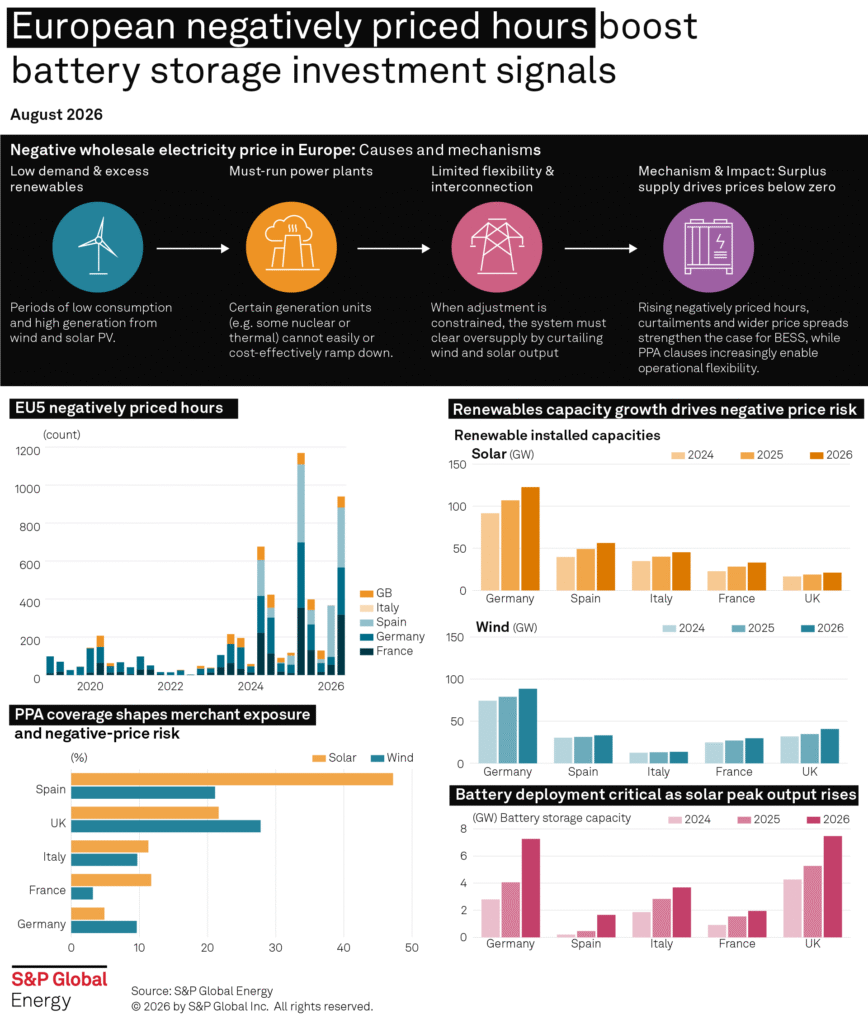
According to S&P Global, negative-price hours in the first half of 2026 across five major European markets, including Great Britain, were around 2% higher than the record levels recorded in the same period of 2025. In 2025 as a whole, the number of negative-price hours was more than 13 times higher than in 2022.
Significant differences remain between markets. France recorded the highest number of negative-price hours, with high nuclear output adding downward pressure on prices. In Germany, higher gas prices supported electricity prices during the summer, while Italy recorded no negative-price hours due to its greater reliance on gas-fired generation.
Nevertheless, the trend is spreading across most European markets.
Batteries gain value as price spreads widen
Data from Platts, part of S&P Global Energy, show that wholesale price spreads available to batteries in Germany reached daily peaks of more than €650 ($753.6)/MWh and averaged nearly €200/MWh in the second quarter of 2026, exceeding levels in Spain and Great Britain.
In solar-heavy markets such as Spain, these trends are strengthening the investment case for utility-scale storage. They are also reshaping revenues for market-exposed solar projects. Around 10% to 15% of European solar capacity is currently exposed to merchant risk, while more than 61 GW is contracted under power purchase agreements (PPAs). In Germany, for example, only around 9% of installed capacity is directly exposed to the market.
According to S&P Global, the issue is not the economic competitiveness of solar technology, but the declining value of unadjusted solar output during peak generation periods. Electricity produced by solar plants increasingly risks being generated when the system needs it least and when its market value is lowest.
PPAs evolve toward more structured products
The observed dynamic is also reshaping the PPA market. Traditional “pay-as-produced” contracts, under which buyers purchase electricity as it is generated, were designed for markets where renewable output generally retained high value and generation-profile risk was easier to absorb.
In markets with high solar penetration, that model carries greater profile risk. Buyers receive electricity when plants generate it, regardless of whether output aligns with consumption or favorable pricing periods.
“The drop in contracting for independent solar projects shows that negative prices are becoming a structural issue in PPA design, rather than just a problem for the merchant market,” said Bruno Brunetti, head of renewable revenue streams at S&P Global Energy Horizons.
Independent solar PV accounted for more than 55% of PPA deals announced in Europe in 2025. Its share fell to around one-third in the first half of 2026, with less than 3 GW contracted. Brunetti said buyers continue to seek renewable energy but increasingly favor contracts that explicitly address delivery timing, captured prices and exposure to negative-price hours.
Combining technologies is therefore becoming increasingly important, driving a shift toward asset aggregation and more structured energy products. The focus is moving beyond purchasing or generating a specific volume of renewable electricity toward managing when that electricity is produced and delivered.
S&P Global said the market is moving toward models that match generation and demand on an hourly basis. Hourly certificates and other granular certification systems could represent the next step in corporate clean energy procurement, shifting the focus from annual renewable energy volumes to matching generation with consumption over time.
The post Negative prices reshape Europe’s solar, storage and PPA markets appeared first on pv magazine Global.


