
NVIDIA has been one of Wall Street’s biggest winners during the artificial intelligence (AI) boom. Its chips power many of the world’s largest AI models, making the company a key supplier to Microsoft, Amazon, Google, Meta, and other tech giants.
Yet, in 2026, NVIDIA’s (NVDA) stock has fallen behind the broader market after years of explosive gains. Some investors see the pullback as a buying opportunity. Others are asking whether the company’s rapid growth can continue as AI demands more electricity, more data centers, and larger investments in clean energy.
NVIDIA Stock Slows After Years of Record Gains
NVIDIA became the world’s most valuable public company earlier this year as demand for AI chips continued to surge. Its market value briefly climbed above $4 trillion, making it the first company to reach that milestone.
Even so, the stock has struggled to match the broader market in recent months. According to The Motley Fool, investors have become more cautious after several years of exceptional gains. Expectations are now much higher, meaning the company must continue delivering strong revenue growth to justify its premium valuation.
Many analysts, however, remain optimistic. They point to NVIDIA’s dominant position in AI computing, where demand still exceeds supply in several parts of the market.
AI Investment Still Fuels NVIDIA’s Growth
The long-term outlook for AI infrastructure remains strong.
According to the International Data Corporation (IDC), global spending on AI could hit $632 billion by 2028, growing at a compound annual rate of about 29%. Most of that investment will focus on AI servers, cloud infrastructure, networking gear, and advanced chips.
NVIDIA sits at the center of this expansion.
Its latest Blackwell AI platform is now being deployed by major cloud providers worldwide. The company says every leading cloud service provider offers NVIDIA AI infrastructure, while thousands of companies are building AI applications using its hardware and software.
Demand also continues to grow beyond traditional cloud computing. Governments, manufacturers, healthcare firms, financial institutions, and research groups are all investing in AI systems that need advanced graphics processing units (GPUs).
These trends help explain why many investors still see NVIDIA as one of the biggest long-term beneficiaries of the AI revolution.
The AI Boom Comes With a Bigger Carbon Footprint
Rapid growth comes with a cost. Training and running AI models require enormous computing power. That means more data centers, more electricity, and more advanced chips.
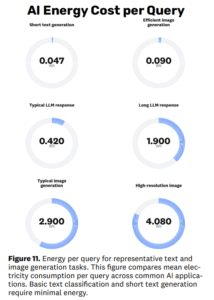
According to the International Energy Agency (IEA), electricity demand from data centers is expected to more than double by 2030, driven largely by AI. The agency estimates that by the end of the decade, global data centers could use about 945 terawatt-hours (TWh) of electricity. That’s more than Japan’s annual power use.
Building these facilities also creates large emissions. Manufacturing semiconductors, servers, steel, cement, and cooling equipment requires significant amounts of energy and raw materials.
This has shifted more attention toward the environmental impact of AI. Investors are increasingly looking beyond revenue growth. They also want to know how companies will reduce emissions while expanding AI infrastructure.
- RELATED: AI’s Environmental Cost: Data Centers Now Rival Entire Nations in Energy, Water, and Land Use
Efficiency Becomes NVIDIA’s Competitive Edge
NVIDIA says improving energy efficiency is one of its biggest priorities.
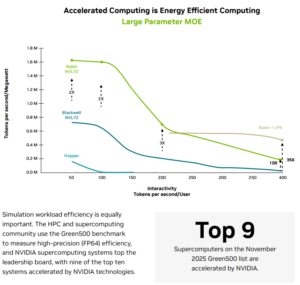
According to the company’s latest Sustainability Report, nine of the world’s ten most energy-efficient supercomputers on the Green500 list use NVIDIA technologies. The company also says its newest Blackwell platform delivers much higher AI performance while using less energy per computation than previous generations.
The company has also expanded its climate commitments. NVIDIA’s near-term emissions reduction targets have been validated by the Science Based Targets initiative (SBTi).
The tech giant aims to reduce absolute Scope 1 and Scope 2 greenhouse gas emissions by 50% by fiscal year 2030 from a fiscal 2023 baseline. It also plans to reduce Scope 3 emissions from the use of sold products by 75% per petaFLOP over the same period.
Those goals reflect a growing reality across the technology sector. The next stage of AI growth will not be judged only by faster chips or higher profits. It will also depend on how efficiently companies can power the AI economy while keeping emissions under control.
Where Does NVIDIA’s Biggest Carbon Footprint Lie?
Like many technology companies, most of NVIDIA’s emissions do not come from its offices.
According to its 2026 Sustainability Report, more than 99% of the company’s greenhouse gas emissions come from Scope 3 sources. These include emissions from suppliers, manufacturing partners, transportation, and the use of its products. NVIDIA designs its chips but relies on manufacturing partners such as TSMC to produce them.

To address this, the company is working more closely with suppliers. It encourages them to improve energy efficiency, use more renewable electricity, and report their emissions.
NVIDIA also says it is increasing the use of recycled materials in its products and packaging while improving product design to reduce waste. These efforts are becoming more important as demand for AI chips continues to grow.
Climate Goals Extend Across the AI Value Chain
NVIDIA has expanded its climate strategy in recent years.
The company aims to cut its Scope 1 and Scope 2 emissions by 50% by fiscal year 2030, using fiscal year 2023 as its baseline. It also plans to reduce Scope 3 emissions from the use of sold products by 75% per petaFLOP by 2030. These targets have been validated by the Science Based Targets initiative (SBTi).
NVIDIA has already achieved another important milestone. The company now sources 100% renewable electricity for its offices and data centers under its operational control. It is also investing in more energy-efficient buildings and improving water conservation across its global facilities.
While these actions reduce NVIDIA’s direct footprint, the larger challenge remains its global supply chain and the rapid expansion of AI infrastructure.
Investors Want Growth—and Climate Progress
NVIDIA’s recent stock pullback has not changed its long-term outlook.
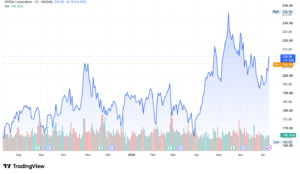
Most analysts still expect AI spending to remain strong over the next several years. Major cloud companies continue to invest hundreds of billions of dollars in new AI infrastructure, keeping demand for NVIDIA’s GPUs high.
However, investors are also paying closer attention to sustainability. Large institutional investors increasingly consider climate risks alongside financial performance. They want to see whether companies can keep growing while lowering emissions, improving supply chain transparency, and meeting their climate targets.
For NVIDIA, that means future success will depend on more than selling faster chips. It will also depend on making AI infrastructure more efficient and less carbon-intensive.
The Next AI Race Is About Sustainable Growth
The next phase of the AI revolution will not be measured only by computing power. It will also depend on how efficiently companies use energy, reduce emissions, and build cleaner supply chains. Governments, customers, and investors are all placing greater emphasis on sustainable growth.
NVIDIA remains well-positioned to benefit from rising AI demand. Its technology powers much of today’s AI ecosystem, and analysts continue to see strong long-term growth potential despite recent stock weakness.
At the same time, the company faces a new challenge. As AI expands, so does its environmental footprint. Meeting its science-based climate targets while supplying the hardware behind the AI boom will be one of NVIDIA’s biggest tests over the next decade.
The post NVIDIA (NVDA) Stock Pullback Comes as AI Giant Faces Its Biggest Sustainability Test Yet appeared first on Carbon Credits.


