
A Canadian Nuffield Scholar is attempting to find new ways to turn manure in to profit for poultry farmers. Georgia Lewis, OFCAF (On-Farm Climate Action Fund) Technical Lead of Agricultural Services for Perennia Food and Agriculture in Nova Scotia is in the midst of ongoing research into valorization of poultry manure, which she hopes will lead to new ways for producers and communities to take advantage of the by-product of these operations.
“I grew up in town in Kingston, in the [Annapolis] Valley, and was always drawn to food,” says Lewis. “And more or less growing up in an agricultural region and needed money, so I was always working on farms and just ended up loving the community around agriculture.”
Lewis attended the Nova Scotia Agricultural College for environmental sciences, where she touched on waste management but mostly worked in agronomy. She then spent time in Alberta working with large agricultural firms such as Cargill.
“My background with agriculture is more agronomic, plant production, nutrient management and so on, but I came back to Nova Scotia wanting to do my Master’s and was quite open to what that looked like. I was just happy to work with a certain supervisor, Andrew Hammermeister, at the now-Dalhousie Agricultural Campus, and we were going to look at pelletized poultry manure from an agronomic standpoint, and look at the nitrogen use efficiency within crop productions and try to understand the nitrogen release rate of pelletized poultry manure and see if we could align that with cereal production.”
The plan was to look at a complete agronomic standpoint and get into sustainable resource management through that to try to use local amendments specifically.
“But then we took a stand back and said, ‘actually, we’re not really sure where this product is coming from, how it’s being made, where the manure is being sourced from, and what kind of environmental impacts are associated with the actual production of pelletized poultry manure.’ So we were curious too! So if we were going to promote the use of the product through research, it would first be beneficial to go back down the supply chain and say ‘hey, let’s look at the environmental impacts associated with producing it.’”
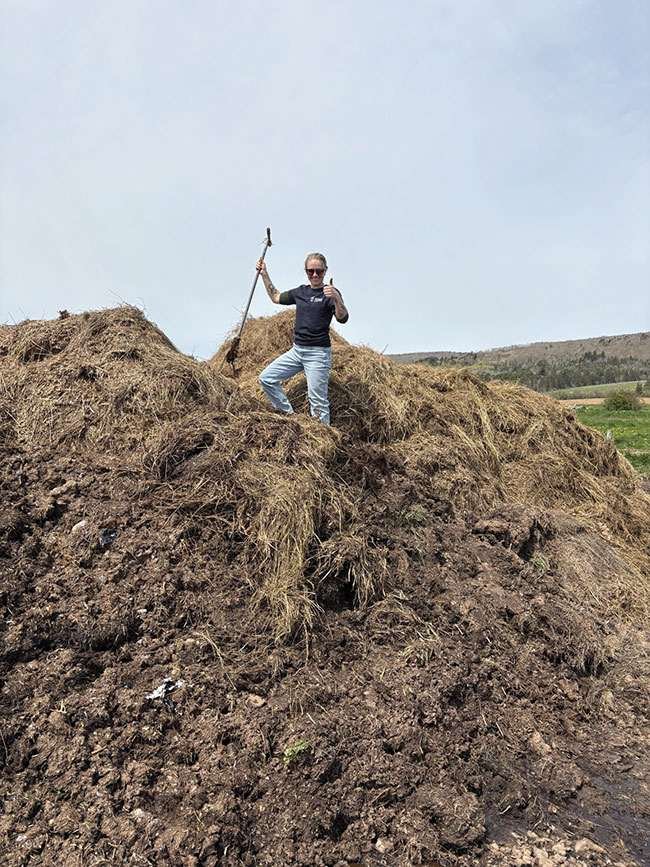
Lewis carried out a life cycle assessment on two different manufacturers: one that sourced their manure from boiler production and another that sourced from layer production. This effort, started in the early 2020s, allowed her to look at the processing, manufacturing and utilization of manure from a different angle. She could now see direct connections to her past interest in nutrient management which led her to questions about how much synthetic fertilizer is being used.
“And that can be applied to all livestock industries and manure processing and then also industries outside of agriculture too. We have seafood waste that can be interesting, human wastes that could play into it. We have so much poo – it’s a co-product and a resource that we have available to us.”
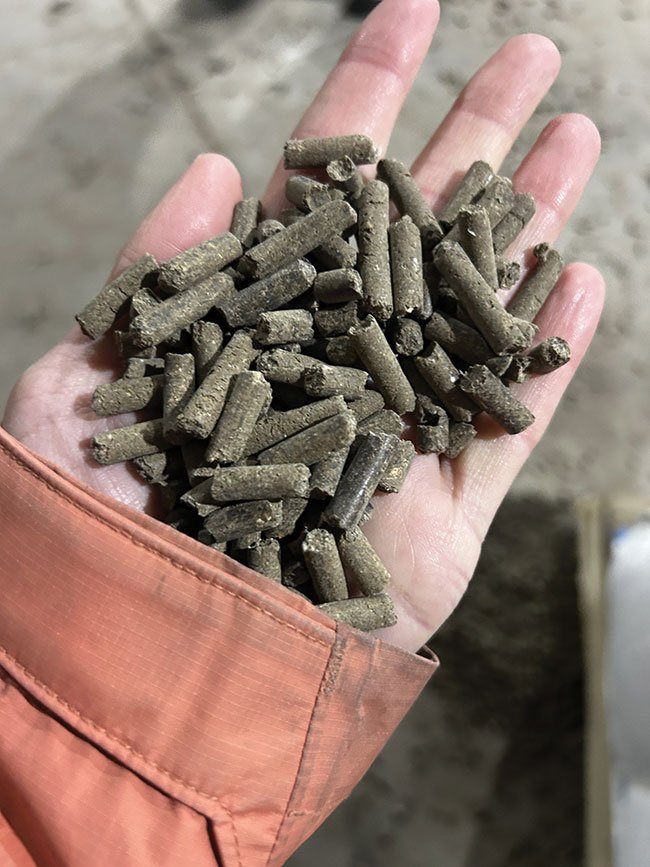
A key focus of Lewis’ research is into pelletizing – creating pellets out of dried and grinded manure so that they can be employed conveniently on farms as a fertilizer. The process is quite popular internationally – she cites the example of a large Japanese egg producer, who have begun pelletizing their manure in the last decade and now have multiple pelletizers set up so they can sell it to rice producers and other international buyers. Closer to home, a turkey operation in Minnesota made pelletizing manure a key facet of their business and takes in manure from other farm in the area.
“[It’s] very high value for organic producers,” Lewis says. “It’s a high nitrogen fertilizer or amendment for organic producers and is in high demand down there.”
Pelletized poultry manure generally has a nutrient profile that falls between three to four percent nitrogen, two to three percent phosphorus and one to two percent potassium, and contains more organic and microbial matter, which makes it a slow release form of nitrogen.
“It depends on soil tests and nutrient management plans, but some people might want to amend with pelletized poultry manure. They’re usually applying about a ton per acre, depending on the crop, so you will get about 50% of the nitrogen available to the plant in the first year and then you would get a bit more throughout the next growing seasons, depending on climate and environmental things going on, soil types and such.”
That impact of the manure on soil and organic matter varies depending on types of bedding used as well. Layer manure tends to be higher in nutrients and nitrogen content than that of boilers, owing to the types of bedding used.
The pelletized manure is dehydrated, which is very useful, particularly as it relates to layer poultry which at about 80 percent moisture content is significantly more wet than boiler manure. Both types can be dehydrated down to under 10 percent moisture content, thus avoiding additional shipping costs due to water weight. It can also serve to make the product more consistent. The dehydration process itself carries a significant energy cost but that could be balanced out in the end.
“You’re having to either use electricity or you’re burning something to then dehydrate the manure. But, on the other end, if that’s substituting synthetic fertilizer use, maybe it’s a good trade off. I think that’s something where more research can come into play.”
Asked about whether there is a local environmental context to her work, Lewis states that ‘all poo is created differently’ and notes that the reasons for processing manure differ from region to region. Concentrations will differ regionally and those concentrations can lead to environmental impacts to water and air, as well as socially. In Japan, for example, because the land mass is so small, farms are often neighbouring residential areas (there are 25 dairy farms within the Tokyo prefecture), so odor control becomes a larger issue.
Regulatory environments play a heavy factor as well. Lewis observed that there are strict regulations around on-farm nitrogen in the European Union (EU), which has led to manure processing becoming much more prevalent there.
Lewis sees Canada as having an opportunity to take nutrients from concentrated livestock areas and move them over to commodity crops, in order to use less synthetic fertilizers, urea and synthetic nitrogen sources. And her dream is that the agricultural sector of Canada’s Martime provinces could become a sustainable nutrient industry.
“I really want to explore what the opportunities are for our producers, specifically with our poultry folks and our feathered friends to see how we can utilize their manure. So I would love [to do] a research project that can dive into more of a collaborative approach with our producers here. I would love for it to be all-hands-on-deck, having a board, having the producers involved with some of the decision making and having that cooperative model and actually utilize our manure efficiently and be able to make some money from it.”
Lewis is cognizant about stricter environmental regulations that could come into effect in smaller agricultural regions that have a lot of water such as Atlantic Canada – she stresses ‘cognizant’ as opposed to ‘concerned’ as she does understand the purpose of such regulations. But she has seen such regulations come into effect in the UK and the EU.
“If we’re to get on top of this now and be able to make a little bit of money with it, I think we might not even make it to that point then, because they might be like ‘nope, we’re not seeing major runoff, leaching ammonia, gas emissions, all these things associated with livestock production and manure,’ and they can hopefully leave producers alone and then they won’t have another pressure coming down on them. So I would really like to get involved in the community here.”
Asked about whether the benefits of manure pelletization and valorization would be more pronounced for larger or smaller farms, Lewis notes that in other provinces organic producers of any size that are limited on nitrogen are using pelletized poultry manure. For the maritime provinces, however, she says that it could support soil health, nitrogen and phosphorus needs for larger conventional producers and smaller organic producers, as well as market gardeners and hobby farmers.
“They can buy a couple of little bags and apply it to their gardens and away they go. So hopefully [it would work] with all levels. We’re seeing such pressures from the fertilizer market in terms of quantity and costs. If we’re able to utilize a little bit of what’s happening here, hopefully it would help all producers at all levels of production here.”
Recently, Lewis’ research has taken her to the UK, the EU and Zimbabwe to learn more about manure processing systems. She says unfortunately, she was mostly able to visit dairy, beef and swine farms, not poultry farms. But that doesn’t mean that poultry manure wasn’t a hot topic.
“It seems no matter what country you go to, poultry manure is the manure that a lot of people are looking for if they are limited on manure, just because of the high nutrient content and different characteristics. And it’s probably easier to transport, especially with the boiler being a bit drier. [Zimbabwe] was the place where there is no essential regulations, there’s no policies associated with manure. But there’s on-farm motivation to utilize manure wisely, because that can offset the use of other inputs coming in on farm. So there’s general responsible farm management that way, but in terms of the government being involved, that’s not happening.”
One of the key takeaways that Lewis emphasizes from her research is that we do have the technology to redistribute and utilize manure – it’s not that we don’t have the science or require innovations. All of that exists globally. But it requires the will.
“I think its more of a collaboration problem, or opportunity, when it comes to manure management and utilizing it efficiently and a distribution and logistics opportunity. There’s a social aspect to it that I think is really interesting. I think when there’s people that are driving it really well and there’s a really great community around it and a drive within a farming group, then there’s a lot more opportunity than just ‘hey, we’re going to throw in a pelletizer and someone’s going to try to get someone’s manure.’ The basics can be met easily. I think it’s the social aspect.”
Lewis’ Nuffield Scholarhship research is sponsored by the Atlantic Poultry Research Institute and Ontario’s Burnbrae Farms, which is the largest egg producer in Canada. She is due to deliver a report and a presentation on her findings in in Guelph in January 2027. •


