

Soile Kilpi, engineering firm AFRY’s management consulting director for the Americas, spoke at the Pulp and Paper Technical Association of Canada’s (PAPTAC’s) PaperWeek virtual conference last month, presenting an outlook for fibre-based packaging with advanced properties, as part of a papermaking panel focused on barrier coatings.
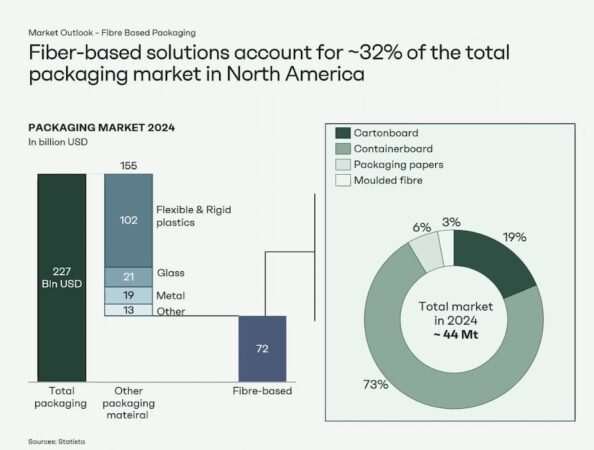
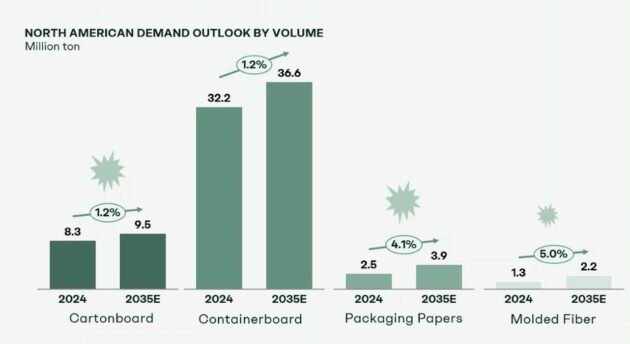
“Fibre-based accounts for about 32% of the total packaging market in North America, while plastic accounts for 50%,” she said, “but plastic bans around the world are pushing the market towards papers with barrier coatings that are recyclable.”
Graphic: AFRY.
By way of example, Canada enacted single-use plastics (SUP) prohibition regulations (SUPPR) with a goal of achieving zero plastic waste by 2030, which the Federal Court of Appeal upheld in January. Among other items, the SUPPR apply to the food-service sector’s clamshell containers, lidded containers and boxes containing expanded polystyrene (EPS) foam, extruded polystyrene (XPS) foam, polyvinyl chloride (PVC), carbon black and oxo-degradable plastic.
At the same time, nine of the 10 provinces have now implemented extended producer responsibility (EPR) schemes for packaging, putting the onus of recycling on the manufacturers.
Graph: AFRY.
Kipli, a former board member of the U.S. Endowment for Forestry and Communities with extensive pulp-and-paper industry experience, said the shift away from non-recyclable plastics is resulting not only from legislation and regulations, but also from brand owners’ new sustainability policies for procurement. The challenge for the pulp and paper industry is to find fibre-based ‘solutions’ that can provide the same attributes—both technical and value-based—that have made conventional polymers so attractive to the packaging market.
“Novel barriers stand out for sustainability, but lag in functionality and price-competitiveness,” she said. “Many are still in the early stages of technological development and commercialization.”
Graph: AFRY.
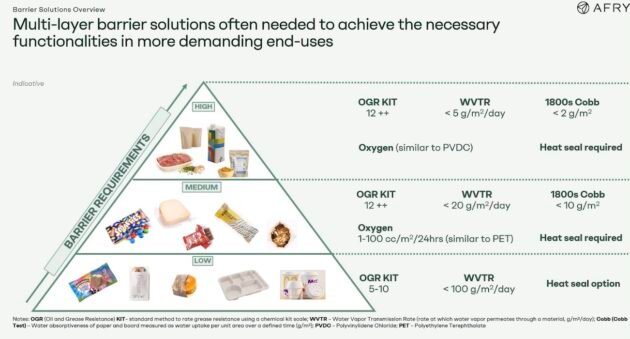
Fortunately, the growth of fibre-based food packaging has helped drive further developments in functional barrier coatings. Often, a multi-layer barrier will be needed to achieve the attributes required for more demanding end uses.
“Scaling and cost reduction will be increasingly important to gain market share from plastics,” said Kilpi.


