Where Are the Best and Worst States to Retire in 2026?
Key Takeaways
- Wyoming ranks first for retirement in 2026, narrowly edging out Florida.
- South Dakota, Colorado, and Minnesota round out the top five, while Kentucky ranks last.
- Several affordable states, including Tennessee and Nevada, rank considerably lower overall due in part to weaker health care scores.
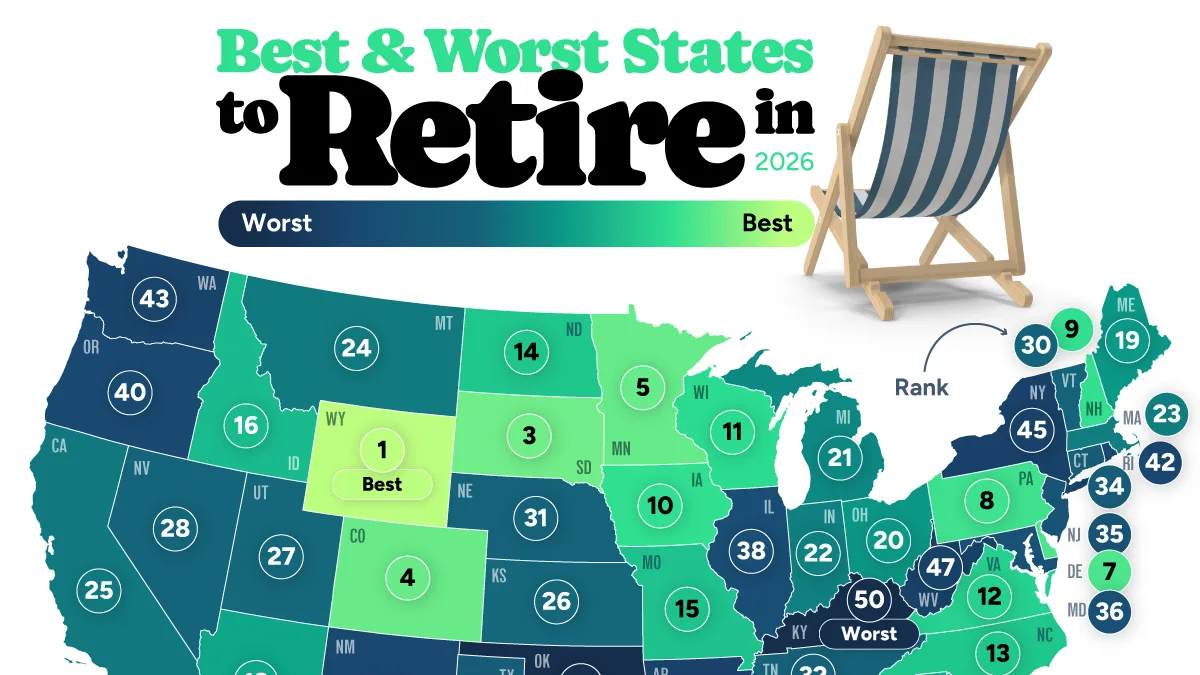
Florida has long been a popular retirement destination, but it isn’t America’s top-ranked state for retirement in 2026. Wyoming takes the top spot by the narrowest of margins, thanks largely to its affordability.
This graphic ranks all 50 U.S. states for retirement in 2026, using data from WalletHub.
The study evaluates 46 indicators across affordability, quality of life, and health care, including taxes, living costs, medical services, and recreational opportunities.
Why Cheaper States Aren’t Always Best for Retirement
The rankings reveal how states balance affordability, quality of life, and health care, with some surprising trade-offs.
| Rank | State | Score | Affordability | Quality of Life | Health Care |
|---|---|---|---|---|---|
| 1 | Wyoming | 61.56 | 1 | 6 | 33 |
| 2 | Florida | 61.55 | 2 | 1 | 27 |
| 3 | South Dakota | 58.69 | 15 | 25 | 4 |
| 4 | Colorado | 58.37 | 19 | 19 | 3 |
| 5 | Minnesota | 58.29 | 33 | 7 | 1 |
| 6 | Alaska | 57.90 | 13 | 34 | 5 |
| 7 | Delaware | 57.35 | 3 | 36 | 15 |
| 8 | Pennsylvania | 56.85 | 26 | 5 | 13 |
| 9 | New Hampshire | 56.40 | 23 | 8 | 20 |
| 10 | Iowa | 56.26 | 17 | 11 | 28 |
| 11 | Wisconsin | 56.05 | 24 | 9 | 18 |
| 12 | Virginia | 55.48 | 20 | 15 | 25 |
| 13 | North Carolina | 54.91 | 7 | 26 | 37 |
| 14 | North Dakota | 54.90 | 28 | 33 | 7 |
| 15 | Missouri | 54.73 | 10 | 29 | 32 |
| 16 | Idaho | 54.32 | 21 | 24 | 26 |
| 17 | South Carolina | 53.67 | 6 | 37 | 34 |
| 18 | Arizona | 53.24 | 27 | 32 | 16 |
| 19 | Maine | 52.50 | 37 | 4 | 14 |
| 20 | Ohio | 52.40 | 22 | 13 | 38 |
| 21 | Michigan | 51.59 | 32 | 16 | 29 |
| 22 | Indiana | 51.21 | 14 | 35 | 41 |
| 23 | Massachusetts | 50.94 | 48 | 2 | 2 |
| 24 | Montana | 50.73 | 36 | 10 | 23 |
| 25 | California | 50.70 | 39 | 22 | 8 |
| 26 | Kansas | 49.73 | 29 | 31 | 35 |
| 27 | Utah | 49.72 | 35 | 18 | 31 |
| 28 | Nevada | 49.54 | 5 | 45 | 42 |
| 29 | Georgia | 49.52 | 16 | 40 | 40 |
| 30 | Vermont | 49.23 | 47 | 3 | 10 |
| 31 | Nebraska | 49.10 | 38 | 28 | 19 |
| 32 | Tennessee | 49.02 | 4 | 47 | 44 |
| 33 | Texas | 48.54 | 25 | 38 | 39 |
| 34 | Connecticut | 48.5 | 44 | 23 | 6 |
| 35 | New Jersey | 47.33 | 45 | 30 | 9 |
| 36 | Maryland | 47.05 | 41 | 20 | 22 |
| 37 | Alabama | 46.85 | 8 | 43 | 48 |
| 38 | Illinois | 46.78 | 42 | 14 | 30 |
| 39 | Louisiana | 46.65 | 12 | 46 | 46 |
| 40 | Oregon | 46.24 | 43 | 27 | 24 |
| 41 | New Mexico | 46.18 | 30 | 44 | 36 |
| 42 | Rhode Island | 45.98 | 40 | 39 | 21 |
| 43 | Washington | 45.63 | 46 | 17 | 17 |
| 44 | Arkansas | 45.34 | 11 | 50 | 45 |
| 45 | New York | 45.34 | 50 | 12 | 12 |
| 46 | Hawaii | 45.27 | 49 | 21 | 11 |
| 47 | West Virginia | 45.24 | 18 | 41 | 50 |
| 48 | Mississippi | 44.60 | 9 | 49 | 49 |
| 49 | Oklahoma | 42.59 | 31 | 48 | 43 |
| 50 | Kentucky | 41.83 | 34 | 42 | 47 |
Wyoming finishes just ahead of Florida for first place, with a margin of only 0.01 points. The two offer different advantages: Wyoming ranks first for affordability, while Florida leads for quality of life. Neither, however, makes the top 25 for health care.
The trade-offs are even greater elsewhere. Tennessee and Nevada rank fourth and fifth for affordability, but finish 32nd and 28th overall, partly due to weaker health care rankings. Minnesota presents the opposite picture, ranking fifth overall with the nation’s top-rated health care, despite placing 33rd for affordability.
For retirees, these results highlight how priorities such as monthly expenses, access to doctors, and lifestyle can shape the best place to settle.
How Location Changes the Cost of Retirement
A comfortable retirement comes with a very different price tag depending on where you live. Retirees in Hawaii need an estimated $2.2 million in savings, compared with about $903,000 in top-ranked Wyoming and $826,000 in Tennessee, assuming Social Security income and a 4% annual withdrawal rate.
These estimates illustrate the enormous impact location can have on retirement savings. However, individual needs can vary significantly depending on housing, health, and lifestyle, making the lowest savings requirement just one factor in choosing where to retire.
The Costs That Matter Later in Retirement
A budget that works at 65 may look different at 85, particularly when everyday activities begin to require paid assistance.
For instance, annual assisted living costs range from $52,425 in Mississippi to $145,155 in Hawaii, a difference of nearly $93,000. Meanwhile, South Dakota ranks third overall for retirement, yet has the nation’s highest annual cost of in-home services, roughly twice that of Louisiana.
These long-term expenses can change the financial equation considerably. A state that looks affordable at the start of retirement may become more expensive as health and care needs increase, making it important to consider costs across several decades rather than just the first few years.
Learn More on the Voronoi App
To learn more about this topic, check out this graphic on the annual cost of retiring in every U.S. state.