Inside the World’s Most Valuable Banks in 2026
Key Takeaways
- JPMorgan Chase’s $910.4 billion market capitalization exceeds that of the next two largest banks combined.
- China and the U.S. are home to eight of the world’s 10 most valuable banks.
- Four of the world’s six most valuable banks are Chinese, led by China Construction Bank.
The U.S. and China dominate the world’s most valuable banks, but one American institution stands far above the rest.
This visualization ranks the world’s 25 most valuable publicly traded banks and bank holding companies using CompaniesMarketCap figures as of November 2026.
Market capitalization measures the value of a company’s outstanding shares, reflecting investors’ assessment of its earnings prospects and risks.
Beijing-NYC Dominance
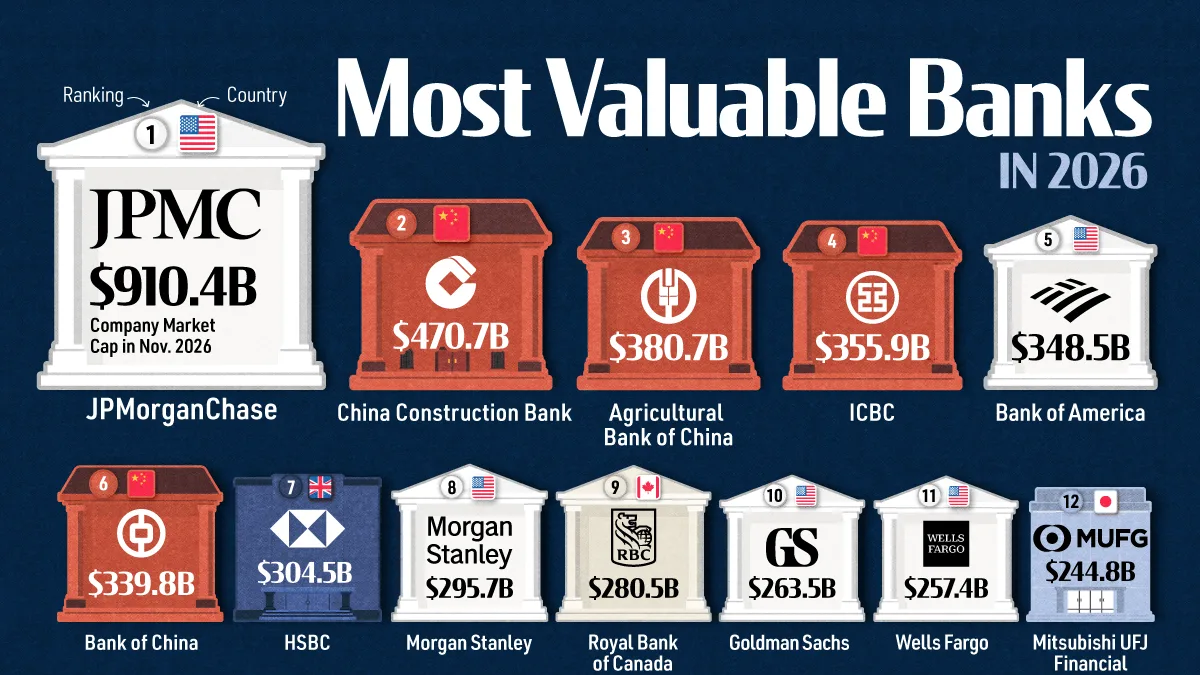
JPMorgan Chase leads with a valuation of $910.4 billion, nearly double the market capitalization of runner-up China Construction Bank ($470.7 billion).
China has greater representation near the top, however, with four banks in the top six: China Construction Bank, Agricultural Bank of China, ICBC, and Bank of China.
The table below ranks the world’s most valuable banks as of November 2026.
| Rank | Company | 2026 Market Cap (billions $) |
|---|---|---|
| 1 |  JPMorgan Chase |
910.4 |
| 2 |  China Construction Bank |
470.7 |
| 3 | Agricultural Bank of China |
380.7 |
| 4 | ICBC |
355.9 |
| 5 | Bank of America |
348.5 |
| 6 | Bank of China |
339.8 |
| 7 |  HSBC |
304.5 |
| 8 | Morgan Stanley |
295.7 |
| 9 |  Royal Bank of Canada |
280.5 |
| 10 | Goldman Sachs |
263.5 |
| 11 | Wells Fargo |
257.4 |
| 12 |  Mitsubishi UFJ Financial |
244.8 |
| 13 | Citigroup |
205.3 |
| 14 | Toronto Dominion Bank |
202.2 |
| 15 |  Commonwealth Bank |
200.0 |
| 16 |  Santander |
174.7 |
| 17 | CM Bank |
173.6 |
| 18 | Charles Schwab |
158.3 |
| 19 |  DBS Group |
158.0 |
| 20 | Sumitomo Mitsui |
152.9 |
| 21 |  UBS |
146.8 |
| 22 | BBVA |
141.8 |
| 23 |  UniCredit |
141.8 |
| 24 |  HDFC Bank |
132.3 |
| 25 | ICICI Bank |
123.5 |
Outside the U.S. and China, only two banks make the global top 10: the United Kingdom’s HSBC ($304.5 billion) and Royal Bank of Canada ($280.5 billion).
HSBC leads in Europe, followed by Spain’s Santander ($174.7 billion) and Switzerland’s UBS ($146.8 billion). Notably, no French or German bank makes the world’s top 25 despite the substantial assets held by several of their largest lenders.
Meanwhile, outside China, Asia’s most valuable bank is Mitsubishi UFJ Financial Group ($244.8 billion), the largest of Japan’s three so-called “megabanks.”
Why JPMorgan Is Worth So Much More
JPMorgan’s commanding valuation is supported by its substantial earnings. The Manhattan-headquartered bank generated $57 billion in net income in 2025, with a 17% return on equity, according to its annual report.
Unlike banks that depend heavily on traditional lending, JPMorgan generates profits across consumer banking, investment banking, trading, and wealth management. In 2025, its commercial and investment banking division earned $27.8 billion, while consumer and community banking contributed another $18.2 billion. Asset and wealth management added $6.5 billion.
Its reach is equally impressive. The bank served 86.6 million consumer customers and 7.4 million small-business customers at year-end 2025, supported by more than 5,000 branches and approximately 75 million active digital customers.
Together, these businesses provide multiple sources of earnings, helping explain why investors value JPMorgan so far above its global competitors.
Why the Biggest Banks Aren’t Always the Most Valuable
China’s major lenders demonstrate that balance-sheet size and stock market value can produce different leaders. While JPMorgan is the world’s most valuable bank, it holds fewer assets than China’s Big Four banks: ICBC, Agricultural Bank of China, China Construction Bank, and Bank of China. Their enormous lending businesses place them at the center of China’s financial system.
Wealth management offers another route to scale. Morgan Stanley ($295.7 billion) generated over $30 billion in wealth management revenue in 2025, nearly half of its total revenue. Managing client investments creates a substantial fee-based business alongside investment banking and trading.
HSBC’s results, meanwhile, highlight the value of an international network. The London-headquartered bank’s 2025 performance benefited from wealth management businesses in Hong Kong and other international markets, alongside wholesale transaction banking. Serving customers’ savings, investments, and cross-border business needs gives banking groups opportunities beyond conventional loans and deposits.
Learn More on the Voronoi App
To explore how the world’s largest bank is responding to shifts in the U.S. banking market, check out Banks are closing all over America, but JPMorgan still sees an opportunity on Voronoi.