Which Countries Have the Most Government Debt Per Person?
Key Takeaways
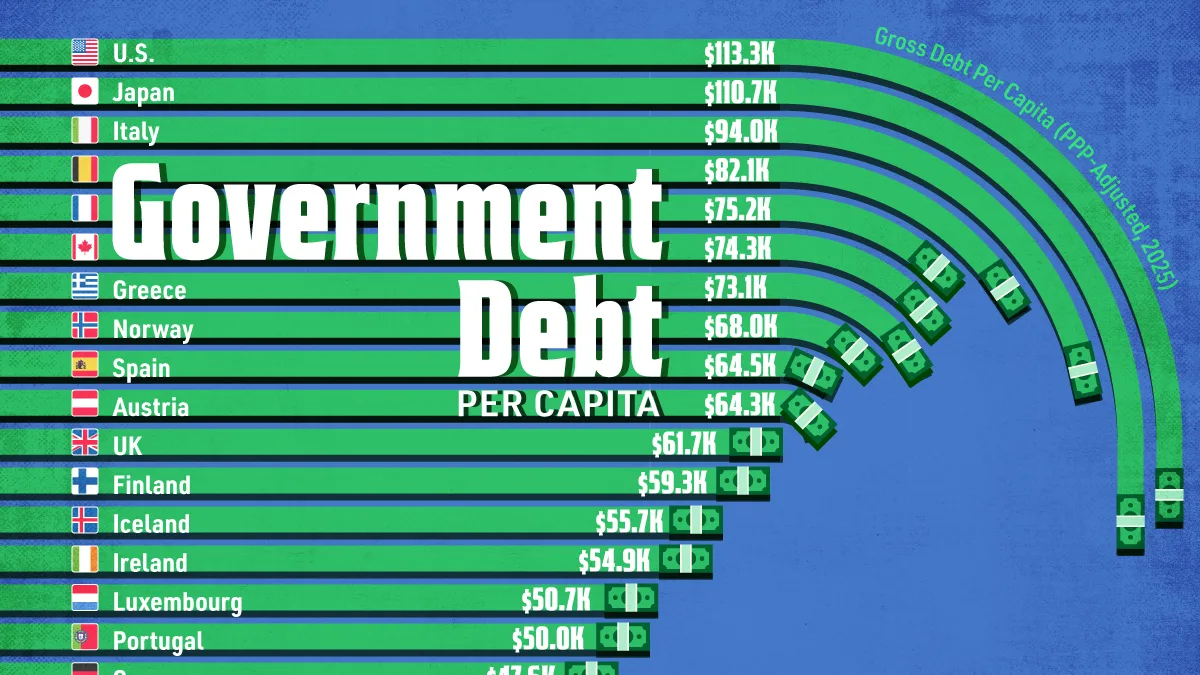
- The U.S. has the highest government debt per person in the dataset at $113,348, narrowly exceeding Japan at $110,667.
- The U.S. and Japan are the only countries in the dataset with government debt exceeding $100,000 per person.
- Italy ranks third at $94,002 per person, followed by Belgium and France at $82,089 and $75,208, respectively.
A six-figure number is usually associated with a mortgage, salary, or retirement account. In two major economies, it also describes government debt per person.
Looking at debt on a per-capita basis puts enormous national balance sheets into more tangible terms. These figures aren’t personal bills, and they don’t indicate by themselves whether a country’s debt is sustainable.
Using data from the OECD, this graphic compares government gross debt per capita across countries. Figures are for 2025, or the latest available year, and are expressed in U.S. dollars adjusted for differences in purchasing power.
How Much Government Debt Is There Per Person?
The differences are substantial even among similarly wealthy economies. Here’s how government gross debt per capita compares across the countries in the dataset:
| Rank | Country | Government gross debt per capita ($, PPP) |
|---|---|---|
| 1 |  U.S. U.S. |
113,348 |
| 2 |  Japan Japan |
110,667 |
| 3 |  Italy Italy |
94,002 |
| 4 |  Belgium Belgium |
82,089 |
| 5 |  France France |
75,208 |
| 6 |  Canada Canada |
74,260 |
| 7 |  Greece Greece |
73,078 |
| 8 |  Norway Norway |
68,009 |
| 9 |  Spain Spain |
64,457 |
| 10 |  Austria Austria |
64,298 |
| 11 |  UK UK |
61,712 |
| 12 |  Finland Finland |
59,294 |
| 13 |  Iceland Iceland |
55,663 |
| 14 |  Ireland Ireland |
54,878 |
| 15 |  Luxembourg Luxembourg |
50,673 |
| 16 |  Portugal Portugal |
50,037 |
| 17 |  Germany Germany |
47,619 |
| 18 |  Australia Australia |
46,042 |
| 19 |  Switzerland Switzerland |
42,686 |
| 20 |  Israel Israel |
42,219 |
| 21 |  Netherlands Netherlands |
42,114 |
| 22 |  Hungary Hungary |
40,668 |
| 23 |  Slovenia Slovenia |
40,538 |
| 24 |  Poland Poland |
39,067 |
| 25 |  Croatia Croatia |
38,374 |
| 26 |  Sweden Sweden |
36,078 |
| 27 |  Romania Romania |
35,920 |
| 28 |  New Zealand New Zealand |
35,217 |
| 29 |  Slovakia Slovakia |
33,608 |
| 30 |  Czechia Czechia |
30,448 |
| 31 |  South Korea South Korea |
29,590 |
| 32 |  Denmark Denmark |
29,078 |
| 33 |  Latvia Latvia |
26,603 |
| 34 |  Lithuania Lithuania |
23,323 |
| 35 |  Estonia Estonia |
17,707 |
| 36 |  Chile Chile |
17,705 |
| 37 |  Mexico Mexico |
16,187 |
| 38 |  Bulgaria Bulgaria |
13,684 |
| 39 |  Türkiye Türkiye |
11,812 |
Some of the sharpest contrasts appear between major European economies. Italy’s $94,002 in government debt per person is nearly double Germany’s $47,619, while Belgium’s $82,089 is almost twice the Netherlands’ $42,114.
Across the full dataset, the gap is even wider: U.S. government debt per person is nearly 10 times Türkiye’s $11,812.
Importantly, higher debt per person does not necessarily mean a country is struggling to repay it. Debt sustainability also depends on factors such as the size of the economy, borrowing costs, tax revenues, and investor demand.
Government Debt Is Still Climbing
The large per-person figures aren’t static. Across OECD countries, outstanding government bond debt reached a record $61 trillion in 2025, up from $55 trillion just one year earlier.
That $6 trillion increase alone is larger than the annual economic output of every country except the U.S. and China. Put another way, OECD governments added roughly the equivalent of Germany’s economy to their bond debt in a single year.
Still, debt per person is a measure of scale, not a verdict on fiscal health. Countries with similar debt loads can face very different borrowing costs and repayment risks depending on economic growth, government revenues, interest rates, and investor demand.
Learn More on the Voronoi App
To learn more about this topic, check out this graphic on the world’s most indebted households.