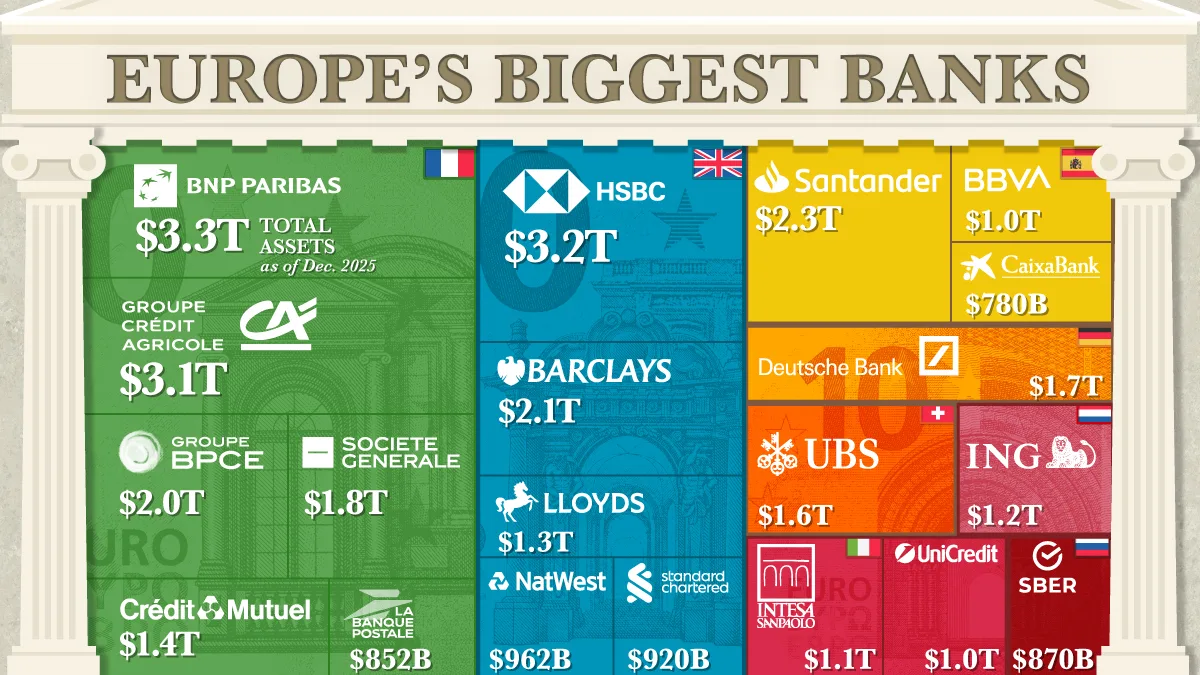
Ranked: Europe’s Biggest Banks by Assets
See visuals like this from many other data creators on our Voronoi app. Download it for free on iOS or Android and discover incredible data-driven charts from a variety of trusted sources.
Key Takeaways
- BNP Paribas is Europe’s largest bank, with $3.3 trillion in assets as of December 2025.
- Five of Europe’s 10 biggest banks are headquartered in France, more than any other country.
- Despite Germany’s status as Europe’s largest economy, Deutsche Bank ranks only eighth by assets.
The most famous banks in the world may be American, but some of the oldest are to be found in Europe. And as it turns out, France may well be the banking capital of the continent.
Using the latest data from S&P Global, this graphic ranks the 20 largest European banks by total assets as of December 2025.
France Is Home to Europe’s Biggest Banks
London and Zurich may be among Europe’s best-known financial centers, but France is home to half of the continent’s 10 largest banks by assets.
The table below ranks the 20 largest European banks by total assets in December 2025.
| Current Rank | Company | Total Assets ($B) |
|---|---|---|
| 1 |  BNP Paribas BNP Paribas |
3,279 |
| 2 |  HSBC HSBC |
3,212 |
| 3 | Crédit Agricole Group |
3,149 |
| 4 |  Banco Santander Banco Santander |
2,252 |
| 5 | Barclays |
2,078 |
| 6 | Groupe BPCE |
1,987 |
| 7 | Société Générale |
1,813 |
| 8 |  Deutsche Bank Deutsche Bank |
1,685 |
| 9 |  UBS Group UBS Group |
1,617 |
| 10 | Crédit Mutuel Group |
1,442 |
| 11 | Lloyds Banking Group |
1,271 |
| 12 |  ING Groep ING Groep |
1,238 |
| 13 |  Intesa Sanpaolo Intesa Sanpaolo |
1,127 |
| 14 | UniCredit |
1,022 |
| 15 | BBVA |
1,006 |
| 16 | NatWest Group |
962 |
| 17 | Standard Chartered |
920 |
| 18 |  Sberbank of Russia Sberbank of Russia |
870 |
| 19 | La Banque Postale |
852 |
| 20 | CaixaBank |
780 |
BNP Paribas was formed through a 2000 merger between two of France’s largest banks, Banque Nationale de Paris (BNP) and Paribas. BlackRock and the Belgian government both hold minority stakes in the bank, which maintained a U.S. retail banking presence until 2019.
France is also home to Crédit Agricole ($3.1 trillion), BPCE ($2 trillion), Société Générale ($1.8 trillion), and Crédit Mutuel ($1.4 trillion).
The Traditional Banking Hubs
Europe’s second- and fifth-largest banks are headquartered in the United Kingdom. HSBC has $3.2 trillion in assets, while Barclays has $2.1 trillion.
London’s historical position as a European financial center faced new challenges following the UK’s 2020 withdrawal from the European Union. Both banks spent hundreds of millions of pounds responding to the UK’s departure from the European common market.
Other major British banks include Lloyds ($1.3 trillion), NatWest Group ($962 billion), and Standard Chartered ($920 billion).
Germany’s Decentralized Banking Sector
Germany, Europe’s largest economy, has only one bank among the continent’s 20 largest by total assets. Deutsche Bank ranks eighth with $1.7 trillion and is dual-listed on the Frankfurt and New York stock exchanges.
Germany’s decentralized banking system is deliberate. Rather than relying on a few financial giants, the country has a three-pillar system consisting of private commercial banks, regional public savings banks, and cooperative credit unions.
By comparison, Spain has three banks in Europe’s top 20: Santander ($2.3 trillion), BBVA ($1 trillion), and CaixaBank ($780 billion). All three have extensive retail operations, with Santander and BBVA maintaining particularly large international footprints.
Learn More on the Voronoi App 
Learn how these banks stack up against the rest of the world on Voronoi, the new app from Visual Capitalist.