How College Tuition Compares Around the World
Key Takeaways
- England’s three-year bachelor’s degree costs about $39,400 in tuition, roughly the same as four years at a U.S. public university.
- Five education systems charge domestic students no tuition, though students can still accumulate substantial debt from living costs.
A bachelor’s degree can mean a five-figure tuition bill every year, or no tuition bill at all, depending on where a student enrolls.
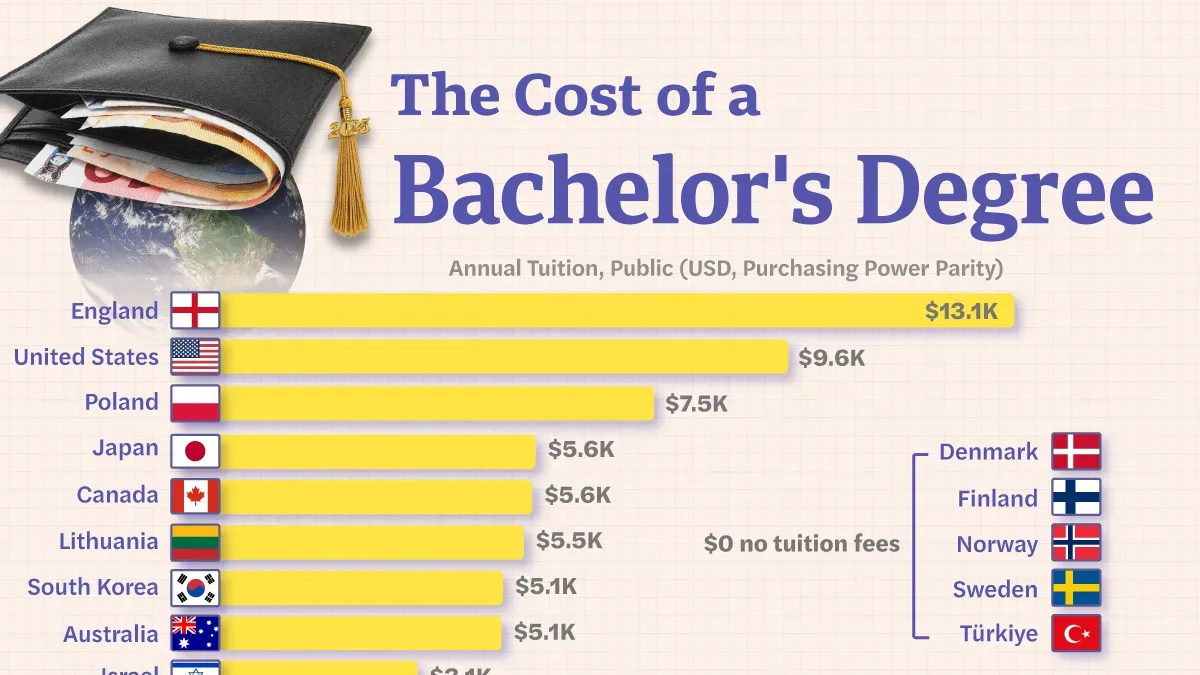
This graphic ranks annual tuition for domestic bachelor’s students across 28 education systems, using data from the OECD’s Education at a Glance 2025.
Figures are in U.S. dollars adjusted for purchasing power parity, reflect gross fees before grants and scholarships, and exclude living costs.
For England, the OECD uses government-dependent private institutions, which receive most of their funding from the state and are the closest equivalent to public universities there. Germany’s figure includes master’s and doctoral fees along with costs for foreign students.
Why Is Tuition So High in England and the U.S.?
England’s annual tuition of $13,135 for a bachelor’s degree is more than four times the OECD average of $3,186, and about $3,540 above the U.S. figure of $9,596.
Despite the higher annual cost, England’s three-year bachelor’s degree totals about $39,400 in tuition, only slightly above the roughly $38,400 cost of four years at a U.S. public university.
The table below shows annual tuition for domestic bachelor’s students in all 28 systems, in U.S. dollars adjusted for purchasing power parity:
| Rank | Country | Annual tuition for domestic bachelor’s students, public institutions ($, PPP) |
|---|---|---|
| 1 |  England (UK) England (UK) |
13,135 |
| 2 |  United States United States |
9,596 |
| 3 |  Poland Poland |
7,497 |
| 4 |  Japan Japan |
5,645 |
| 5 |  Canada Canada |
5,590 |
| 6 |  Lithuania Lithuania |
5,458 |
| 7 |  South Korea South Korea |
5,132 |
| 8 |  Australia Australia |
5,108 |
| 9 |  Latvia Latvia |
4,824 |
| 10 |  New Zealand New Zealand |
4,748 |
| 11 |  Israel Israel |
3,088 |
| 12 |  Netherlands Netherlands |
3,041 |
| 13 |  Italy Italy |
2,570 |
| 14 |  Romania Romania |
2,163 |
| 15 |  Spain Spain |
1,708 |
| 16 |  Croatia Croatia |
1,660 |
| 17 |  Switzerland Switzerland |
1,427 |
| 18 |  Flemish Comm. (Belgium) Flemish Comm. (Belgium) |
1,410 |
| 19 |  Austria Austria |
1,043 |
| 20 |  Luxembourg Luxembourg |
494 |
| 21 | French Comm. (Belgium) |
433 |
| 22 |  France France |
252 |
| 23 |  Germany Germany |
157 |
| 24 |  Denmark Denmark |
0 |
| 24 |  Finland Finland |
0 |
| 24 |  Norway Norway |
0 |
| 24 |  Sweden Sweden |
0 |
| 24 |  Türkiye Türkiye |
0 |
England’s position at the top partly reflects its government-set tuition fee cap. After being frozen at £9,250 for eight years, the cap increased in 2025.
For the U.S., the OECD notes that nearly 82% of students receive grants, scholarships, or loans, and that the financial return on a U.S. degree is higher than in any other OECD country.
High-tuition systems often provide substantial financial support. In England, the U.S., Australia, and New Zealand, the OECD finds that more than half of students receive loans or grants. Canada and Poland are exceptions, charging more than $5,500 while supporting fewer than 40% of students.
Continental Europe largely fills the middle of the ranking, with fees under $2,000 and support targeted toward lower-income students. Belgium shows how much tuition can vary within one country, with its Flemish Community charging more than three times as much as its French Community.
Free Tuition Does Not Mean a Debt-Free Degree
At the other end of the ranking, Denmark, Finland, Norway, Sweden, and Türkiye report no tuition fees for domestic students. Germany charges just $157 a year and France $252, but low tuition does not necessarily mean students graduate without debt.
The OECD describes the Nordic model as a deliberate choice to fund universities through progressive taxation, with graduates contributing through higher income taxes later in life rather than through tuition fees.
Even without tuition costs, students in these countries often need financial assistance. The OECD found that more than half of students in Norway, Sweden, and Finland take out loans, primarily to cover living expenses.
The average Norwegian graduate owes more than $46,000, roughly two-thirds of the debt carried by a graduate in England, despite paying no tuition at all.
Learn More on the Voronoi App
If you enjoyed today’s post, check out Student Debt in America by State on Voronoi.