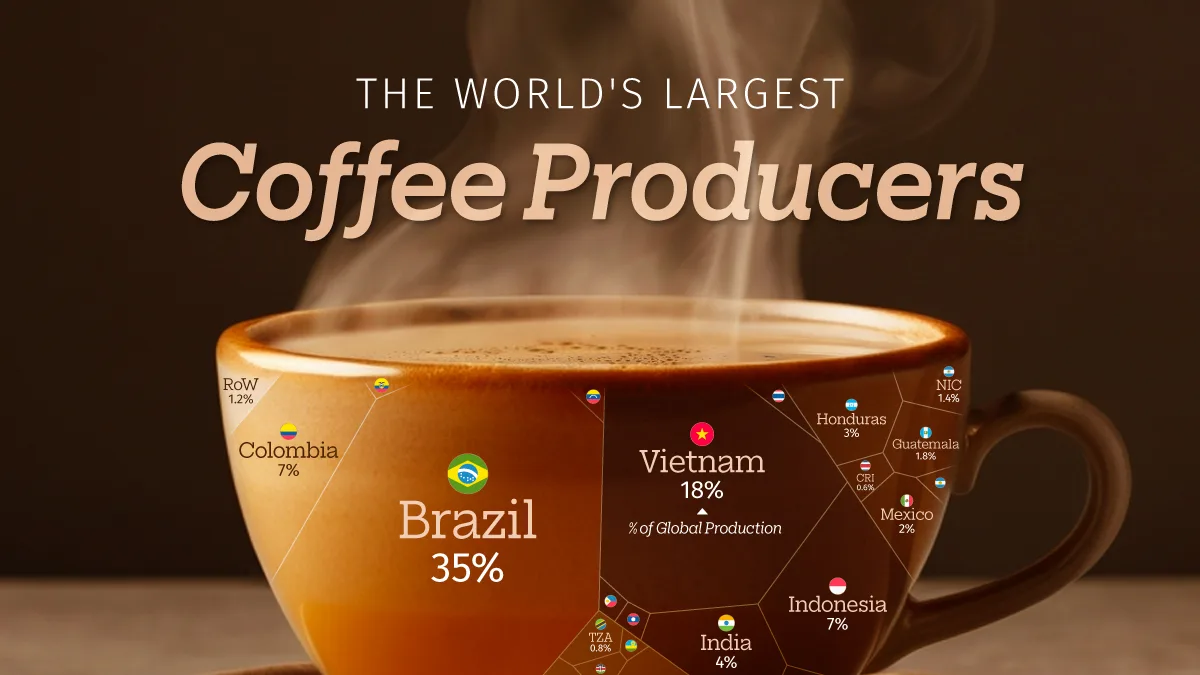
The World’s Largest Coffee Producers
Key Takeaways
- Brazil produces 35% of the world’s coffee, more than Vietnam, Colombia, and Indonesia combined.
- Vietnam ranks second with 18% of global production, driven largely by robusta coffee.
- The top 25 coffee-producing countries account for 99% of global output.
Coffee is integral to many people’s morning routines and is one of the world’s most widely traded agricultural commodities. Production is concentrated in a relatively small number of countries, most of which lie within the “coffee belt” between the Tropics of Cancer and Capricorn.
This visualization ranks the world’s largest coffee producers in the 2025/2026 marketing year by their share of total global green coffee production. Output is reported in 60-kilogram bags of unroasted coffee beans, using data from the USDA Foreign Agricultural Service.
Together, the five largest producers account for nearly three-quarters of global coffee production.
Brazil Produces More Coffee Than Next Three Countries Combined
In the 2025/2026 marketing year, Brazil produced 63 million 60-kilogram bags of green coffee beans, equivalent to 35% of global production.
Most of Brazil’s output is arabica coffee, a variety typically grown at higher elevations and widely used in specialty and premium coffee markets.
| Rank | Country | Total Production in Millions of 60 Kilogram Bags |
Share of Global Production (%) |
|---|---|---|---|
| 1 |  Brazil Brazil |
63.0 | 35 |
| 2 |  Vietnam Vietnam |
31.7 | 18 |
| 3 |  Colombia Colombia |
12.5 | 7 |
| 4 |  Indonesia Indonesia |
12.4 | 7 |
| 5 |  Ethiopia Ethiopia |
11.6 | 6 |
| 6 |  Uganda Uganda |
7.10 | 4 |
| 7 |  India India |
6.43 | 4 |
| 8 |  Honduras Honduras |
5.53 | 3 |
| 9 |  Peru Peru |
4.76 | 3 |
| 10 |  Mexico Mexico |
4.08 | 2 |
| 11 |  Guatemala Guatemala |
3.16 | 1.8 |
| 12 |  Nicaragua Nicaragua |
2.56 | 1.4 |
| 13 |  China China |
1.90 | 1.1 |
| 14 |  Malaysia Malaysia |
1.50 | 0.8 |
| 15 |  Tanzania Tanzania |
1.45 | 0.8 |
| 16 |  Ivory Coast Ivory Coast |
1.30 | 0.7 |
| 17 |  Costa Rica Costa Rica |
1.16 | 0.6 |
| 18 |  Thailand Thailand |
0.90 | 0.5 |
| 19 |  Kenya Kenya |
0.85 | 0.5 |
| 20 |  Papua New Guinea Papua New Guinea |
0.80 | 0.4 |
| 21 |  El Salvador El Salvador |
0.59 | 0.3 |
| 22 |  Venezuela Venezuela |
0.50 | 0.3 |
| 23 |  Laos Laos |
0.48 | 0.3 |
| 24 |  Philippines Philippines |
0.45 | 0.3 |
| 25 |  Ecuador Ecuador |
0.35 | 0.2 |
| 25 |  Rwanda Rwanda |
0.35 | 0.2 |
| — |  World Total World Total |
178.83 | 100 |
Brazil’s coffee production exceeds the combined output of Vietnam, Colombia, and Indonesia, which together produce 56.6 million bags.
Vietnam Has Emerged as the Second-Largest Producer
Known for specialty drinks such as egg coffee and salt coffee, Vietnam ranks second, producing 31.7 million 60-kilogram bags, or 18% of global coffee production. The country produces roughly half as much coffee as Brazil but nearly three times as much as Colombia.
Although Vietnam has produced coffee since the mid-19th century, its rise to global prominence is more recent. It became the world’s second-largest coffee producer in 1999 after surpassing Colombia. This growth has been driven by the rapid expansion of robusta cultivation, a hardier variety with a higher caffeine content that is commonly used in instant coffee, espresso blends, and lower-cost commercial products.
Vietnam produced 19.2 million more bags than third-ranked Colombia, whose 12.5 million bags represented 7% of global production. Indonesia followed closely with 12.4 million bags, while Ethiopia, the birthplace of arabica coffee, rounded out the top five with 11.6 million bags, or 6% of production.
Regional Coffee Production Has Shifted Toward Asia
South America remains central to global coffee supply, led by Brazil, Colombia, and Peru. However, its share has declined since the 1960s as production in Asia has expanded.
Asia’s share of global coffee output has risen from less than 5% in the 1960s to 32% today, driven largely by the expansion of robusta cultivation in Vietnam. Indonesia, India, China, Malaysia, Thailand, Laos, and the Philippines also contribute to the region’s production.
Despite being coffee’s birthplace, Africa is now the third-largest coffee-producing region, led by Ethiopia, Uganda, Tanzania, Ivory Coast, Kenya, and Rwanda.
Looking ahead, climate change is making coffee production more challenging by affecting crop quality, reducing suitable growing areas, and increasing pest pressures. Because global supply is concentrated among relatively few countries, weather-related disruptions could increase production volatility and place further pressure on already elevated coffee prices.
Learn More on the Voronoi App
To learn more about this topic, check out this graphic on the countries that drink the most coffee each day.