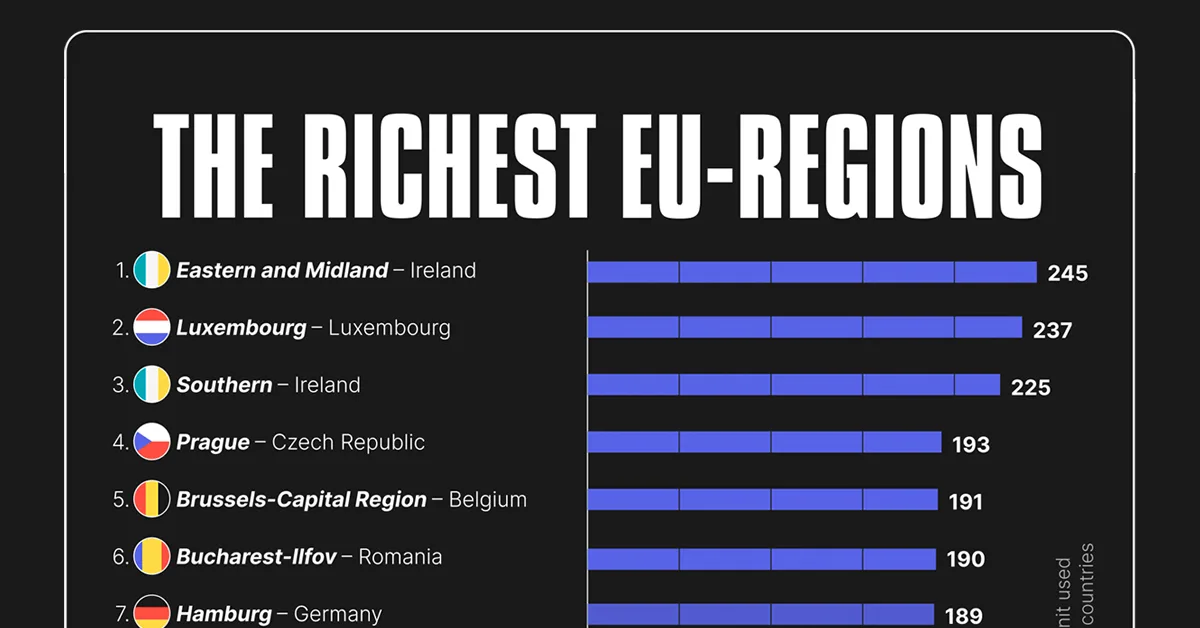
Ranked: The EU’s Richest Regions
This was originally posted on our Voronoi app. Download the app for free on iOS or Android and discover incredible data-driven charts from a variety of trusted sources.
Key Takeaways
- Ireland’s Eastern and Midland region ranks first, with GDP per capita more than double the EU average.
- Luxembourg and Southern Ireland also rank far above the norm, driven in part by multinational activity.
- Capital hubs like Prague and Bucharest-Ilfov rank among the EU’s richest regions, highlighting how wealth clusters in major cities.
Ireland and Luxembourg dominate the top of this ranking, but some of the most surprising entries come from Central and Eastern Europe, where capital regions rival Western Europe’s wealthiest hubs.
Using data from Eurostat and visualized by DataPulse, this graphic ranks EU regions by GDP per capita in purchasing power standards (PPS), which adjusts for cost-of-living differences across countries.
The EU’s Top 30 Regions by GDP per Capita
The table below shows the EU’s top-performing regions by GDP per capita, measured in purchasing power standards (PPS):
| Rank | Region | Country | GDP per Capita (€) | % of EU Avg |
|---|---|---|---|---|
| 1 | Eastern and Midland |  Ireland Ireland |
107,200 | 268 |
| 2 | Luxembourg |  Luxembourg Luxembourg |
97,700 | 245 |
| 3 | Southern | Ireland |
86,500 | 217 |
| 4 | Hamburg |  Germany Germany |
78,300 | 196 |
| 5 | Prague |  Czech Republic Czech Republic |
76,600 | 192 |
| 6 | Brussels |  Belgium Belgium |
76,000 | 190 |
| 7 | Bucharest – Ilfov |  Romania Romania |
75,000 | 188 |
| 8 | Capital Region of Denmark |  Denmark Denmark |
70,100 | 175 |
| 9 | North Holland |  Netherlands Netherlands |
69,900 | 175 |
| 10 | Upper Bavaria | Germany |
67,700 | 170 |
| 11 | Budapest |  Hungary Hungary |
67,200 | 168 |
| 12 | Utrecht | Netherlands |
64,900 | 162 |
| 13 | Bolzano – South Tyrol |  Italy Italy |
64,200 | 161 |
| 14 | Île-de-France |  France France |
64,000 | 160 |
| 15 | Warsaw |  Poland Poland |
62,800 | 157 |
| 16 | Walloon Brabant | Belgium |
61,900 | 155 |
| 17 | Stuttgart (district) | Germany |
61,300 | 153 |
| 18 | Stockholm |  Sweden Sweden |
61,100 | 153 |
| 19 | Bratislava Region |  Slovakia Slovakia |
61,000 | 153 |
| 20 | Darmstadt (district) | Germany |
59,200 | 148 |
| 21 | Salzburg |  Austria Austria |
58,100 | 146 |
| 22 | North Brabant | Netherlands |
55,400 | 139 |
| 23 | Vienna | Austria |
54,600 | 137 |
| 24 | Antwerp | Belgium |
54,100 | 135 |
| 25 | Sostinės regionas |  Lithuania Lithuania |
53,000 | 133 |
| 26 | Bremen (state) Bremen | Germany |
52,700 | 132 |
| 27 | Lombardy | Italy |
52,700 | 132 |
| 28 | Zagreb |  Croatia Croatia |
52,500 | 131 |
| 29 | Lower Saxony Braunschweig | Germany |
51,500 | 129 |
| 30 | South Holland | Netherlands |
51,500 | 129 |
| — | Average |  European Union European Union |
40,000 | 100 |
The top of the ranking is dominated by two familiar outliers: Ireland and Luxembourg.
Eastern and Midland (Ireland) leads the EU by a wide margin, while Southern Ireland and Luxembourg also rank far above the regional average. Notably, several Central and Eastern European capitals rank ahead of regions in much larger Western economies.
Why Ireland and Luxembourg Stand Out
At first glance, Ireland and Luxembourg appear to be runaway leaders. But part of that strength reflects the way multinational firms book profits in these economies.
In Ireland especially, the presence of major foreign companies can push GDP per capita far above what domestic consumption or household income alone would suggest. Economists often describe this gap as GDP distortion, where globally generated profits are recorded locally.
The Power of Capital Regions
Many of Europe’s wealthiest regions are centered around capital cities or major economic hubs. Prague, Brussels, Paris (Île-de-France), and Copenhagen all rank highly due to:
- Concentration of government institutions
- High-value service industries
- Corporate headquarters and financial activity
These regions act as economic engines, attracting talent, investment, and infrastructure that boost productivity and output per person.
Eastern Europe’s Surprising Entries
Notably, Bucharest-Ilfov (Romania) and Budapest (Hungary) rank among the EU’s top regions, despite their countries having lower overall GDP per capita.
This creates a striking contrast: cities like Bucharest and Budapest rank among the EU’s richest regions, even though their countries rank much lower overall. Economic activity is concentrated in these capital hubs, where multinational firms and high-value services drive productivity well above national averages.
The broader takeaway is that national averages can hide where economic power is really concentrated. Across the EU, a relatively small group of capital cities, financial centers, and multinational hubs account for an outsized share of regional wealth.
Learn More on the Voronoi App 
For more insights on Europe’s wealth distribution, check out Europe’s Richest Countries on the Voronoi app.