Ranked: The Highest-Paying College Majors for New Graduates
Key Takeaways:
- Computer engineering graduates earn the highest early-career median wage at $90,000, compared with $40,000 for the lowest-paying major.
- Engineering accounts for eight of the 10 highest-paying majors, with computer science also near the top.
- Early-career earnings vary widely by field of study, highlighting how college major can influence starting pay.
Some college majors lead to much higher starting salaries than others.
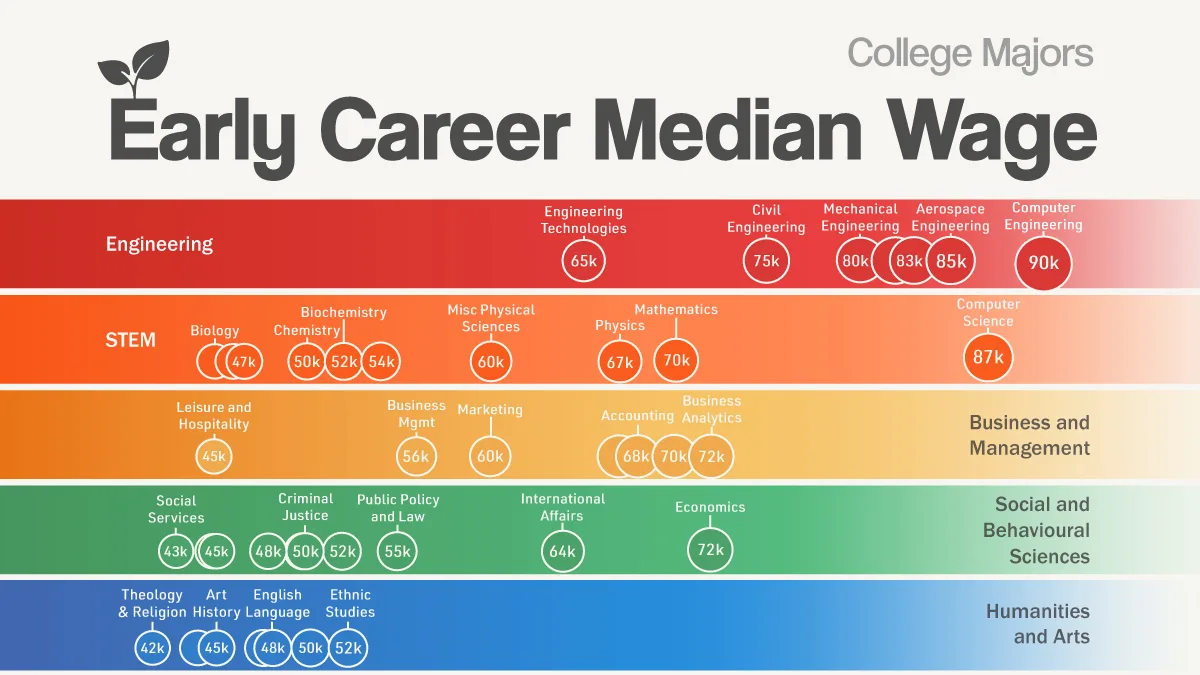
Using data from the Federal Reserve Bank of New York, this graphic compares the median annual wages earned by recent college graduates between the ages of 22-27 across 74 majors.
While salary is only one factor when choosing a degree, these rankings offer a snapshot of how different fields translate into earnings at the beginning of a career.
Which College Majors Pay the Most Upon Graduation?
The table below summarizes early-career median wages by college major:
| Major | Early Career Median Wage | Stream |
|---|---|---|
| Computer Engineering | $90,000 | Engineering |
| Computer Science | $87,000 | STEM |
| Aerospace Engineering | $85,000 | Engineering |
| Chemical Engineering | $85,000 | Engineering |
| Industrial Engineering | $83,000 | Engineering |
| Electrical Engineering | $82,000 | Engineering |
| Mechanical Engineering | $80,000 | Engineering |
| Civil Engineering | $75,000 | Engineering |
| Construction Services | $75,000 | Engineering |
| General Engineering | $75,000 | Engineering |
| Miscellaneous Engineering | $75,000 | Engineering |
| Business Analytics | $72,000 | Business and Management |
| Economics | $72,000 | Social and Behavioural Sciences |
| Finance | $70,000 | Business and Management |
| Mathematics | $70,000 | STEM |
| Nursing | $70,000 | Health and Medical |
| Accounting | $68,000 | Business and Management |
| Information Systems & Management | $67,000 | Business and Management |
| Physics | $67,000 | STEM |
| Engineering Technologies | $65,000 | Engineering |
| International Affairs | $64,000 | Social and Behavioural Sciences |
| Medical Technicians | $62,000 | Health and Medical |
| Advertising and Public Relations | $60,000 | Communications and Media |
| Architecture | $60,000 | Architecture and Design |
| General Business | $60,000 | Business and Management |
| Marketing | $60,000 | Business and Management |
| Miscellaneous Physical Sciences | $60,000 | STEM |
| Agriculture | $56,000 | Agriculture and Environmental Sciences |
| Business Management | $56,000 | Business and Management |
| Public Policy and Law | $55,000 | Social and Behavioural Sciences |
| Miscellaneous Technologies | $54,000 | STEM |
| Biochemistry | $52,000 | STEM |
| Communications | $52,000 | Communications and Media |
| Ethnic Studies | $52,000 | Humanities and Arts |
| Interdisciplinary Studies | $52,000 | Interdisciplinary |
| Philosophy | $52,000 | Humanities and Arts |
| Political Science | $52,000 | Social and Behavioural Sciences |
| Chemistry | $50,000 | STEM |
| Commercial Art & Graphic Design | $50,000 | Humanities and Arts |
| Criminal Justice | $50,000 | Social and Behavioural Sciences |
| Earth Sciences | $50,000 | STEM |
| Environmental Studies | $50,000 | Agriculture and Environmental Sciences |
| Geography | $50,000 | Social and Behavioural Sciences |
| Health Services | $50,000 | Health and Medical |
| Mass Media | $50,000 | Communications and Media |
| Nutrition Sciences | $50,000 | Health and Medical |
| Treatment Therapy | $50,000 | Health and Medical |
| Sociology | $49,900 | Social and Behavioural Sciences |
| Journalism | $49,000 | Communications and Media |
| English Language | $48,000 | Humanities and Arts |
| Family and Consumer Sciences | $48,000 | Social and Behavioural Sciences |
| Foreign Language | $48,000 | Humanities and Arts |
| Miscellaneous Education | $48,000 | Education |
| History | $47,500 | Humanities and Arts |
| Animal and Plant Sciences | $46,600 | STEM |
| Miscellaneous Biological Science | $46,000 | STEM |
| Special Education | $46,000 | Education |
| Secondary Education | $45,300 | Education |
| General Social Sciences | $45,200 | Social and Behavioural Sciences |
| Anthropology | $45,000 | Social and Behavioural Sciences |
| Art History | $45,000 | Humanities and Arts |
| Biology | $45,000 | STEM |
| Early Childhood Education | $45,000 | Education |
| Elementary Education | $45,000 | Education |
| Fine Arts | $45,000 | Humanities and Arts |
| General Education | $45,000 | Education |
| Leisure and Hospitality | $45,000 | Business and Management |
| Liberal Arts | $45,000 | Humanities and Arts |
| Psychology | $45,000 | Social and Behavioural Sciences |
| Performing Arts | $44,000 | Humanities and Arts |
| Social Services | $43,000 | Social and Behavioural Sciences |
| Theology and Religion | $41,600 | Humanities and Arts |
| Pharmacy | $40,000 | Health and Medical |
| Overall | $58,000 | — |
Computer engineering tops the list with a median early-career wage of $90,000, followed by computer science ($87,000) and aerospace and chemical engineering (both $85,000).
By comparison, pharmacy graduates earn the lowest median wage at $40,000, while theology and religion ($41,600) and social services ($43,000) also rank near the bottom.
Why Do Some Degrees Pay More Right Out of College?
The largest salary differences often reflect labor market demand, technical specialization, and the industries graduates enter. STEM and quantitative fields tend to command higher starting salaries because employers compete aggressively for specialized talent.
Meanwhile, many education, nonprofit, social service, and arts graduates enter occupations where pay grows more gradually or is influenced by public-sector budgets. These differences reflect career paths and industry economics rather than the broader value of a profession.
A graduate’s first employer and industry can also shape earnings beyond the first job, with recent research suggesting early career opportunities contribute to income differences that persist over time.
Does a College Degree Still Matter?
Despite ongoing debates about tuition costs and return on investment, most research continues to show that earning a bachelor’s degree improves both employability and lifetime earnings. According to the Association of Public and Land-grant Universities, college graduates are roughly half as likely to be unemployed as workers with only a high school diploma and earn substantially more over their careers.
While salary shouldn’t be the only consideration when choosing a major, understanding expected earnings alongside personal interests and career goals can help students make more informed decisions.
As higher education expands globally, countries are also seeing growing numbers of university graduates, reflecting the increasing importance of post-secondary education in today’s workforce.
What Explains the Salary Gap?
The top 10 majors in this dataset all report early-career median wages of at least $75,000, led primarily by engineering and technology disciplines. In contrast, every major in the bottom 10 earns $45,000 or less, with many graduates entering education, social work, religion, and the arts.
These differences reflect labor market demand and industry pay scales rather than the broader value of a profession. While major influences early earnings, experience, graduate education, and career progression continue to shape income over time.
Learn More on the Voronoi App 
Interested in more education and labor market insights? Check out Most Underemployed College Degrees on the Voronoi app, where you can discover more data-driven charts from trusted sources around the world.