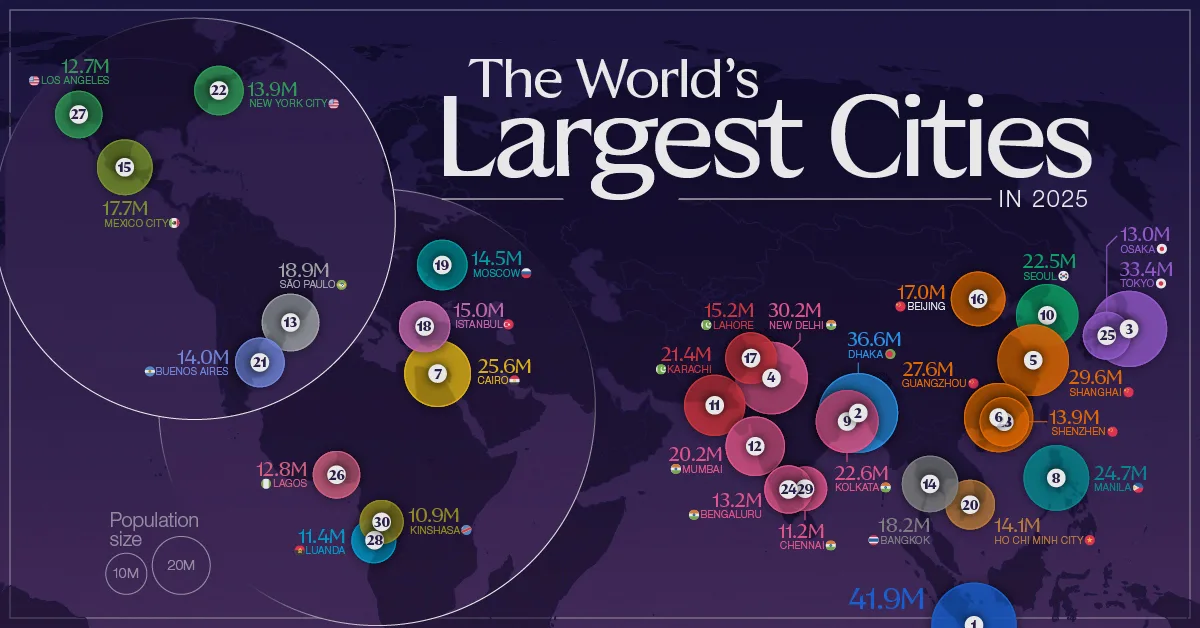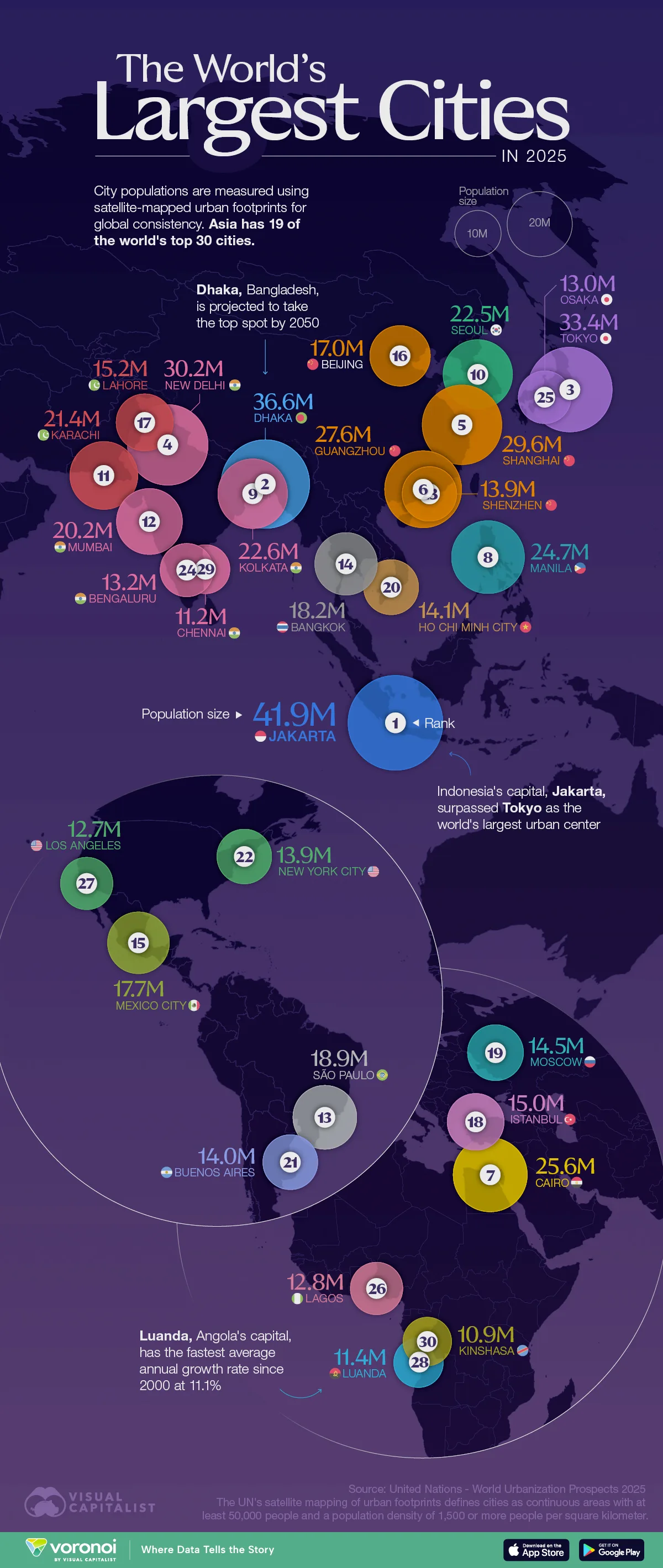
The World’s Largest Cities by Population, 2025
See visuals like this from many other data creators on our Voronoi app. Download it for free on iOS or Android and discover incredible data-driven charts from a variety of trusted sources.
Key Takeaways
- Asian megacities dominate the rankings, with Jakarta, Dhaka, and Tokyo leading the world in population.
- Rapid urban growth is increasingly concentrated in Africa and South Asia, while some mature cities are slowing or shrinking.
Population growth, migration, and economic opportunity continue to pull millions into major metropolitan areas. At the same time, aging populations and limited space are beginning to slow growth in several long-established megacities.
This visualization ranks the largest urban centers on Earth, showing where people are clustering today, and where future growth is likely to occur.
The data for this visualization comes from the UN World Urbanization Prospects 2025 report.
 Defining Cities: There are multiple ways to define city boundaries, for example using administrative boundaries or urban agglomerations. This study by the UN uses satellite mapping of urban footprints to define cities as continuous areas with at least 50,000 people and a population density of 1,500 or more people per square kilometer.
 Data & Discussion
Asia remains the epicenter of global urban population. Indonesia’s capital, Jakarta ranks as the world’s largest city in 2025 with nearly 42 million people, followed closely by Dhaka, Bangladesh, and Tokyo.
China and India alone account for a significant share of the top 30 cities, including Shanghai, Guangzhou, New Delhi, and Mumbai. These megacities benefit from large domestic populations, economic concentration, and long-standing roles as regional hubs.
| Rank | City | Country | Population (2025) |
|---|---|---|---|
| 1 | Jakarta |  Indonesia Indonesia |
41.9M |
| 2 | Dhaka |  Bangladesh Bangladesh |
36.6M |
| 3 | Tokyo |  Japan Japan |
33.4M |
| 4 | New Delhi |  India India |
30.2M |
| 5 | Shanghai |  China China |
29.6M |
| 6 | Guangzhou | China |
27.6M |
| 7 | Cairo |  Egypt Egypt |
25.6M |
| 8 | Manila |  Philippines Philippines |
24.7M |
| 9 | Kolkata | India |
22.6M |
| 10 | Seoul |  South Korea South Korea |
22.5M |
| 11 | Karachi |  Pakistan Pakistan |
21.4M |
| 12 | Mumbai | India |
20.2M |
| 13 | São Paulo |  Brazil Brazil |
18.9M |
| 14 | Bangkok |  Thailand Thailand |
18.2M |
| 15 | Mexico City |  Mexico Mexico |
17.7M |
| 16 | Beijing | China |
17.0M |
| 17 | Lahore | Pakistan |
15.2M |
| 18 | Istanbul |  Türkiye Türkiye |
15.0M |
| 19 | Moscow |  Russia Russia |
14.5M |
| 20 | Ho Chi Minh City |  Vietnam Vietnam |
14.1M |
| 21 | Buenos Aires |  Argentina Argentina |
14.0M |
| 22 | New York City |  U.S. U.S. |
13.9M |
| 23 | Shenzhen | China |
13.9M |
| 24 | Bengaluru | India |
13.2M |
| 25 | Osaka | Japan |
13.0M |
| 26 | Lagos |  Nigeria Nigeria |
12.8M |
| 27 | Los Angeles | U.S. |
12.7M |
| 28 | Luanda |  Angola Angola |
11.4M |
| 29 | Chennai | India |
11.2M |
| 30 | Kinshasa |  DRC DRC |
10.9M |
Rapid Growth in Africa and South Asia
While Asia dominates in size, the fastest growth is increasingly happening elsewhere.
Luanda, Angola’s capital, is the fastest-growing city with an annual rate of about 11% since 2000, driven by high birth rates and rural-to-urban migration. Other African cities like Lagos and Kinshasa are also climbing the rankings, reflecting the continent’s young population and accelerating urbanization.
Slowing and Shrinking Megacities
Not all large cities are growing fast. Several mature urban centers, including Osaka and Mexico City, are seeing slower growth or outright population decline.
Aging populations, lower fertility rates, and limited housing supply are key factors. In high-income countries, urban growth is increasingly shaped by productivity gains rather than population expansion, marking a shift from past decades.
Learn More on the Voronoi App 
If you enjoyed today’s post, check out The Most Populous Countries by the Year 2100 on Voronoi, the new app from Visual Capitalist.