Ranked: The World’s 50 Largest Banks by Assets
See visuals like this from many other data creators on our Voronoi app. Download it for free on iOS or Android and discover incredible data-driven charts from a variety of trusted sources.
Key Takeaways
- The world’s 50 largest banks hold $101.6 trillion in assets combined.
- Chinese banks dominate the ranking, led by the four largest banks in the world.
- JPMorgan Chase ranks fifth by assets, but remains the world’s most valuable bank by market capitalization.
Banks sit at the center of the global financial system, and the assets they hold help move credit, deposits, and liquidity through the economy.
Together, the world’s 50 largest banks hold $101.6 trillion in assets, a total approaching the world’s $111 trillion government debt load in 2025.
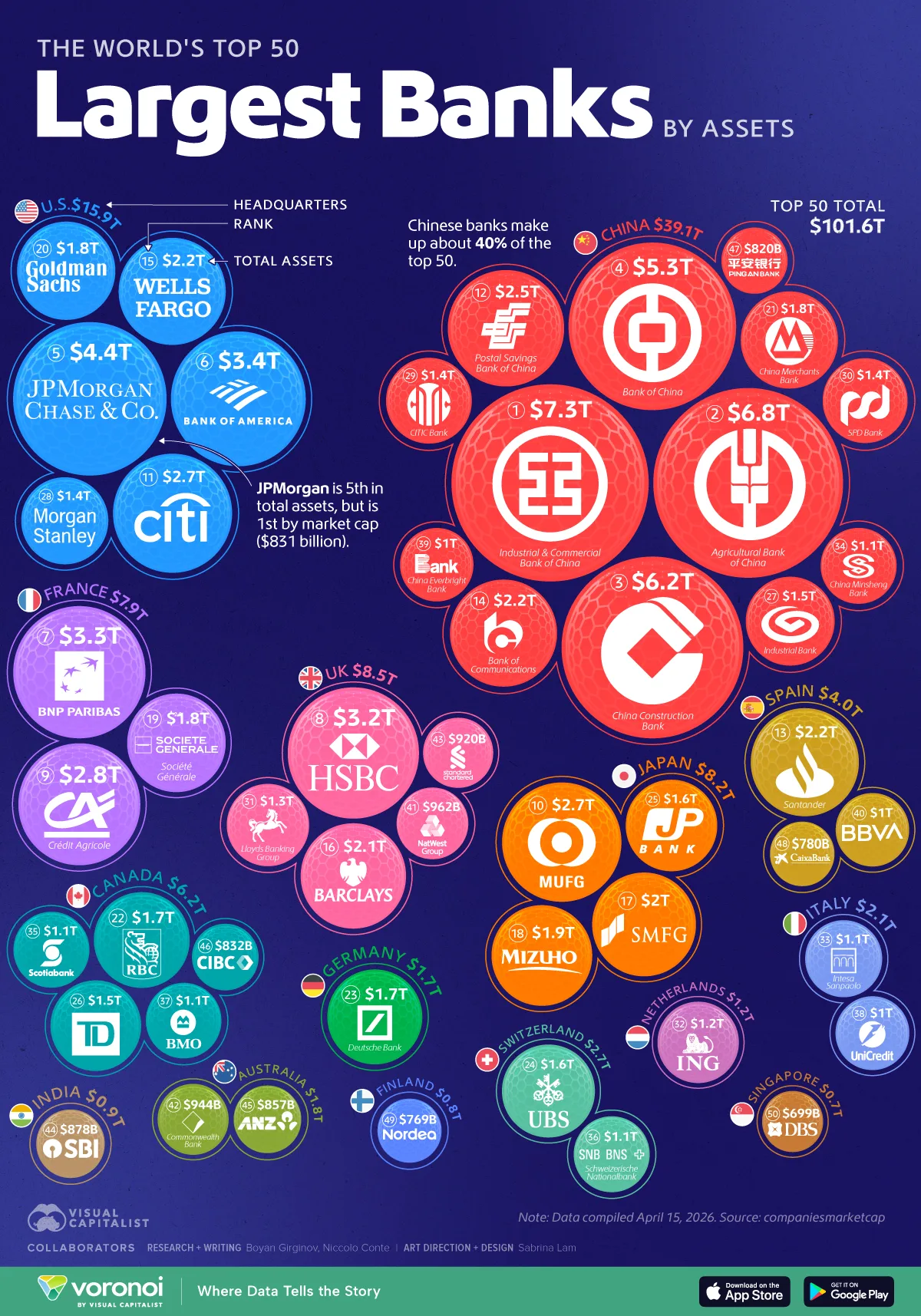
This graphic ranks the 50 largest banks in the world by total assets, using data from CompaniesMarketCap as of April 15, 2026. The figures represent each bank’s total assets for the most recent reporting period and include cash and cash equivalents, loans, investments, properties, and equipment.
Chinese and American Banks Hold the Most Assets
Chinese banks dominate the top of the ranking. The four largest banks in the world are all Chinese state-owned lenders: ICBC, Agricultural Bank of China, China Construction Bank, and Bank of China.
Together, those four institutions hold $25.5 trillion, or roughly one-quarter of the $101.6 trillion total of the top 50 banks.
The data table below shows the values of the 50 largest global banks’ assets, along with the country of each bank.
| Rank | Bank | Total Assets (Billions, USD) | Country |
|---|---|---|---|
| 1 | ICBC | $7,300 |  China China |
| 2 | Agricultural Bank of China | $6,800 | China |
| 3 | China Construction Bank | $6,200 | China |
| 4 | Bank of China | $5,300 | China |
| 5 | JPMorgan Chase | $4,400 |  United States United States |
| 6 | Bank of America | $3,400 | United States |
| 7 | BNP Paribas | $3,300 |  France France |
| 8 | HSBC | $3,200 |  United Kingdom United Kingdom |
| 9 | Crédit Agricole | $2,800 | France |
| 10 | Mitsubishi UFJ Financial | $2,700 |  Japan Japan |
| 11 | Citigroup | $2,700 | United States |
| 12 | Postal Savings Bank of China | $2,500 | China |
| 13 | Santander | $2,200 |  Spain Spain |
| 14 | Bank of Communications | $2,200 | China |
| 15 | Wells Fargo | $2,200 | United States |
| 16 | Barclays | $2,100 | United Kingdom |
| 17 | Sumitomo Mitsui Financial Group | $2,000 | Japan |
| 18 | Mizuho Financial Group | $1,900 | Japan |
| 19 | Société Générale | $1,800 | France |
| 20 | Goldman Sachs | $1,800 | United States |
| 21 | CM Bank | $1,800 | China |
| 22 | Royal Bank Of Canada | $1,700 |  Canada Canada |
| 23 | Deutsche Bank | $1,700 |  Germany Germany |
| 24 | UBS | $1,600 |  Switzerland Switzerland |
| 25 | Japan Post Bank | $1,600 | Japan |
| 26 | Toronto Dominion Bank | $1,500 | Canada |
| 27 | Industrial Bank | $1,500 | China |
| 28 | Morgan Stanley | $1,400 | United States |
| 29 | CITIC Bank | $1,400 | China |
| 30 | Shanghai Pudong Development Bank | $1,400 | China |
| 31 | Lloyds Banking Group | $1,300 | United Kingdom |
| 32 | ING | $1,200 |  Netherlands Netherlands |
| 33 | Intesa Sanpaolo | $1,100 |  Italy Italy |
| 34 | China Minsheng Bank | $1,100 | China |
| 35 | Scotiabank | $1,100 | Canada |
| 36 | Schweizerische Nationalbank | $1,100 | Switzerland |
| 37 | Bank of Montreal | $1,100 | Canada |
| 38 | UniCredit | $1,000 | Italy |
| 39 | China Everbright Bank | $1,000 | China |
| 40 | Banco Bilbao Vizcaya Argentaria | $1,000 | Spain |
| 41 | NatWest Group | $962 | United Kingdom |
| 42 | Commonwealth Bank | $944 |  Australia Australia |
| 43 | Standard Chartered | $920 | United Kingdom |
| 44 | State Bank of India | $878 |  India India |
| 45 | ANZ Bank | $857 | Australia |
| 46 | CIBC (Canadian Imperial Bank of Commerce) | $832 | Canada |
| 47 | Ping An Bank | $820 | China |
| 48 | CaixaBank | $780 | Spain |
| 49 | Nordea Bank | $769 |  Finland Finland |
| 50 | DBS Group | $699 |  Singapore Singapore |
The U.S. comes next, led by JPMorgan Chase with $4.4 trillion in assets and Bank of America with $3.4 trillion.
The rest of the top 10 is rounded out by three European banks (BNP Paribas, HSBC, Crédit Agricole) and one Japanese lender (Mitsubishi UFJ).
A large part of banks’ assets are cash and liquid assets, partly because regulators require them to withstand market stress and funding pressure.
Regional Concentration Among Global Banks
Asia leads the ranking, holding nearly half of the assets of the world’s 50 largest lenders.
| Region | # of Banks | Average Assets per Bank | Total Assets (USD, Billions) |
|---|---|---|---|
 Asia Asia |
19 | $2,584 | $49,097 |
 Europe Europe |
18 | $1,602 | $28,831 |
 North America North America |
11 | $2,012 | $22,132 |
 Other Other |
2 | $901 | $1,801 |
That dominance is driven overwhelmingly by 13 Chinese banks, which alone account for about 39% of the total.
Europe ranks second, largely on volume rather than scale: it has nearly as many banks on the list as Asia (18 vs. 19), yet those institutions are generally smaller, averaging just $1.6 trillion in assets per bank compared with Asia’s $2.6 trillion.
North America is anchored by six U.S. banks and five Canadian ones, giving the region fewer banks than Europe but larger institutions on average.
Learn More on the Voronoi App 
To learn about the assets held by central banks, check out this graphic, which visualizes the top 20 central banks by assets.