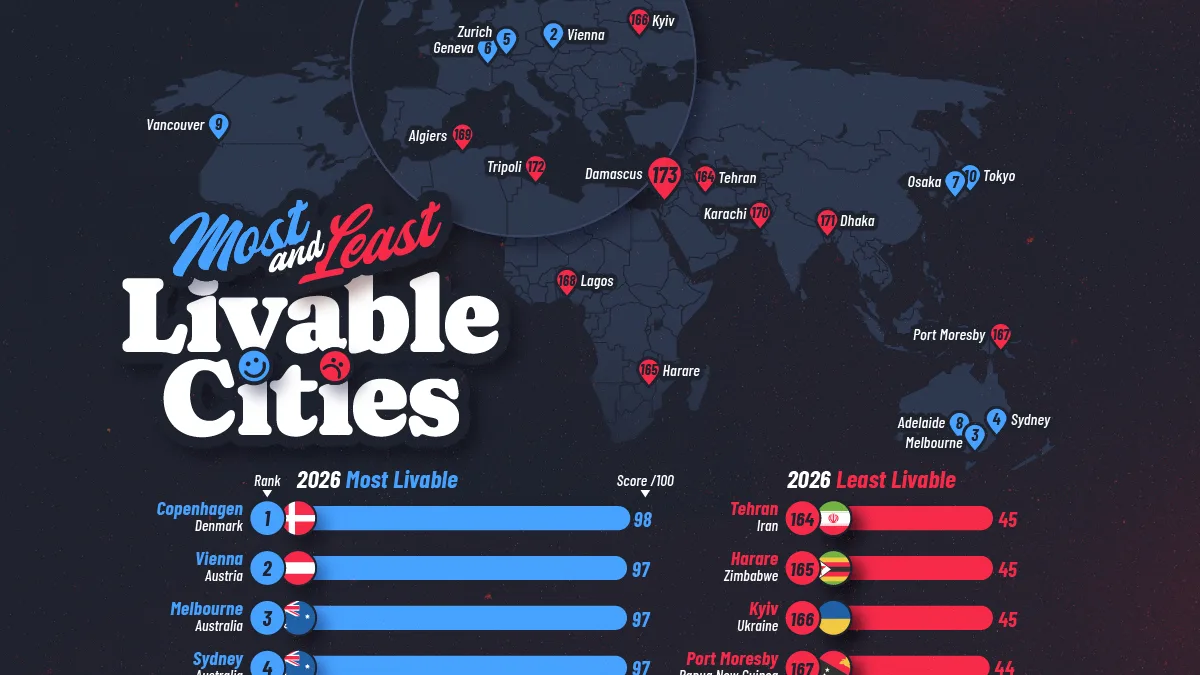
The World’s Most and Least Livable Cities in 2026
See visuals like this from many other data creators on our Voronoi app. Download it for free on iOS or Android and discover incredible data-driven charts from a variety of trusted sources.
Key Takeaways
- Copenhagen tops the EIU’s 2026 Global Liveability Index with a score of 98.
- Europe and Australia account for seven of the world’s 10 highest-ranked cities.
- Damascus ranks last among the 173 cities evaluated.
The Economist Intelligence Unit’s (EIU) Global Liveability Index measures quality of life across five categories: stability, healthcare, education, infrastructure, and culture.
This visualization compares the highest- and lowest-ranked cities in the 2026 edition of the index, revealing which urban centers provide the strongest living conditions—and which continue to be held back by conflict, political instability, or underdeveloped public services.
Copenhagen Takes the Top Spot
Copenhagen claimed the top spot with an overall score of 98 out of 100, becoming the first city outside Vienna to lead the EIU’s rankings in several years.
| Rank | Most Livable Cities | Country | Overall Score (0-100) |
|---|---|---|---|
| 1 | Copenhagen |  Denmark Denmark |
98 |
| 2 | Vienna |  Austria Austria |
97 |
| 3 | Melbourne |  Australia Australia |
97 |
| 4 | Sydney | Australia |
97 |
| 5 | Zurich |  Switzerland Switzerland |
96 |
| 6 | Geneva | Switzerland |
96 |
| 7 | Osaka |  Japan Japan |
96 |
| 8 | Adelaide | Australia |
96 |
| 9 | Vancouver |  Canada Canada |
96 |
| 10 | Tokyo | Japan |
96 |
The Danish capital scored highly for its public services, safe neighborhoods, efficient transportation, healthcare, and environmental standards.
Vienna placed second, followed by Australia’s two largest cities, Melbourne and Sydney.
Europe and Australia Lead the Rankings
Cities in Europe and Australia continue to set the global benchmark for urban quality of life, supported by extensive public services, transportation networks, healthcare systems, and urban infrastructure.
Switzerland placed Zurich and Geneva in the top six, while Australia was represented by Melbourne, Sydney, and Adelaide.
Japan also performed strongly, with Osaka and Tokyo both earning scores of 96.
Vancouver was the only North American city to make the top 10, reflecting Canada’s continued reputation for urban livability.
Conflict and Instability Weigh on the Lowest-Ranked Cities
At the bottom of the index, conflict, political instability, economic pressures, and weak infrastructure can make it difficult to provide reliable public services.
Damascus received the lowest score at 32, followed by Tripoli and Dhaka.
| Rank | Least Liveable Cities | Country | Overall Score |
|---|---|---|---|
| 164 | Tehran |  Iran Iran |
45 |
| 165 | Harare |  Zimbabwe Zimbabwe |
45 |
| 166 | Kyiv |  Ukraine Ukraine |
45 |
| 167 | Port Moresby |  Papua New Guinea Papua New Guinea |
44 |
| 168 | Lagos |  Nigeria Nigeria |
44 |
| 169 | Algiers |  Algeria Algeria |
43 |
| 170 | Karachi |  Pakistan Pakistan |
43 |
| 171 | Dhaka |  Bangladesh Bangladesh |
42 |
| 172 | Tripoli |  Libya Libya |
41 |
| 173 | Damascus |  Syria Syria |
32 |
Cities including Kyiv, Tehran, Karachi, and Lagos also appeared near the bottom of the index. Many face security concerns or strained public services that reduce day-to-day quality of life.
Learn More on the Voronoi App 
If you enjoyed today’s post, check out How Happy Are the World’s Population Giants? on Voronoi.