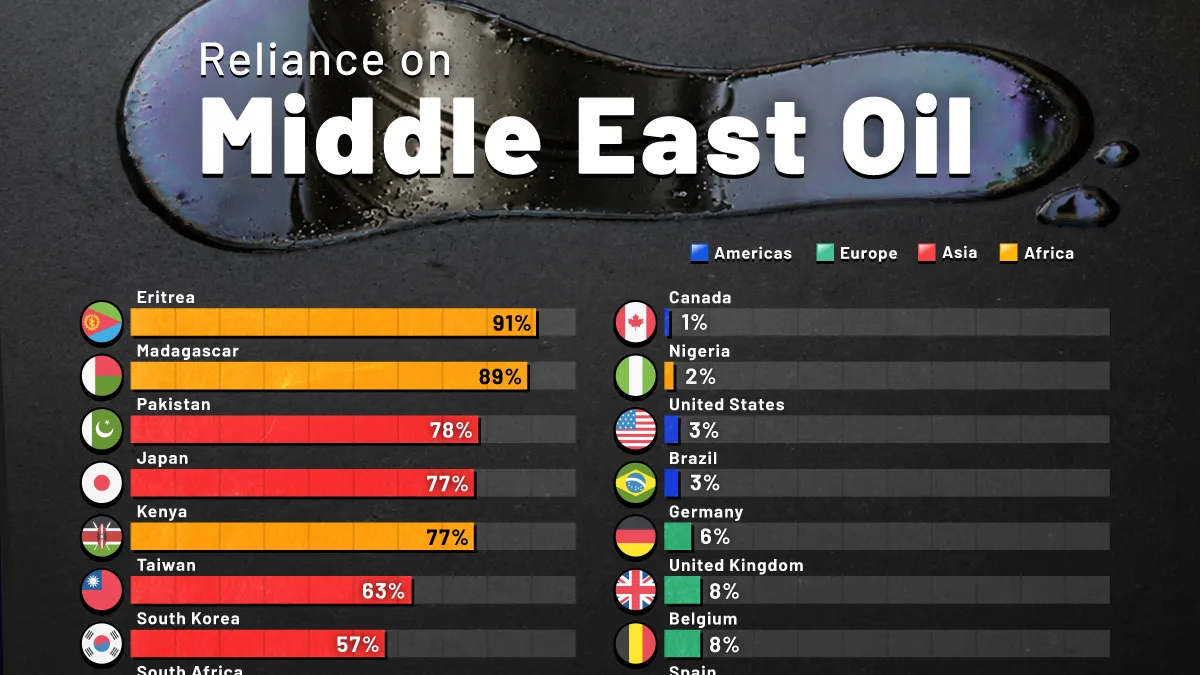
Ranked: Which Countries Depend Most on Middle East Oil?
See visuals like this from many other data creators on our Voronoi app. Download it for free on iOS or Android and discover incredible data-driven charts from a variety of trusted sources.
Key Takeaways
- Japan imports the equivalent of 77% of its oil consumption from the Middle East, highlighting East Asia’s continued dependence on the region.
- The U.S. and Canada are among the least reliant major economies, at just 3% and 1%, respectively.
- Countries that depend heavily on Middle Eastern oil may be more vulnerable to supply disruptions and geopolitical shocks.
Middle East oil remains a critical energy source for many countries, but dependence varies dramatically around the world.
This graphic ranks selected countries by the share of domestic oil consumption supplied by imports from the Middle East, based on data from IEA World Energy Statistics as of 2024.
While North America sources very little of its oil from the region, several Asian economies remain heavily dependent. Japan imports the equivalent of 77% of its oil consumption from the Middle East, while Taiwan, South Korea, India, and China also rank among the more exposed major economies.
At the other end of the spectrum, Canada, the United States, and Brazil rely very little on Middle Eastern supplies thanks to domestic production and alternative sourcing options.
Africa and Asia Lead the Rankings
Smaller economies dominate the very top of the ranking, led by Eritrea (91%) and Madagascar (89%). However, the most consequential countries from a global energy perspective are in Asia.
Japan ranks fourth overall, with Middle East imports equal to 77% of domestic oil consumption. Taiwan (63%), South Korea (57%), India (45%), and China (38%) also source a significant share of their oil from the region, making East Asia one of the world’s most important destinations for Middle Eastern crude.
| Country | Imports from the Middle East as a share of consumption |
|---|---|
 Eritrea Eritrea |
91% |
 Madagascar Madagascar |
89% |
 Pakistan Pakistan |
78% |
 Japan Japan |
77% |
 Kenya Kenya |
77% |
 Taiwan Taiwan |
63% |
 Korea Korea |
57% |
 South Africa South Africa |
54% |
 Tanzania Tanzania |
53% |
 Namibia Namibia |
50% |
 Sri Lanka Sri Lanka |
50% |
 Thailand Thailand |
50% |
 India India |
45% |
 Lithuania Lithuania |
40% |
 China China |
38% |
 Viet Nam Viet Nam |
36% |
 Iceland Iceland |
34% |
 Philippines Philippines |
34% |
 Poland Poland |
34% |
 Greece Greece |
33% |
 Sudan Sudan |
31% |
 Egypt Egypt |
30% |
 Singapore Singapore |
28% |
 Serbia Serbia |
25% |
 Malaysia Malaysia |
22% |
 Bangladesh Bangladesh |
20% |
 Mozambique Mozambique |
20% |
 Brunei Brunei |
19% |
 France France |
18% |
 Italy Italy |
16% |
 Slovenia Slovenia |
12% |
 Türkiye Türkiye |
11% |
 Indonesia Indonesia |
10% |
 Netherlands Netherlands |
10% |
 Austria Austria |
9% |
 Spain Spain |
9% |
 Belgium Belgium |
8% |
 United Kingdom United Kingdom |
8% |
 Germany Germany |
6% |
 Brazil Brazil |
3% |
 United States United States |
3% |
 Nigeria Nigeria |
2% |
 Canada Canada |
1% |
Pakistan also ranks near the top at 78%, while Sri Lanka, Thailand, and India each show significant reliance on Middle Eastern oil.
Why East Asia Depends Heavily on Middle East Oil
East Asia’s dependence reflects a simple reality: many of the region’s largest economies consume far more oil than they produce. As a result, they rely on imports to meet transportation, industrial, and petrochemical demand, with the Middle East serving as the world’s largest export hub for crude oil.
Japan is one of the clearest examples. With few domestic fossil fuel resources, the country relies heavily on overseas suppliers to meet energy demand.
India and China appear lower in percentage terms, at 45% and 38%, but their large economies mean their absolute import volumes are substantial.
Europe and North America Show Lower Reliance
European countries are spread across the middle and lower parts of the ranking.
Lithuania has the highest share among listed European countries at 40%, followed by Iceland and Poland at 34%.
Large European economies such as France, Italy, Spain, the United Kingdom, and Germany show more moderate reliance. Germany sits at just 6%.
North America is among the least reliant. The United States is at 3%, while Canada is at just 1%, reflecting domestic production and access to regional suppliers.
Energy Security Remains a Strategic Issue
The rankings also provide a snapshot of geopolitical exposure. Oil shipped from the Middle East often passes through strategic chokepoints such as the Strait of Hormuz, one of the world’s busiest energy corridors. Any disruption to these routes can affect countries that depend heavily on the region’s exports.
While global oil markets allow trade flows to adjust over time, countries with diversified suppliers or significant domestic production generally have greater flexibility during periods of market stress.
Learn More on the Voronoi App 
If you enjoyed today’s post, check out America’s Hottest Oil State? New Mexico on Voronoi, the new app from Visual Capitalist.