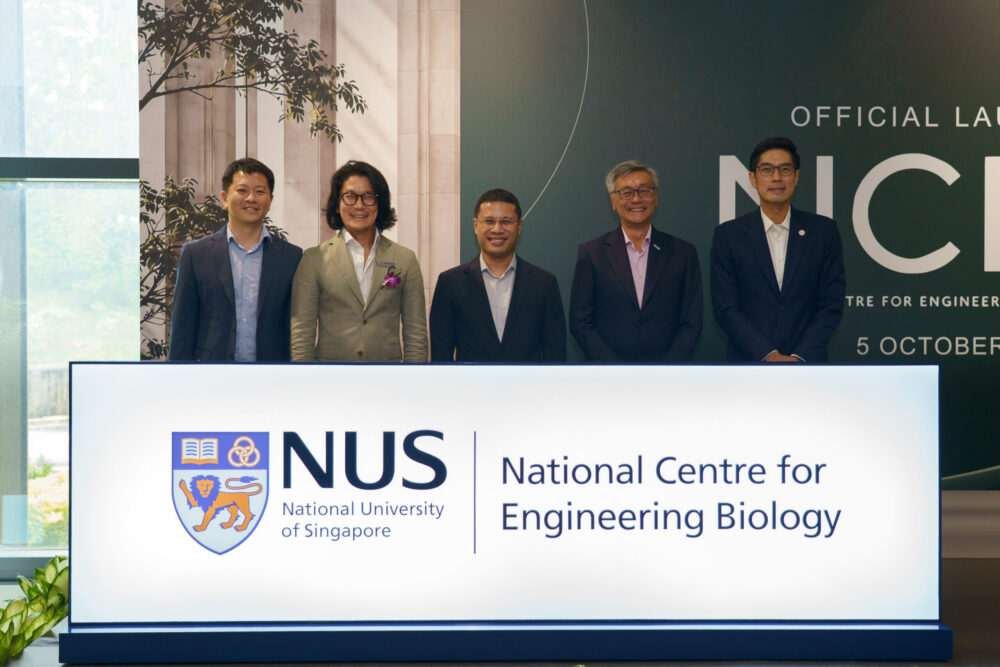
Singapore has opened a national hub for engineering biology. The National Centre for Engineering Biology (NCEB) is hosted at the National University of Singapore (NUS). It launched with a new research facility. Education Minister Desmond Lee was guest of honour.
The centre will use AI and automation to make specialty chemicals from renewable feedstocks. These high-value products include biosurfactants, specialty lipids, and flavour and fragrance compounds. Many are hard to make with conventional chemistry. They often rely on energy-intensive, fossil-derived processes.
The big idea is predictive biological design. Researchers want to model how genetic makeup shapes cell function. That would let them engineer microbes that perform reliably. Work is organised around three areas: machine learning for biodesign, specialty chemical production, and advanced biofoundry capabilities.
The flagship project starts with functional fatty acids. AI platforms propose better enzyme and pathway designs. The Advanced BioFoundry then builds and tests them in large numbers. Results flow back into the models, so each cycle improves the next.
The new facility follows a Design, Build, Test, Learn cycle. It has four connected zones: computing, a main laboratory, the biofoundry and a bioproduction area. Robotic liquid handlers and automated colony pickers run as one workflow. Droplet-based screening sorts single cells by performance. Mass spectrometry systems then measure what each cell produces across thousands of samples.
Scale-up is covered too. The Bioprocessing Innovation Platform, built with the Singapore Institute of Technology, offers pilot-scale fermentation and downstream processing. A digital backbone supports the work, including the SynBioDB database and the SynDe design platform.
Funding comes from a National Research Foundation grant of close to S$50 million (around USD $39 million). The grant runs for seven years from 2023. Partners include Nanyang Technological University, Singapore Institute of Technology, Temasek Polytechnic, Nanyang Polytechnic, and the Agency for Science, Technology and Research.
Executive Director Professor Matthew Chang said the centre builds on more than a decade of engineering biology work in Singapore. He said academic, government and industry partners will share one research ecosystem. The aim, he added, is cleaner ways to make products people depend on.
More than 150 researchers, students and staff contribute across partner institutions. About 50 more positions are open.
The post Singapore launches S$50 M centre for AI-guided biomanufacturing appeared first on World Bio Market Insights.
- Source: https://worldbiomarketinsights.com/singapore-launches-s50-m-centre-for-ai-guided-biomanufacturing/