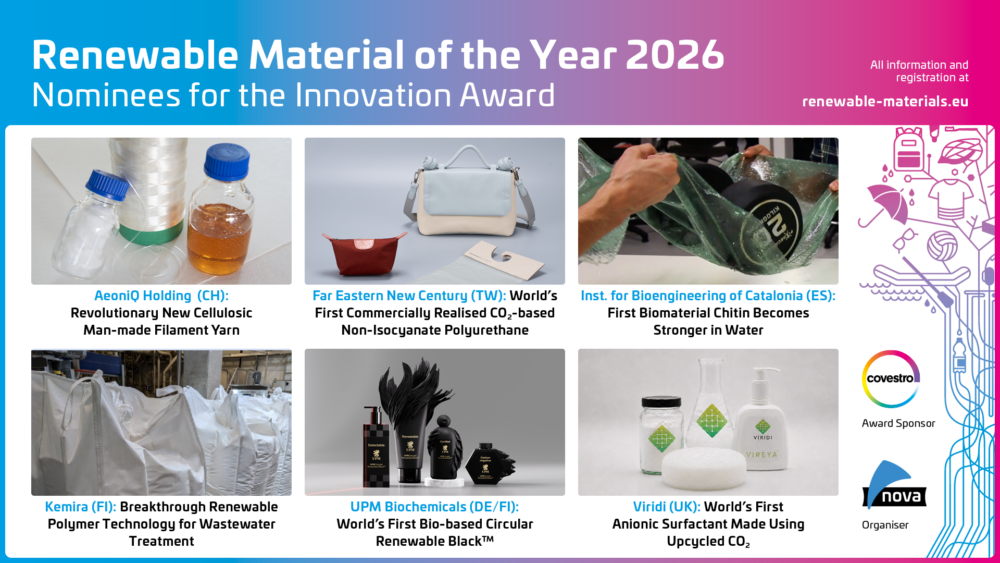
The Renewable Materials Conference (RMC) has named six nominees for its annual innovation award, “Renewable Material of the Year 2026.” The event runs September 22-24 in Siegburg/Cologne, Germany.
RMC is organised by nova-Institute. It has become a key meeting point for the renewable carbon economy. The conference expects 400-500 attendees this year.
This year’s theme is “Defossilisation through innovation.” Sessions will cover the defossilisation of the chemical industry, fossil-free plastics, and biodegradation.
The Six Nominees
The innovation award is sponsored by Covestro. It recognises standout materials each year. The conference’s advisory board narrowed a large pool of submissions down to six finalists. The winner will be chosen by audience vote during the conference.
This year’s nominees:
- AeoniQ Holding (Switzerland) — A cellulosic filament yarn built as an alternative to polyester and nylon. It’s made from renewable cellulose sources like wood pulp and textile waste. The process runs on 100% renewable energy with a 99.5% closed-loop manufacturing cycle. The company says it fully biodegrades in soil within 12 weeks. A first industrial-scale plant opens in Portugal in Q4 2026.
- Far Eastern New Century (Taiwan) — TOPGREEN® AirTek PU is billed as the world’s first commercially realised CO₂-based non-isocyanate polyurethane. The process converts captured industrial CO₂ into elastomers. It skips phosgene and isocyanates entirely. Emissions drop 58% compared to conventional TPU. The technology holds 22 patents and has already picked up industry recognition.
- Institute for Bioengineering of Catalonia (Spain) — AquaChitin is a chitosan-based material sourced from crustacean processing waste and organic urban waste. Unlike most plastics, it gets stronger in water rather than degrading. Production uses water-based, zero-waste chemistry. The process also recovers nickel used in its molecular network.
- Kemira (Finland) — KemAlpha® is a renewable polymer for wastewater treatment. It’s designed to replace fossil-based coagulants. The material is made from alpha-glucan derived from renewable sugar feedstocks. It’s already proven at full scale at a dairy producer in northern Europe. The technology is commercialised through a joint venture between Kemira and IFF.
- UPM Biochemicals (Germany/Finland) — UPM Circular Renewable Black
 is billed as the world’s first bio-based, NIR-detectable, carbon-negative black pigment. It solves a long-standing recycling problem. Conventional black pigments block near-infrared sorting systems, making packaging unrecyclable. This lignin-based pigment stays detectable. It’s tied to UPM’s €1.3 billion Leuna biorefinery.
- Viridi (UK) — Vireya is described as the world’s first anionic surfactant made using upcycled CO₂. It contains up to 33% CO₂. The company claims a product carbon footprint up to 70% lower than incumbent surfactants. It also avoids palm-oil derivatives, supporting compliance with the EU Deforestation Regulation.
The post Six nominees named for Renewable Materials Conference Innovation Award appeared first on World Bio Market Insights.