

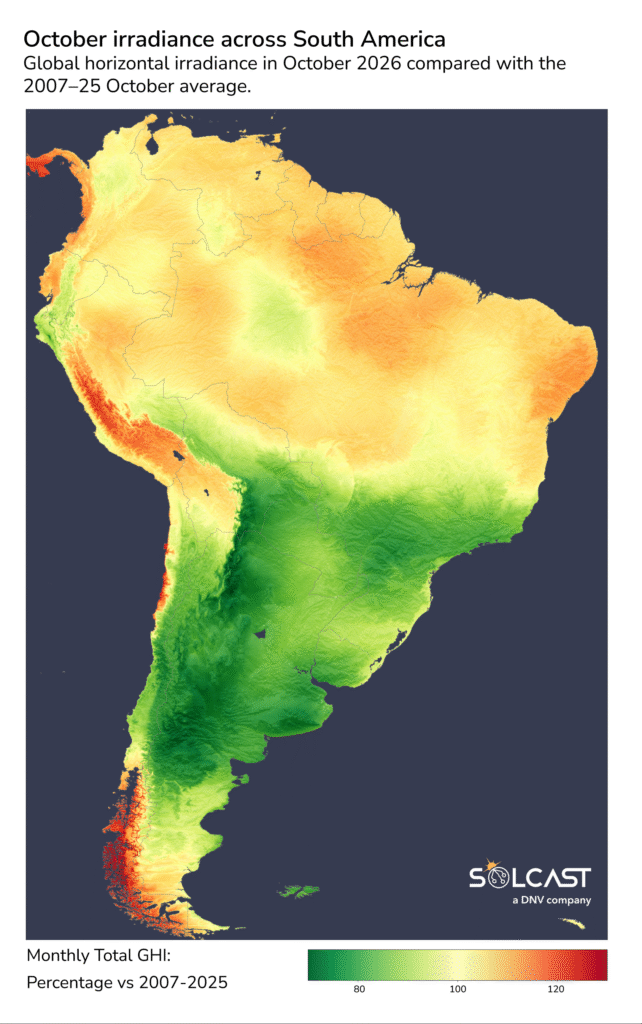
Irradiance was above average across most of South America north of 10°S in October 2026, while parts of the south-east recorded substantial deficits, according to analysis using the Solcast API. Global Horizontal Irradiance (GHI) was 4% above the 2007–25 average north of 10°S, but 14% below average in Paraguay, 10% below in Uruguay and 19% below in Argentina’s Pampas. Brazil’s largest distributed-solar states also recorded below average irradiance, while Chile saw below-average GHI in the centre and above-average conditions in the north and Patagonia.
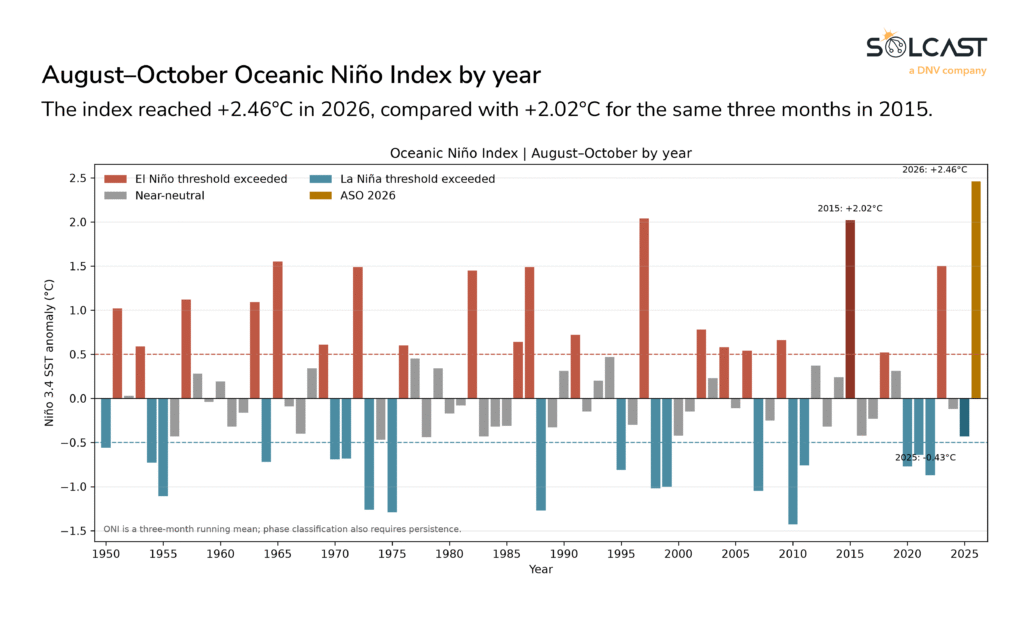
El Niño typically brings drier conditions to the Amazon and northern South America and wetter conditions to the south-east. NOAA’s Oceanic Niño Index reached +2.46°C for August–October 2026, above the +2.02°C recorded in the same period in 2015 and close to the +2.59°C later peak of the 2015–16 event. October reflected this broad contrast. North of 10°S, rainfall was 11% below average and 84% of the area was sunnier than usual. GHI was 9% above average in Pernambuco, 5% above in Ceará and 4% above in Bahia.
Farther south, lower irradiance overlapped with Brazil’s largest distributed-solar markets. GHI was 19% below average in Paraná, 16% below in São Paulo, 7% below in Rio Grande do Sul and 5% below in Minas Gerais, Brazil’s four largest states for distributed solar capacity. Neighbouring countries showed a similar irradiance pattern. Paraguay was 12% wetter than average and GHI was 14% below average, while GHI was 10% below average in Uruguay and 19% below in the Argentine Pampas, despite rainfall there being below or near normal.
Wildfire smoke substantially reduced clear-sky irradiance around Manaus. Aerosol optical depth averaged 0.67, more than double the 2007–25 October average of 0.32, reducing clear-sky GHI by 7.5%. On October 18, the smokiest day, the reduction reached about onethird. However, drier conditions and reduced cloud cover largely offset the aerosol impact, leaving actual monthly GHI close to average in Manaus (+0.2%) and Porto Velho (+0.7%). Without the smoke, both cities would have experienced an unusually sunny October.
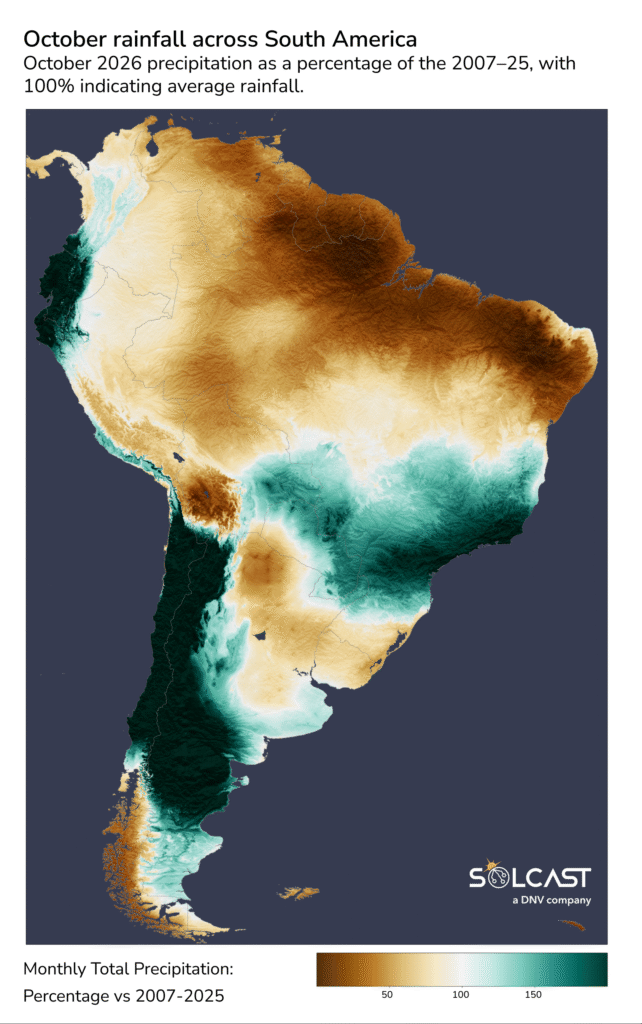
Elsewhere, drought did not necessarily bring sunnier skies. Santa Cruz, Bolivia, recorded GHI 21% below average despite drought conditions in the region. Central Chile was also cloudier, with GHI 11% below average. Santiago received 74 mm of rain in the first week of October alone, almost three times its average October total of about 26 mm. ERA5 data put rainfall for the whole month at about 174 mm, more than six times average, while GHI finished 28% below average. In contrast, GHI was 14% above average in northern Chile and 12% above in Chilean Patagonia, where weaker westerly winds and about half the usual rainfall meant fewer cloud-bearing fronts reached the Chilean side.
Solcast produces these figures by tracking clouds and aerosols at 1-2km resolution globally, using satellite data and proprietary AI/ML algorithms. This data is used to drive irradiance models, enabling Solcast to calculate irradiance at high resolution, with typical bias of less than 2%, and also cloud-tracking forecasts. This data is used by more than 350 companies managing over 350 GW of solar assets globally.
The post Strong El Niño coincides with uneven October solar resource across South America appeared first on pv magazine Global.


