

By Ari Pottens and Scott Seymour
The rupture in relations with the United States has created an existential challenge for Canada’s economic well-being. Its response is taking shape through a nation-building agenda meant to strengthen the economy, diversify trade, and strengthen Canadian sovereignty.
A central aspect of that agenda involves advancing major infrastructure projects that “reinforce Canadian sovereignty.” Canada’s climate agenda, however, is going to be immensely impacted by the additional greenhouse gas emissions required for the proposed buildout, including a one-million-barrel-per-day pipeline and natural-gas-powered data centres requiring 5.5 gigawatts of energy.
These projects make Canada’s enhanced oil and gas methane regulations more important than ever. If they are robustly implemented in every oil and gas producing province, they can significantly reduce emissions even as new emissions-intensive projects move forward. Strong methane rules will not erase the climate impact of expanded fossil-fuel infrastructure and use, but they are one of the fastest, most practical tools available to slow the rate of near-term warming.
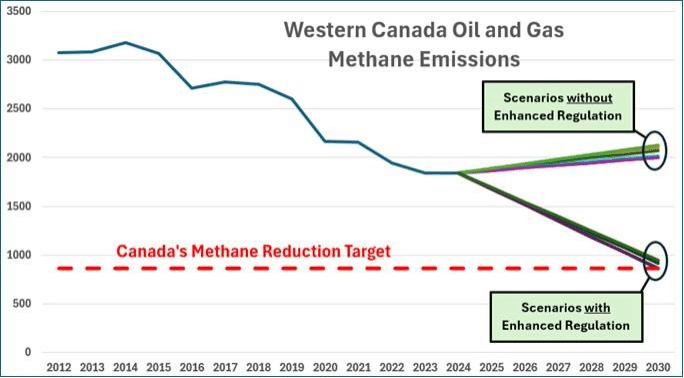
Our analysis uses emissions data from the National Inventory Report and oil and gas production projections from Canada’s Energy Future to establish a baseline before adding production changes related to the proposed pipeline and gas-powered data centres. The critical difference in methane emissions performance between the scenarios considered is whether methane regulations are fully implemented in the provinces.
Methane has earned this special attention because it is more than 80 times as potent a climate warming as carbon dioxide over a 20-year period, meaning that methane mitigation can deliver an outsized benefit in the short-term. The proposal pipeline and data centre buildout is set to increase overall carbon dioxide emissions, but the government can still drastically reduce methane pollution from the oil and gas industry. And as a bonus, these mitigation efforts can drive growth in the Canadian economy.
Canada already has a strong domestic methane mitigation sector with more than 100 companies supplying the equipment and expertise to find and fix leaks and avoid unnecessary emissions from venting and flaring. Increasing methane performance stringency for oil and gas production will increase the demand for this equipment and expertise. An EDF analysis estimates that reducing oil and gas methane emissions by 75% would create 34,000 jobs, many of which are in the mitigation sector.
The benefits aren’t only for Canada’s air quality, climate resiliency, and domestic economy, however: the demand for low-methane energy is steadily increasing among large energy-buying countries in Europe and Asia. Strong, verifiable methane performance for Canadian energy will set our product apart on the international market.
Seizing this opportunity won’t be easy, but the way to do it is clear. The federal government needs to ensure that its ambition is matched by strong provincial rules in every producing jurisdiction, with a particular emphasis on credible emissions measurement.
Watering down the proposed regulations will hurt Canada’s goal of being the most responsible source of energy in North America, and building energy-intensive infrastructure without mitigating the emissions impacts undermine our reputation as an international climate leader.
Nation-building does not mean having to choose between ambitious projects and climate responsibility, or economic growth and pollution reduction. If the government intends to move major energy and data-centre projects forward, it must pair that agenda with the strongest available safeguards. Robust, measurement-based methane regulations—implemented consistently across the country—are an essential place to start.
The post Strong methane regulations are essential as Canada pushes new infrastructure projects forward appeared first on Energy Exchange.


