

A research team in India has compared the performance of bifacial and monofacial solar PV modules under varying albedo and climatic conditions across the country and has found that ground albedo has a strong and systematic influence.
The researchers simulated the systems across five representative Indian climate zones: hot-dry, warm-humid, composite, temperate, and cold.
“Our study goes beyond conventional energy-yield comparisons by establishing the relationship between surface albedo and bifacial gain and by integrating technical, environmental, and economic indicators,” corresponding author Mobi Mathew told pv magazine. “This provides a more comprehensive understanding of how climate and surface reflectivity jointly influence the performance and deployment potential of bifacial PV systems across India.”
Mathew said his team plans to extend the work in two directions. “The first will focus on developing empirical correlations between surface albedo and key bifacial PV performance metrics across diverse Indian climatic conditions, using a stronger empirical basis to understand the relationship between surface reflectivity and bifacial performance,” he said. “The second will extend the assessment towards an integrated energy, exergy, economic, and environmental evaluation of bifacial and monofacial PV systems under different albedo and climatic conditions.”
In the current study, the team used PVsyst to simulate 6 kW grid-connected monofacial and bifacial PV systems in five Indian cities: Jodhpur (hot and dry), Thiruvananthapuram (warm and humid), New Delhi (composite), Bengaluru (temperate), and Leh (cold). The systems used 400 W modules and the same 3 kW inverter configuration. Both systems faced south, with a mounting height of 1.5 m and row spacing of 5 m. They also used the same electrical loss assumptions: 2% module mismatch and approximately 1.5% DC wiring losses.
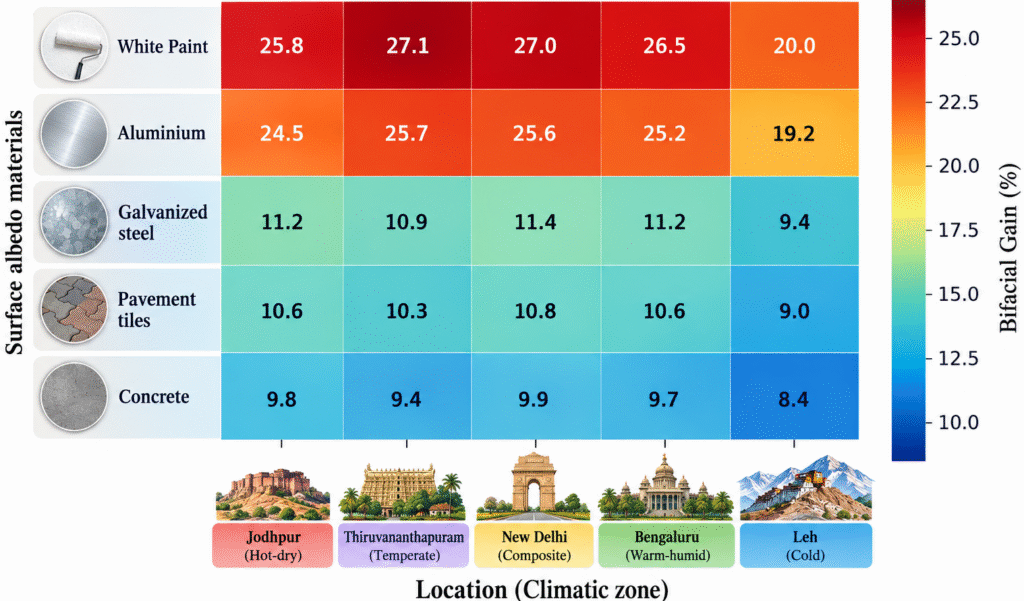
The researchers optimized the tilt angle for each location, ranging from 11 degrees in Thiruvananthapuram to 34 degrees in Leh. For the bifacial systems, they modeled five ground surfaces: concrete (albedo of 0.30), pavement tiles (0.33), galvanized steel (0.35), aluminum (0.85), and white paint (0.90). They simulated annual system performance using long-term synthetic weather data and assessed environmental and economic outcomes over 25 years.
Across all modeled sites and surfaces, bifacial gain ranged from 8.36% to 27.10%. Raising albedo from 0.30 to 0.90 reduced calculated lifecycle greenhouse gas intensity by approximately 10% to 14%, depending on location. The optimized bifacial configurations also had carbon payback times about 13% to 21% shorter than comparable monofacial systems, with the shortest, at 0.99 years, recorded in Leh. Under favorable high-albedo conditions, the researchers calculated a 4% to 7% reduction in the levelized cost of electricity.
“One of the most interesting findings was the strong and systematic influence of ground albedo on bifacial PV performance,” Mathew said. “We found that bifacial gain increases approximately linearly with increasing ground albedo, with every 0.10 increase in albedo producing about 2.6 percentage points of additional bifacial gain. High-reflectance surfaces such as white paint and aluminum increased annual generation by approximately 13% to 16% compared with concrete.”
Mathew added that the results showed the highest annual generation for the high-albedo bifacial configuration in Leh, reaching about 14.3 MWh per year. “These findings demonstrate that the surface surrounding a bifacial PV installation can become an important and controllable design parameter, alongside module selection and climatic conditions,” he said.
The results appear in “Performance comparison of bifacial and monofacial solar PV modules under varying albedo and climatic conditions across India,” published in Next Energy. Researchers from India’s Nehru College of Engineering & Research Center, HICCER – Hariterde International Council of Circular Economy Research, SR University, Indira Gandhi National Open University, and Saintgits College of Engineering participated in the study.
The post Study finds up to 27.1% bifacial PV gain across five Indian climate zones appeared first on pv magazine Global.


