
For over half of the world’s population, rice isn’t just a food; it’s a way of life. It’s the energy that powers our days, the tradition that brings families together, and the staple that has nourished cultures for thousands of years. But the way we’ve been growing this vital grain has come at a high cost to our planet.
Traditional rice farming methods, while productive, are incredibly demanding on our resources. They guzzle freshwater, release powerful greenhouse gases, and rely heavily on chemicals that harm our soils and waterways.
Defining Sustainable Rice Farming
Sustainable rice farming is a comprehensive approach to agriculture that balances environmental health with economic viability and social equity. It’s about producing rice without depleting the natural resources on which future generations will depend. This concept is a direct response to the massive environmental footprint of conventional rice production.
Today, we stand at a critical crossroads. With a growing global population and a rapidly changing climate, we must find a better way to produce our most important food. The answer lies in sustainable rice farming—a modern, intelligent, and environmentally friendly approach that promises to secure our food supply for future generations.
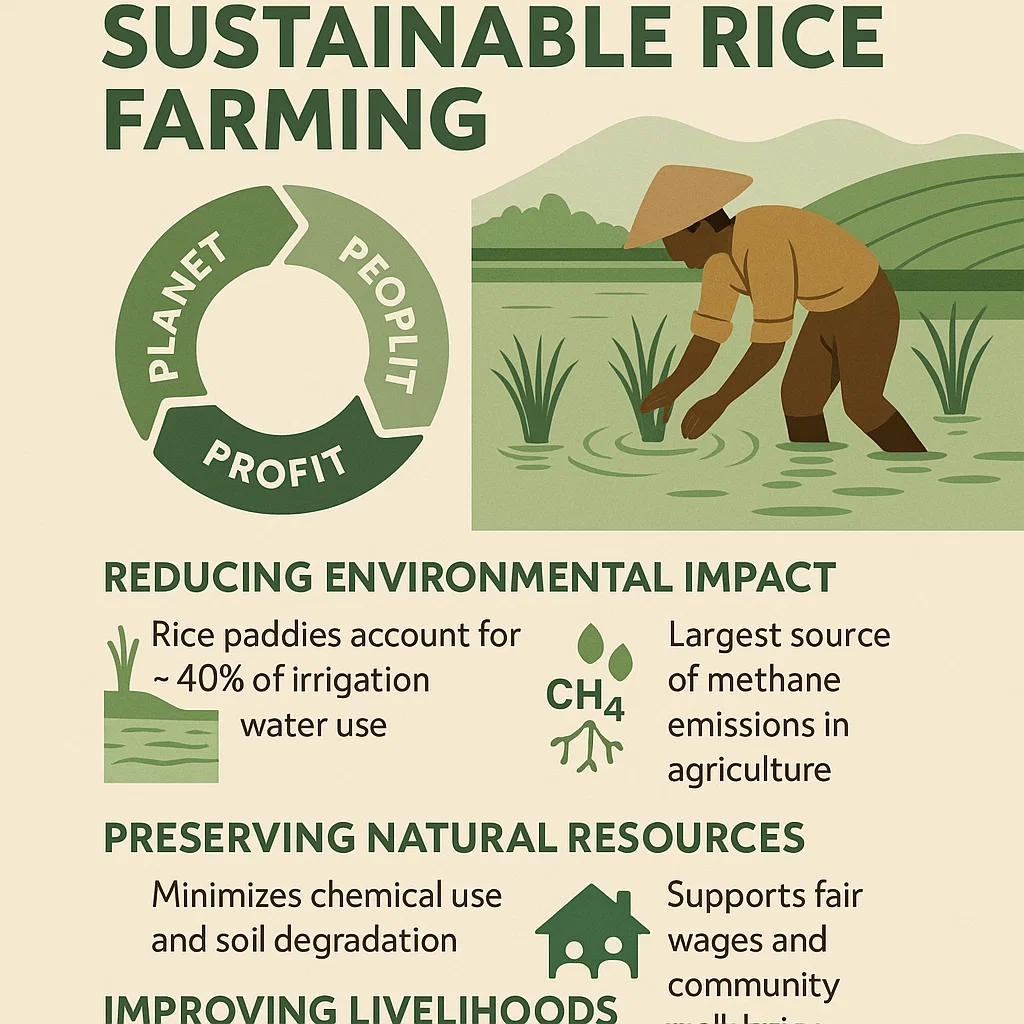
This isn’t just about tweaking old practices; it’s a complete rethink of how we grow rice, focusing on a “triple bottom line” that benefits the planet, the people who farm the land, and their profits. It’s a quiet revolution happening in paddies around the world, and it’s one of the most important stories of our time.
To provide context for the scale of this challenge, the following table details the latest global rice production figures.
| Market | % of Global Production | Total Production (2024/2025, Metric Tons) |
|---|---|---|
| India | 28% | 150 Million |
| China | 27% | 145.28 Million |
| Bangladesh | 7% | 36.6 Million |
| Indonesia | 6% | 34.1 Million |
| Total Global | 100% | 540.83 Million |
| Year-over-Year Change | 3% | N/A |
Consider these facts: Rice paddies are responsible for roughly 40% of the freshwater used for irrigation globally. That’s a staggering figure, given that fresh water is a finite resource. Even more critically, these flooded fields are the largest man-made source of methane, a greenhouse gas over 25 times more potent than carbon dioxide at trapping heat in the atmosphere.
In fact, rice cultivation alone contributes an estimated 1.5% of total global greenhouse gas emissions. Beyond this, conventional farming practices often lead to soil degradation, nutrient depletion, and chemical runoff that pollutes rivers and streams, harming aquatic life.
Sustainable farming offers a way to reverse these trends, ensuring that the rice we eat today doesn’t come at the expense of our children’s future. It’s a holistic model that proves you can do good while doing well.
Core Practices of Sustainable Rice Cultivation
At the heart of sustainable rice farming are innovative practices that address the three biggest challenges of conventional farming: excessive water use, inefficient nutrient management, and reliance on chemical pesticides. By replacing old habits with smarter, more efficient techniques, farmers can significantly reduce their environmental impact while often improving their yields.
Water-Saving Irrigation Techniques
The single most impactful change in sustainable rice farming is moving away from the traditional, continuously flooded paddy. The misconception that rice needs to be submerged in water to grow is slowly being corrected by techniques that prove the opposite.
Alternate Wetting and Drying (AWD): One of the most widely adopted and effective water-saving methods is Alternate Wetting and Drying (AWD). Instead of keeping fields under a constant layer of water, farmers use a simple tool—a field water tube—to monitor the water level in the soil. They allow the field to dry for a few days before re-irrigating it.

This cyclical process saves a significant amount of water. In fact, studies show that AWD can reduce water use by an impressive 15% to 25%. The benefits of AWD go beyond just saving water. By allowing the soil to dry, oxygen is able to enter the soil, which prevents the anaerobic (oxygen-less) conditions that lead to methane production.
This simple change can slash methane emissions from rice paddies by an incredible 30% to 70%. For farmers, this translates into direct cost savings on fuel and labor for irrigation, leading to an average income increase of $67 to $97 per hectare.
The following table provides a clear comparison of the quantitative benefits of these core sustainable practices.
| Practice | Water Savings | Methane Reduction | Yield Increase |
|---|---|---|---|
| AWD | 15-25% | 30-70% | No penalty |
| SRI | 25-50% | High | 56% avg., up to 200% |
| INM | N/A | 1,355% | 0.4-0.7 t/ha, 1.3-66.5% |
System of Rice Intensification (SRI)
Another groundbreaking technique is the System of Rice Intensification (SRI). While often more labor-intensive, SRI has a track record of producing extraordinary results. It is based on four simple principles:
- Planting young seedlings: Very young seedlings (typically 8 to 15 days old) are transplanted carefully into the soil.
- Wider spacing: Seedlings are planted at much wider intervals than in traditional methods.
- Alternate wetting and drying: Fields are irrigated but not continuously flooded, similar to AWD.
- Mechanical weeding: Weeds are controlled by hand or with a simple mechanical weeder, which also aerates the soil, promoting root growth.
The results of SRI are nothing short of spectacular. Farmers have reported yield increases of 20% to 50%, with some cases showing a staggering 200% boost. At the same time, SRI can reduce water usage by 25% to 50% and dramatically cut seed requirements by as much as 80% to 90%.
Integrated Nutrient Management (INM)
Traditional rice farming relies heavily on synthetic fertilizers, particularly nitrogen. While effective, the overuse of these chemicals can deplete soil health over time and lead to a range of environmental problems. Integrated Nutrient Management (INM) offers a balanced solution, combining all available nutrient sources to build a healthier, more resilient soil ecosystem.
The core of INM is the smart use of a combination of organic materials, inorganic fertilizers, and biofertilizers. Organic materials like compost, rice straw, and animal manure are essential. For example, co-applying biochar and manure can increase rice yield by improving soil pH and water retention.
The use of legume cover crops, which naturally add nitrogen to the soil, is another key practice. By focusing on soil health, INM can lead to a significant increase in crop yields, with some studies showing a 1.3% to 66.5% boost. Even more impressively, research has shown that INM can reduce methane emissions by up to 1,355% compared to conventional nutrient management.
A Natural Defense System
Conventional farming often treats pests with a “scorched-earth” approach, using blanket applications of chemical pesticides. This not only harms the environment but also leads to pests developing resistance. Integrated Pest Management (IPM) is a smarter, more targeted strategy that minimizes the need for chemicals.
IPM focuses on a combination of techniques, including:
- Using pest-resistant rice varieties: Selecting rice strains that are naturally resistant to common pests reduces the need for chemicals from the start.
- Introducing beneficial insects: Encouraging natural predators like ladybugs and spiders to live in the rice fields provides a biological control against pests.
- Cultural practices: Techniques like crop rotation and timely planting disrupt pest life cycles.
- Targeted chemical use: When a pesticide is absolutely necessary, it is applied strategically and in minimal amounts.
The result is a healthier ecosystem, a significant reduction in pesticide use, and safer working conditions for farmers. Integrated farming systems, such as rice-fish or rice-duck cultivation, take this a step further by using fish or ducks in the paddies to eat weeds and pests, while their waste provides natural fertilizer.
Environmental, Economic, and Social Benefits
The shift to sustainable rice farming creates a powerful domino effect, with positive impacts that extend far beyond the farm. From protecting our environment to building stronger, more resilient communities, the benefits of this green revolution are clear and quantifiable.
a. Protecting Our Planet
The environmental benefits are perhaps the most well-documented. A 2024 study on a new rice variety showed that it reduced methane emissions by up to 70% while also boosting yields to an impressive 8.96 tons per hectare. In Bangladesh, the adoption of AWD by over 160,000 farmers is saving an estimated 100,000 liters of water per hectare, which has been crucial in the face of increasingly frequent droughts.
Beyond just water and gas, these practices also improve water quality by reducing chemical runoff and enhance biodiversity. The healthier soil, free from heavy chemical loads, supports a greater variety of microbes and organisms, making the entire ecosystem more resilient.
b. Empowering Farmers and Boosting Profits
For farmers, the move to sustainability is not just an ecological decision; it’s an economic one. While there may be an initial investment in training and new tools, the long-term benefits are substantial. By reducing reliance on expensive synthetic fertilizers and pesticides, farmers can drastically lower their input costs. The use of AWD in Bangladesh, for example, has resulted in an average of 22.7% cost savings for participating farmers.
Higher yields and improved crop quality can also lead to higher prices. The Sustainable Rice Platform (SRP), a global alliance of over 100 organizations, has developed a standard for sustainable rice production. Rice certified by the SRP can fetch a premium in the market. In Vietnam’s Mekong Delta, SRP-certified farmers saw a 10-15% reduction in input costs and a 5-10% increase in income.
c. Building Healthier Communities
The social benefits of sustainable farming are equally important. Reduced exposure to harmful chemicals improves the health and well-being of farmers and their families. Moreover, the improved economic stability and higher incomes help to lift entire communities out of poverty, creating more resilient local economies. Gender empowerment is also a key factor, with initiatives often focusing on providing women with the training and resources to adopt these new methods.
Challenges and The Path to Wider Adoption
While the benefits are clear, the transition to sustainable rice farming is not without its hurdles. The biggest barrier is often the knowledge gap. Many smallholder farmers lack the training, technical knowledge, and resources to implement new practices. The initial investment in tools and training can be a significant deterrent, as can the lack of access to financial support or credit.
Policy and market structures also play a crucial role. Without supportive government policies—such as subsidies for sustainable inputs or incentives for using water-saving techniques—adoption can be slow. Furthermore, creating a strong market that connects sustainable producers to conscious consumers is vital to ensuring that farmers are rewarded for their efforts.
Technology and Innovation of Sustainable Rice Farming
The future of sustainable rice farming is being shaped by cutting-edge technology and a growing understanding of climate-smart agriculture.
1. Precision Agriculture: From drones to AI-powered apps, precision agriculture is revolutionizing the way farmers manage their crops. Drones equipped with sensors can monitor field health, detect pests, and identify nutrient deficiencies with pinpoint accuracy.
This allows farmers to apply water and fertilizer only where it’s needed, reducing waste and increasing efficiency. In India, for example, a project using AI-powered drones resulted in a 15% reduction in fertilizer use, a 20% reduction in water use, and a 10% increase in yield.
2. Developing Climate-Resilient Rice Varieties: Scientists at research institutions like the International Rice Research Institute (IRRI) are developing new rice varieties that are more resilient to the challenges of climate change. We now have Sub1 rice, a variety that can survive complete submersion during floods.
We also have new heat-tolerant varieties that are already providing significant benefits. A recent study in Bangladesh found that a new heat-tolerant variety yielded 1.5 to 2 tons more per hectare compared to older varieties.
3. The Power of the Conscious Consumer: Perhaps the most powerful driver of change is the consumer. As people become more aware of the environmental and social impacts of their food choices, the demand for sustainably sourced products is growing.
Programs like the Sustainable Rice Platform (SRP) provide a clear way for consumers to identify and choose rice that was grown responsibly. By making informed choices, consumers can send a clear signal to the market that sustainability is not just a trend but a requirement.
A Collective Responsibility
The challenge of transforming a global food system is not for one group alone. It requires a collective effort from farmers, governments, corporations, researchers, and consumers.
a. For Farmers: Look for training programs and resources from organizations like the Sustainable Rice Platform (SRP) or government extension services. These programs can provide the knowledge, tools, and, in some cases, the financial incentives needed to make the switch.

b. For Consumers: When you shop for rice, look for labels that indicate sustainable practices or certification from organizations like the SRP. Your choice at the grocery store can directly support farmers who are working to protect the planet.
c. For Everyone: Support research and development in climate-smart agriculture. The innovations being developed today are our best tools for building a food system that is both productive and planet-friendly. The journey to a more sustainable future for rice is well underway, and with every step we take together, we can ensure that our most important grain continues to feed the world for generations to come.
Conclusion
Sustainable rice farming is not just an option—it is a necessity. With billions of people relying on rice and millions of farmers depending on it for their income, the way we grow rice affects our food security, our environment, and our future. By adopting sustainable practices, supporting farmer training, and making conscious consumer choices, we can build a rice system that is truly sustainable for generations to come.


