
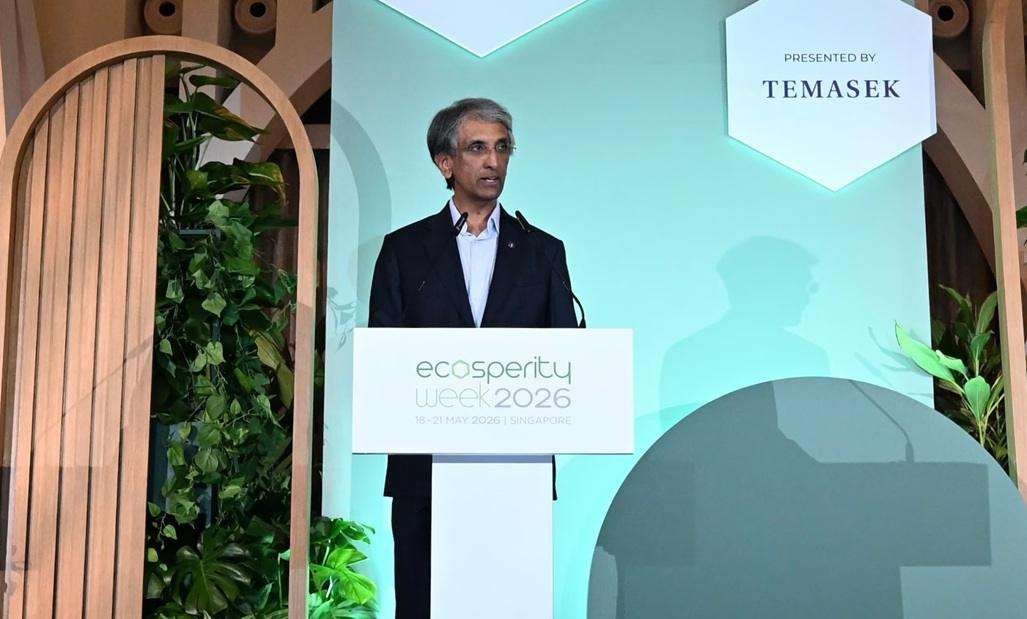
Singapore-based investment company Temasek is likely to miss its 2030 portfolio decarbonization targets, according to CEO Dilhan Pillay, citing major changes in geopolitics, energy markets, technology and climate ambition over the past few years, and the firm’s exposure to hard-to-abate sectors including aviation and power generation.
Despite the expectation to miss the 2030 goal, Pillay stressed that the company remains “fully committed to our climate targets, including the ambition of achieving net zero by 2050,” adding that “timelines may evolve – but it is not about lowering ambition.”
Temasek’s goal, set in 2019, is to reduce the net carbon emissions attributable to its portfolio to half the 2010 levels by 2030. Since setting the goal, Temasek’s portfolio emissions have declined by around 30%.
Pillay delivered his remarks in his opening speech at Ecosperity conference, Temasek’s key platform for global engagement and advocacy in the sustainability space, launched by the company in 2014.
In his remarks, Pillay noted that at the time of Ecosperity’s founding, “there was broad recognition that climate change was urgent, that collective action was needed, and that emissions transcend borders,” and then noted “but today, the world has fundamentally changed.”
Key changes highlighted by the CEO include “a major revision of the international rules-based order, especially with respect to trade and globalization,” less predictable policy signals, tighter fiscal positions, as well as the emergence of generative AI, which has driven significantly higher levels of energy demand and competition for capital that would otherwise be used for other purposes – including climate transition opportunities.
The key factor driving Pillay’s expectation of missing the 2030 goal is Temasek’s portfolio exposure to hard-to-abate sectors, in which he said “the technologies and solutions needed for decarbonisation are still not commercially scaled or economically viable today.”
Temasek has significant exposure to sectors including aviation and power generation, with holdings including a majority stake in Singapore Airlines, and a 50% stake in power company Sembcorp Industries.
As an example of the challenges facing these sectors, referencing Singapore Airlines, Pillay said that it has been working together with the company on solutions to scale sustainable aviation fuel (SAF), but noted that SAF still accounts for less than 1% of global jet fuel supply and remains around two to five times more expensive than conventional jet fuel.
Pillay outlined Temasek’s three key initiatives to continue its pursuit of its climate ambitions, including deploying capital “towards areas such as renewable energy, electrification, climate technologies, industrial decarbonisation, and energy resilience,” – highlighting its recent involvement in supporting green steel company Stegra; engaging with portfolio companies, particularly in hard-to-abate sectors, to support emissions reduction efforts, and embedding climate considerations directly into investment decisions, including through the application of an internal carbon price and by linking sustainability goals to compensation.
Pillay said:
“The journey will be harder and less linear – but it is one we must continue, because the cost of inaction is far higher.”


