
The U.S. trucking industry is taking a major step toward electrification as shippers move from pilot projects to large-scale fleet commitments.
Smart Freight Centre and Catalyst Mobility, formerly CALSTART, have helped organize a 2,500-truck battery-electric Class 8 order through their Zero-Emission Truck Shipper-Carrier Alliance Leading Electrification (ZET SCALE) program. The organizations say the deal is the largest electric Class 8 truck order in the U.S. and could nearly double the country’s existing electric Class 8 fleet.
The press release says Tesla has been selected as the primary original equipment manufacturer (OEM) for the initial procurement following a competitive request-for-proposals process. Kenworth, Volvo and RIDE will remain secondary options for carriers whose operating requirements call for different truck configurations.
The development comes at a critical point for U.S. freight. Trucks move enormous volumes of goods across the country, but the sector remains heavily dependent on diesel.
Why Heavy Trucks Matter for U.S. Emissions
Transportation is the largest source of direct greenhouse gas emissions in the U.S. economy. Within transportation, medium- and heavy-duty trucks accounted for 23% of transportation-sector greenhouse gas emissions in 2022, according to the EPA.
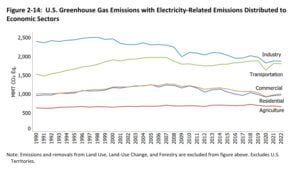
The emissions challenge is particularly significant for long-haul trucking. The U.S. Department of Energy estimates that long-haul freight trucks account for only about 7% of medium- and heavy-duty vehicles but around 38% of their greenhouse gas emissions, reflecting their high mileage, heavy loads, and energy consumption.
The broader medium- and heavy-duty vehicle fleet is also still dominated by fossil fuels. A DOE analysis found that about 92% of these vehicles ran on diesel and 7% on gasoline, with natural gas and propane accounting for roughly 1%.
That makes Class 8 trucks an important target for decarbonization.
Electric Truck Sales Are Growing, But From a Small Base
The U.S. electric truck market is expanding, although heavy-duty adoption remains relatively small compared with conventional trucking.
- The International Energy Agency said global electric truck sales surpassed 400,000 units in 2025, with electric heavy freight truck sales nearly tripling to about 230,000 units.
U.S. electric truck sales increased 25% to roughly 17,000 units in 2025. However, more than 95% of those U.S. sales were medium freight trucks, partly because Rivian’s electric delivery vans are included in the category.
- For the heavier Class 8 segment, the numbers are much smaller. Reporting based on the International Council on Clean Transportation’s 2026 market monitor put U.S. zero-emission heavy truck sales at about 875 units in 2025, representing only around 0.3% of the market.
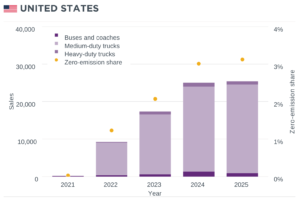
The ZET SCALE procurement therefore stands out because its initial order is several times larger than annual U.S. zero-emission heavy-truck sales recorded in 2025.
Tesla (TSLA) Semi Gets a Major Commercial Opportunity
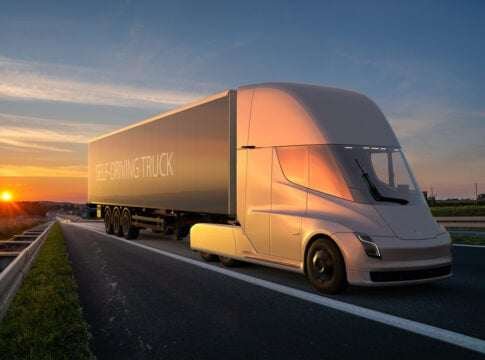
Tesla’s Semi is at the center of the new procurement. As per reports, Tesla has officially started high-volume production of its Semi electric truck at a new dedicated factory in Nevada. The company says the facility can produce up to 50,000 electric trucks a year.
The company currently lists the Semi with an estimated 500-mile range, energy consumption of about 1.7 kWh per mile, and gross combination weight of up to 82,000 pounds for the long-range version. The company says its Megacharger system can restore up to 60% of range in 30 minutes, with charging capability of up to 1.2 MW.
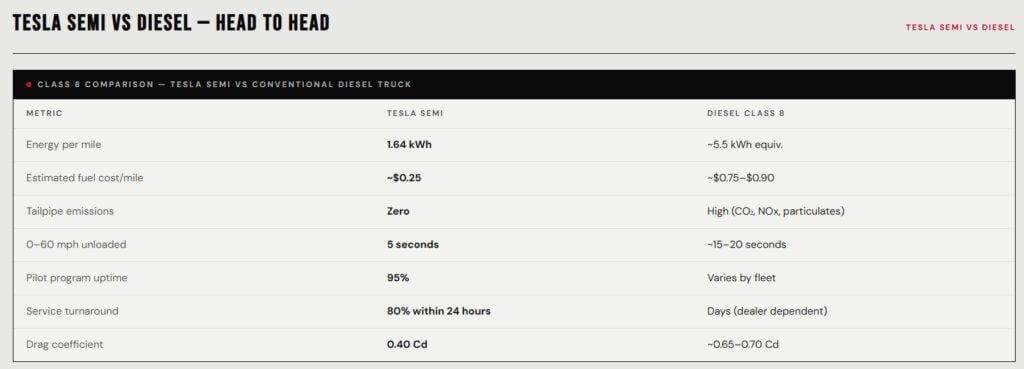
Tesla has also said Semi deliveries will start in 2026. However, the company has faced delays in bringing the truck to high-volume production. In July, Tesla said it was working to increase battery production to support production of the Semi at scale.
The ZET SCALE order allows Tesla to move from limited deployments toward a much larger commercial fleet base.
It also comes as Tesla prepares to expand the Semi beyond the U.S. Reuters reported in September that the company is targeting the European heavy-duty market, where several established truck manufacturers already offer battery-electric models.
Microsoft and PepsiCo Help Aggregate Demand
The bigger story behind the order, however, is not simply Tesla.
ZET SCALE is designed to solve one of the biggest challenges facing electric trucking: fragmented demand.
Individual fleets often hesitate to place large electric-truck orders because of higher upfront costs, uncertain residual values, charging requirements, and questions about how vehicles will perform across different routes.
The alliance pools demand from multiple shippers and carriers. Founding participants include Microsoft and PepsiCo, among others. By combining their requirements, ZET SCALE created a larger purchasing pool that encouraged truck manufacturers to compete for the business.
The model could also help reduce costs beyond the truck itself.
The key advantages include:
- Bulk purchasing: Larger orders can improve pricing and strengthen the business case for electric trucks.
- Shared infrastructure: Deployments are concentrated around freight hubs where charging assets can achieve higher utilization.
- Financing support: ZET Financial plans to use a fair-market-value leasing structure designed to reduce residual-value risk for carriers.
- Operational data: Fleet-specific analysis can compare electricity, diesel, maintenance, and financing costs.
- Multiple OEM options: Tesla leads the first procurement, while Kenworth, Volvo and RIDE provide alternatives for different operating needs.
Ten Freight Hubs Form the First Deployment Wave
The initial deployments will focus on major freight corridors rather than spreading trucks thinly across the country.
ZET SCALE has identified 10 primary freight regions, including Southern California and Los Angeles, Northern and Central California, Seattle-Tacoma, Houston, Dallas, San Antonio, Chicago, Atlanta, and the Northern New Jersey-New York region.
This approach is important because electric trucking depends on more than vehicle availability. Charging infrastructure, route length, electricity prices, truck utilization, and local operating conditions all influence the economics.
Concentrating trucks around established freight hubs can allow fleets to share charging infrastructure and maximize vehicle utilization.
From 2,500 Trucks to 10,000
The 2,500-truck order is being positioned as the first phase rather than the final target.
ZET SCALE aims to expand the model to 10,000 or more electric trucks, while recruiting additional shippers and carriers and expanding into new regions.
That ambition comes as U.S. policymakers and industry groups continue to look for ways to reduce emissions from heavy-duty transportation. DOE’s SuperTruck 3 initiative, for example, is focused on electric and hydrogen fuel-cell technologies and targets a 75% lifecycle reduction in medium- and heavy-duty truck greenhouse gas emissions.
The challenge is no longer simply developing an electric Class 8 truck. The industry must build the commercial ecosystem around it.
ZET SCALE’s approach brings together shippers, carriers, manufacturers, financiers, and charging infrastructure around one procurement strategy. If the model works, it could offer a path for freight companies to electrify without each fleet having to solve the same cost and infrastructure problems independently.
For Tesla, meanwhile, the order could provide an important bridge from limited Semi deployments to a much larger commercial market.
And for U.S. freight decarbonization, the significance may extend beyond the 2,500 trucks themselves. The bigger test is whether aggregated demand can turn electric Class 8 trucks from an emerging technology into a scalable fleet solution.
The post Tesla (TSLA Stock) Leads 2,500 Electric Class 8 Trucks. Microsoft, PepsiCo Back U.S. Freight Decarbonization appeared first on Carbon Credits.


