
By Vanessa Hunt, ASA Director of Publications & Visuals
Before planting season begins, farmers spend months planning and making critical decisions that shape the success of the growing season and the long-term sustainability of their operation. Farming requires a wide range of inputs to plant, grow, and harvest a successful crop. These inputs include products like fertilizer, seed, fuel, and equipment, as well as operational expenses such as repairs, labor, land costs, and taxes.
Currently, input costs are skyrocketing while soy prices are trending down. Geopolitical events are exacerbating the issue as conflict in the Middle East has resulted in significant impacts on the global fertilizer market. Farmers are facing rising fertilizer and diesel costs, along with higher prices for many of the products and services needed to run a farm.
Planning & Planting
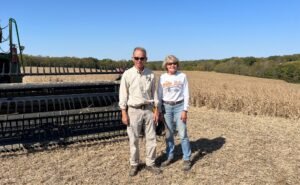
Eric Dolbeare and Roberta-Simpson Dolbeare on their farm in Nebo, Illinois.
Farmers are now grappling with additional unknowns regarding production costs, while needing to amend their planting decisions. They are paying more than ever to grow their crops, often at a loss, and it is weighing heavily on their minds as they have gone into this planting season. Decisions have had to be made, causing major changes for some about what planting and harvesting looks like this year. ASA Director and Illinois farmer Roberta Simpson-Dolbeare says input costs are having an impact on planting decisions for the farm she owns and works on with her husband, Eric.
“We stay pretty much to a 50/50 rotation between corn and beans,” she said. “It’s hard to predict what market prices may do, but those do factor into our final decision of how many acres of corn and beans we’ll plant. However, we generally don’t vary a great deal from a fairly balanced rotation.”
While some farmers are evaluating and considering changing course on what they will plant this year based on input costs, Simpson-Dolbeare said the end result is a bigger factor.
“The price of inputs comes into play, certainly, but the expected income and the relative value of the end result is what we focus on,” she said.
Rising Input Costs
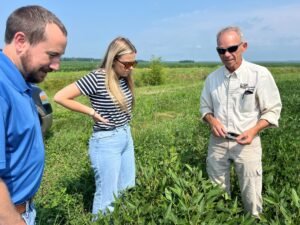
ASA Chief Economist Scott Gerlt and 2024 ASA summer intern Katelyn Klawinsky tour the soybean fields at Roberta and Eric’s farm.
The rise in input costs has affected farmers for the past few years, and these costs have been on an unfortunate upward trend. Increasing costs are touching nearly all additional production costs, from fertilizer to equipment, seeds, and fuel. Speaking about this upward trend, ASA Economist Jacquie Holland said, “Input prices spiked in 2022 to 2023 following the Russian invasion of Ukraine and pandemic supply chain issues. Prices came down but remained elevated above pre-pandemic levels leading up to the Iran War.”
One way to look at how farmers are being affected by costs is what they are doing with their equipment, “In good years, farmers buy new equipment, and in bad years, they put it off,” ASA Chief Economist Scott Gerlt said. “Farmers aren’t purchasing much new equipment right now. In the long run, they may start looking at their land. If they have rental agreements, they may have to renegotiate lower prices or let some leases go. Farmers will reevaluate their operation a lot more closely, seeing what is profitable and what isn’t. They can’t do anything speculative.”
Running a farm, and doing so successfully, takes hard work, dedication, and knowledge that encompasses more than just putting seeds into the ground and harvesting when ready. It is a delicate balance of farming, communicating, and all the technical aspects that go along with running a business. As input costs continue to rise, it is vital that farmers evaluate their finances and make any necessary adjustments to the business.
“We’ve always tried to keep our equipment in good working order, so with rising input costs, I think we are even more diligent about making sure we do necessary maintenance in caring for equipment,” Simpson-Dolbeare said.
Crude oil prices have also contributed to the rise in input costs. While farmers were already facing elevated costs before the recent increase in crude oil prices, there is one potential silver lining: higher crude oil prices can also increase demand for soybean oil. “High crude oil prices have driven up all costs, but they have also pulled up soybean oil demand, which creates value. It’s a double-edged sword,” Gerlt said.
Fertilizer & Countervailing Duties
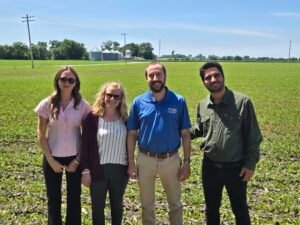
The ASA Economics team visits Daryl Cates’ Illinois farm.
The price of fertilizer has been an ongoing topic in the soybean industry, but costs have soared further due to the conflict involving Iran and the subsequent Strait of Hormuz transit limitations, worsening an already difficult environment for farm input costs. “Global dynamics largely shape fertilizer prices both at home and abroad,” Holland said. “Reductions and pauses in China’s phosphate export volumes has had a major impact on global pricing. Tariff barriers imposed by the U.S. in the form of countervailing duties and International Emergency Economic Powers Act (IEEPA) tariffs also added extra layers of costs to input pricing.”
Countervailing duties (CVDs) on Russia and Morocco, two of the world’s largest phosphate exporters, have created additional limitation in the fertilizer space, which was already experiencing a downward trend in availability. Despite CVDs, the U.S. has continued to import phosphates from Russia due to this tight supply availability. The American Soybean Association has long advocated that countervailing duties must be removed because importers are passing these costs to farmers, adding pressure to an already strained farm input environment. If CVDs were to be removed, Holland said the benefits would include, “unencumbered access to available supplies reducing global scarcity and sending prices lower as a result, all other factors equal.”
Even if the current events causing the rising costs come to an end, it will take months for prices to come down and even years before farmers see price relief. As such, farmers are continually reevaluating how to manage costs, such as cutting back on their fertilizer usage.
“We reduced our fertility to nutrient removal level as a cost saving measure,” Simpson-Dolbeare said. “Yet even with these measures, we still spent more on inputs than we typically have in the past. To sum it up, we applied, on average, 1/3 less and paid 50% more.”
The Need For Open Markets
The soybean export market took a huge hit this year as the #1 customer of soybeans, China, cut its typical purchases in half. This lack of purchases has resulted in a struggling export market, and farmers are not generating the revenue they need to cover the cost of farming. Add in the negative effect of a 10% tariff from China on U.S. soybeans and it’s easy to see that policy change is needed to open the markets that provide farmers the opportunity to be profitable.
“China is by far the largest export concern because the tariff rate has gone up on U.S. soy,” Gerlt said. “Historically, soy has had good market access to other countries. Over the next few years, what China does for U.S. beans will be a big driver for exports.”
Since China cut back on its soybean purchases, farmers have been vocal about urging the administration and Congress to work toward creating open export markets instead of adding tariffs or providing payments to farmers in the form of farm assistance.
“From our viewpoint, reducing tariffs will help us the most,” Simpson-Dolbeare said. “Tariffs are hurting demand for U.S. soy, and tariffs are negatively impacting our input costs. Our greatest concern is how our long-term profitability is affected if tariffs stay in place. We don’t want ongoing aid, we want open trade markets.”
The ASA Executive Committee and board have gone on record over the past year reiterating Simpson-Dolbeare’s sentiment. Farm assistance is appreciated, but what they really want is to rely on open markets to sustain their farms. Tariffs have caused potential soybean buyers to look to markets outside of the U.S., greatly increasing strain on farmers who are already combating the rise in input costs.
Discussions about the increased cost of farming need to continue, and ASA is leading efforts, advocating for actions to bring costs down and to eliminate this financial strain on the farming industry. Between calling for the termination of countervailing duties on phosphate fertilizer imports from Morocco and Russia and educating policymakers on how these inputs affect American agriculture, ASA is working for our farmers to ensure decisions being made in Washington D.C., are benefiting the soybean industry.
The post The Cost of Farming appeared first on American Soybean Association.


