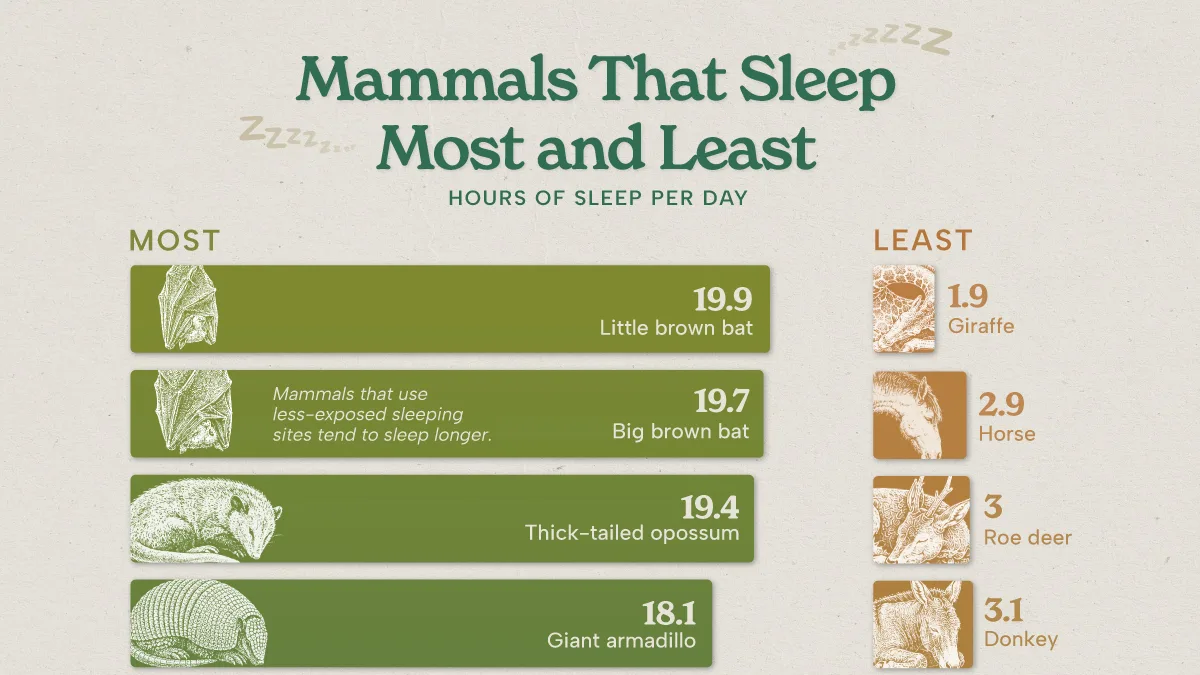
The Mammals That Sleep Most and Least
See visuals like this from many other data creators on our Voronoi app. Download it for free on iOS or Android and discover incredible data-driven charts from a variety of trusted sources.
Key Takeaways:
- The little brown bat tops the rankings at 19.9 hours of sleep per day, while the giraffe sleeps just 1.9 hours, an 18-hour difference.
- Eight of the 10 longest-sleeping mammals in the dataset average at least 16 hours of sleep daily, while most of the shortest sleepers average fewer than 5.5 hours.
- Large grazing herbivores cluster among the lightest sleepers, reflecting the long hours they spend feeding.
How much sleep does a mammal actually need?
According to research by Savage & West, published in the Proceedings of the National Academy of Sciences (PNAS), the answer depends on far more than body size. Diet, habitat, metabolism, and even where an animal sleeps all help explain the wide variation in sleep duration across species.
Which Mammals Sleep the Most?
The table below ranks the mammals that sleep the most by hours per day:
| Rank | Mammal | Reported Sleep (Hours/Day) |
|---|---|---|
| 1 | Little brown bat | 19.9 |
| 2 | Big brown bat | 19.7 |
| 3 | Thick-tailed opossum | 19.4 |
| 4 | Giant armadillo | 18.1 |
| 5 | North American opossum | 18.0 |
| 6 | Long-nosed armadillo | 17.4 |
| 7 | Owl monkey | 17.0 |
| 8 | Arctic ground squirrel | 16.6 |
| 9 | Golden-mantled ground squirrel | 15.9 |
| 10 | Eastern American chipmunk | 15.8 |
| 10 | Tiger | 15.8 |
| 12 | Tenrec | 15.6 |
| 13 | Greater short-tailed shrew | 14.9 |
| 13 | Western American chipmunk | 14.9 |
| 15 | Round-tailed muskrat | 14.6 |
The little brown bat sleeps 19.9 hours per day, closely followed by the big brown bat at 19.7 hours and the thick-tailed opossum at 19.4 hours.
At the other extreme, giraffes average just 1.9 hours, followed by horses at 2.9 hours and roe deer at 3.0 hours.
Why Do Some Mammals Sleep So Much?
The longest sleepers tend to be small mammals, including bats, opossums, armadillos, squirrels, and monkeys.
According to Savage & West’s analysis, smaller mammals generally have faster metabolisms and accumulate sleep pressure more quickly. Rather than sleeping in one long stretch, many divide their rest into numerous sleep bouts throughout the day, resulting in very high total sleep times.
Safety is another important factor. Mammals that sleep in protected locations, such as caves, burrows, or tree hollows, can remain asleep for longer because they face a lower risk of predation. As both Discover Magazine and the original PNAS study note, sheltered sleeping sites are consistently associated with longer sleep durations across mammals.
Why Grazers Sleep So Little
The shortest sleepers are dominated by large herbivores. Giraffes average 1.9 hours of sleep per day, followed by horses at 2.9 hours, donkeys at 3.1, African elephants at 3.3, sheep at 3.8, Asian elephants at 3.9, and cows at 4.0.
| Rank | Mammal | Reported Sleep (Hours/Day) |
|---|---|---|
| 1 | Giraffe | 1.9 |
| 2 | Horse | 2.9 |
| 3 | Roe deer | 3.0 |
| 4 | Donkey | 3.1 |
| 5 | African elephant | 3.3 |
| 6 | Sheep | 3.8 |
| 7 | Asian elephant | 3.9 |
| 8 | Cow | 4.0 |
| 9 | Brazilian tapir | 4.4 |
| 10 | Goat | 5.3 |
| 10 | Tree hyrax | 5.3 |
| 12 | Rock hyrax | 5.4 |
| 13 | Genet | 6.3 |
| 13 | Gray hyrax | 6.3 |
| 15 | Vesper mouse | 7.0 |
One explanation is simple: grass is not particularly energy-dense. Grazing mammals must spend much of the day eating to meet their caloric needs, leaving less time for sleep.
Remaining alert in open environments also helps reduce the risk of predation. As Futura Sciences explains, feeding requirements and exposure to predators together place practical limits on how long many herbivores can rest.
Sleep Is an Evolutionary Adaptation
Like strength, endurance, or migration, sleep has evolved to suit each species’ ecological niche. A tiger can sleep 15.8 hours each day, while an elephant remains active for most of its 24-hour cycle because its lifestyle demands it.
These differences highlight the diversity of mammalian evolution. Whether examining the world’s strongest animals or the species that undertake the longest land migrations, each adaptation reflects a distinct solution to surviving in the wild.
Learn More on the Voronoi App 
Want to discover more fascinating animal data Check out Which Animals Live the Longest? on the Voronoi app, where you’ll find thousands of data-driven visualizations covering nature, science, economics, technology, and much more.