The Five Countries to Land on the Moon, and When They Did It
Key Takeaways
- Only five countries have achieved a successful soft landing on the Moon since 1966.
- The U.S. remains the only nation to land astronauts on the lunar surface.
- Several countries have reached lunar orbit or attempted landings, but only a handful have completed controlled touchdowns.
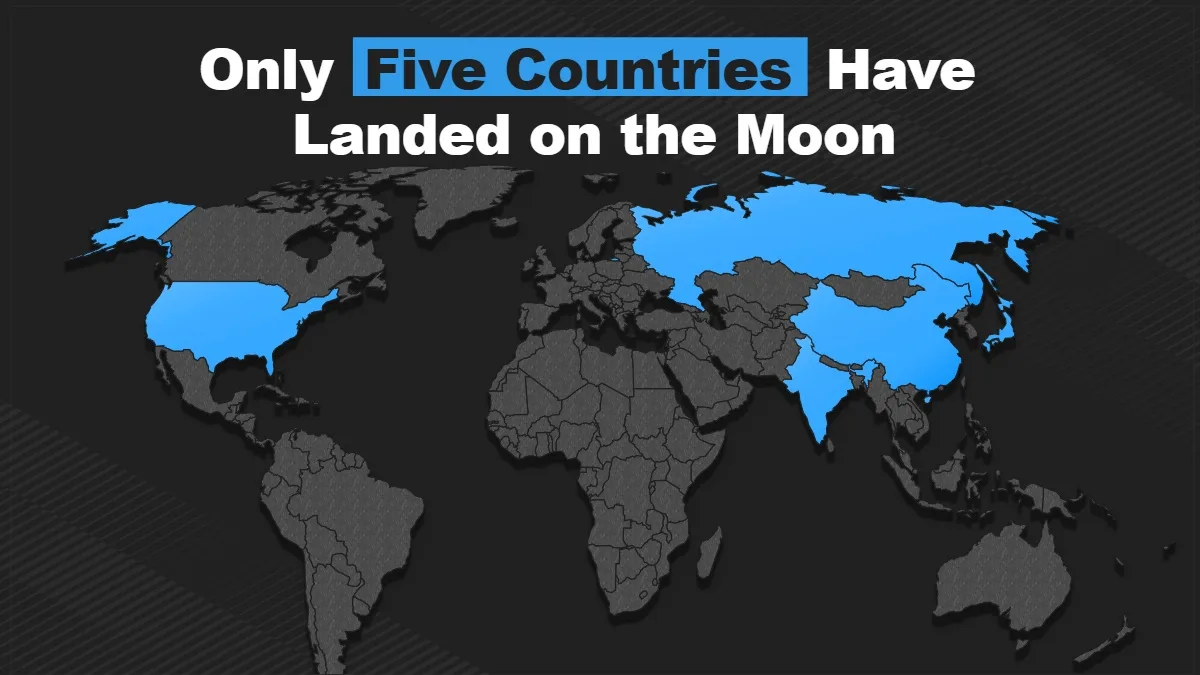
Roughly 200 countries exist today, but only five have successfully landed a spacecraft on the Moon.
Achieving a controlled lunar landing remains one of the most difficult feats in space exploration, requiring decades of engineering expertise, precision navigation, and advanced propulsion systems. While many nations have reached the Moon or attempted landings, only a select group has completed a successful soft landing.
Using data from HowStuffWorks, this map highlights the five countries that have joined this exclusive club. Russia is shown in place of the USSR, which officially dissolved in 1991.
First Successful Moon Landings: A Chronology
Each country reached the Moon during a different era of space exploration, spanning nearly six decades from the Cold War space race to today’s renewed global competition. Here’s when each nation completed its first successful soft landing:
| Year | Nation | Mission | Notes |
|---|---|---|---|
| Feb 3, 1966 | ☭ USSR | Luna 9 | Seven years after the previous Luna 2 reached the Moon (but crashed into it), Luna 9 landed and transmitted data from the lunar surface. |
| Jun 2, 1966 |  United States United States |
Surveyor 1 | Surveyor 1 landed and took over 11,000 pictures. Between 1969-1972, the U.S. then had six successful crewed missions through its Apollo program. |
| Dec 14, 2013 |  China China |
Change’e 3 | China landed its first soft rover on the Moon. This was the world’s first celestial landing since August 1976. |
| Aug 13, 2023 |  India India |
Chandrayaan-3 | India’s ISRO became the fourth space agency to land on the Moon, and the first to land at the lunar south pole. |
| Jan 19, 2024 |  Japan Japan |
SLIM | Nicknamed the “Moon Sniper”, Japan’s entry was designed to be the first hyper-accurate Moon landing. It arrived within 100 m of its target. |
And here is a map of all 28 successful Moon landings by country:
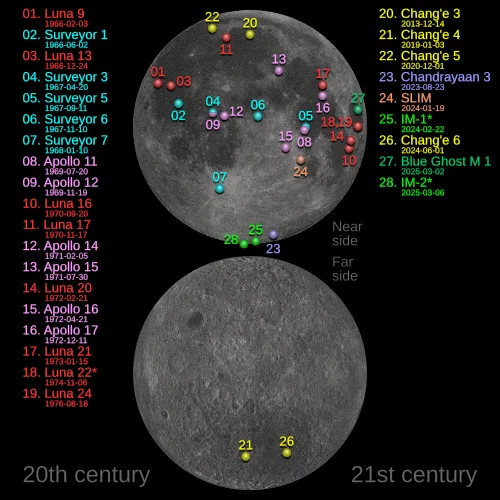
Nearly every successful landing has occurred on the Moon’s near side, where communication with Earth is much easier. China is the only country to achieve successful soft landings on the lunar far side, with its Chang’e 4 and Chang’e 6 missions marking major milestones in robotic exploration.
The nature of lunar exploration is also changing. In 2025, Firefly Aerospace became the first privately funded company to complete a successful Moon landing with its Blue Ghost M1 mission, launched aboard a SpaceX Falcon 9 rocket.
Failed Landings and Other Missions
Even though achieving a soft, controlled landing is rare, there have been many more lunar missions by other countries.
Here are two recent missions that attempted soft landings but failed:
 Israel: The country’s Beresheet mission successfully entered lunar orbit in 2019, but ended with a crash landing.
 Russia: In its first attempt since the dissolution of the USSR, Russia’s Luna 25 mission crash landed in 2023. Russia is expected to have another go with Luna 27 in 2029-2030.
Meanwhile, several other countries and agencies have completed successful non-landing missions to the Moon, including Pakistan, Canada, Italy, the European Space Agency, and South Korea. Private companies have also become more active in lunar exploration.
Future Attempts
The race to join the Moon landing club is far from over. Several countries, along with a growing number of private companies, are developing lunar missions as governments and businesses prepare for a new era of Moon exploration tied to scientific research, resource prospecting, and future crewed missions.
Not every mission reaches the launch pad. For example, Canada’s planned lunar rover mission targeting 2029 was cancelled in March 2026, illustrating just how technically and financially challenging lunar exploration remains.
- Source: https://www.visualcapitalist.com/the-only-five-countries-to-land-on-the-moon-and-when-they-did-it/