The World’s Biggest Gold, Silver, and Platinum Reserves
See visuals like this from many other data creators on our Voronoi app. Download it for free on iOS or Android and discover incredible data-driven charts from a variety of trusted sources.
Key Takeaways
- Australia and Russia together hold nearly 40% of the world’s known gold reserves.
- Peru holds the largest share of global silver reserves, ahead of Russia and Australia.
- South Africa accounts for roughly 83% of global platinum group metal reserves.
Precious metals are among the world’s most valuable natural resources, serving as both financial assets and critical industrial materials.
While gold is prized as a store of value, silver and platinum group metals play essential roles in manufacturing, clean energy technologies, and electronics.
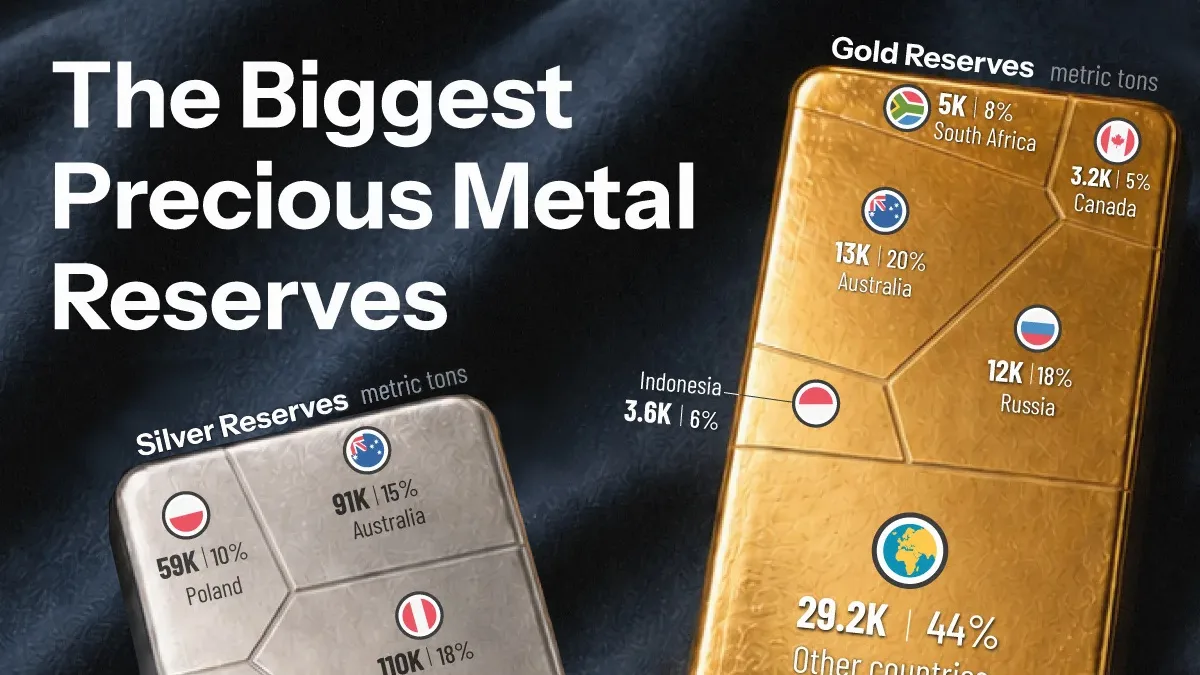
This graphic compares the countries with the largest known reserves of these strategically important metals. The data for this visualization comes from the U.S. Geological Survey’s Mineral Commodity Summaries 2026, based on economically recoverable deposits.
Australia and Russia Lead in Gold
Australia holds the world’s largest gold reserves at 13,000 metric tons, representing roughly one-fifth of the global total.
Russia follows closely with 12,000 metric tons, while South Africa, once the world’s dominant gold producer, ranks a distant third.
| Country | Gold Reserves (metric tons) | Share of world total |
|---|---|---|
 Australia Australia |
13,000 | 20% |
 Russia Russia |
12,000 | 18% |
 South Africa South Africa |
5,000 | 8% |
 Indonesia Indonesia |
3,600 | 6% |
 Canada Canada |
3,200 | 5% |
| Other | 29,200 | 44% |
| World total | 66,000 | 100% |
Together, Australia and Russia account for nearly two-fifths of known global gold reserves. As central banks continue accumulating gold and miners face declining ore grades, these reserves represent an important long-term strategic asset.
Silver Reserves Are More Broadly Distributed
Peru leads global silver reserves with 110,000 metric tons, followed by Russia and Australia with roughly equal shares.
| Country | Silver Reserves (metric tons) | Share of world total |
|---|---|---|
 Peru Peru |
110,000 | 18% |
| Russia |
92,000 | 15% |
| Australia |
91,000 | 15% |
 China China |
67,000 | 11% |
 Poland Poland |
59,000 | 10% |
| Other | 191,000 | 31% |
| World Total | 610,000 | 100% |
Unlike gold, no single country dominates global silver reserves. The top five countries account for about two-thirds of the world’s total, highlighting silver’s broader geographic distribution.
Because silver is used extensively in solar panels, electronics, and industrial applications, these reserves are becoming increasingly important as demand grows alongside the energy transition.
South Africa Dominates Platinum Group Metal Reserves
The distribution of platinum group metals is far more concentrated than either gold or silver.
South Africa holds approximately 83% of global reserves, making it by far the world’s most important holder of these critical minerals.
| Country | Platinum group metal reserves (kilograms) | Share of world total |
|---|---|---|
| South Africa |
63,000,000 | 83% |
| Russia |
11,000,000 | 15% |
 Zimbabwe Zimbabwe |
1,300,000 | 2% |
 United States United States |
590,000 | 1% |
| Canada |
310,000 | 0.4% |
| World total | >76,000,000 | 100% |
Outside South Africa and Russia, platinum group metal reserves are relatively limited. This concentration means supply can be especially sensitive to disruptions in just a handful of producing countries.
Platinum group metals—which include platinum, palladium, rhodium, iridium, osmium, and ruthenium—are indispensable in catalytic converters, electronics, jewelry, medical devices, and emerging hydrogen fuel cell technologies.
Learn More on the Voronoi App 
If you enjoyed today’s post, check out All of the World’s Gold, in One Visual on Voronoi.