

Researchers from Ohio State University and Southern Illinois University have found that households, versus individuals, make solar purchasing decisions happen. Because buying solar is so confusing, the family member driving the project, or the solar “champion” often gets exhausted. Solar companies need to support this person to keep the sale from falling apart, said the report.
The family-centric role was further cemented by the finding that engaged family disagreement on solar also positively predicted adoption.
The researchers, Nicole Sintov, Kristin Hurst, and Naseem H. Dillman-Hasso, posit in “Family dynamics are a missing piece in understanding residential solar adoption,” published in nature energy, that looking at couples and families — versus just individuals within the households — can help solar salespeople better predict deals that close. The work spanned interviews with 39 couples and surveys of 394 households including 126 solar adopters and 268 “lost customers” who contacted an installer, completed an inspection, or applied for permits but never bought.
The researchers suggest marketing materials should be designed to “encourage constructive dialogue and facilitate coordination among family members.” The paper said workshops and facilitated discussions should be structured to help the family collectively “navigate logistics, financial decisions and information gathering.”
Table Reproduced from Article
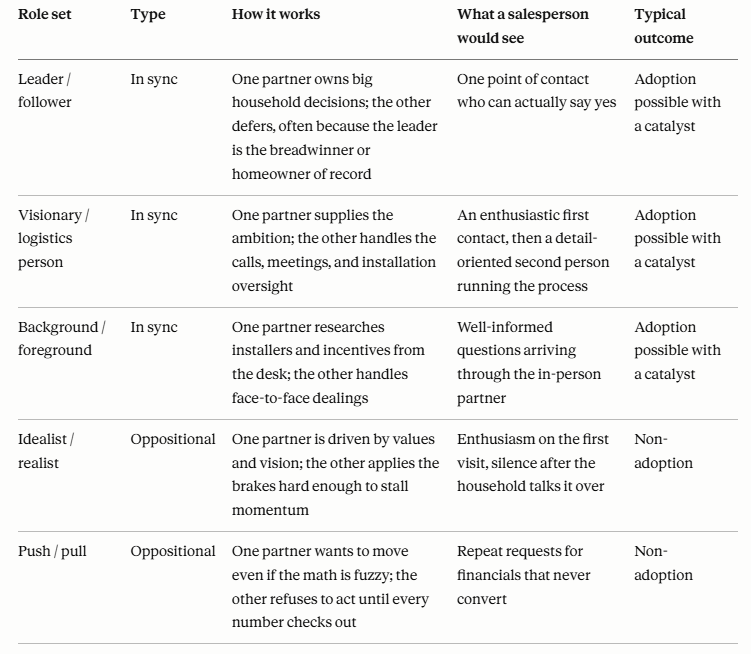
Looking at couples, the researchers found that every adopter couple had “in sync” role sets that showed a practical household structure. The roles were usually complementary, such as visionary and logistics person, or background versus foreground researcher. These couples had a solar champion, and generally a partner who trusted them.
“Out of sync” oppositional couples were usually structured as a champion and a holdout. None of them installed solar.
A key detail, though – even when couples were in sync and trusted each other with the decision, it often took external catalysts to push the decision forward. Some catalysts noted included a shrinking federal tax benefit, electricity rates doubling, fear of frequent outages, or simply not having access to the local utility.
Meaning – timing manners.
“Champions probably bear emotional and cognitive burdens…demands shouldered by champions may increase the risk of burnout or loss of motivation, leaving households stalled despite initial enthusiasm,” said the paper.
In the survey study, greater household-wide support for solar predicted adoption — and so did greater disagreement within the household, which the authors said may reflect active deliberation rather than apathy. Households where more members executed tasks in pursuit of solar were also more likely to adopt.
While the research did not find that burnout occurred, as it was not directly measured, the authors hypothesize that support in these key moments can help drive uptake. The researchers see parallels in “diffusion of innovations” research, which suggests supporting champions with tools that distribute responsibilities can support deal closings.
The post To sell solar, sell the family, support the champion, and mind the timing appeared first on pv magazine Global.


