

Last week, U.S. climate policy changed quickly. California boosted its carbon market, but federal regulators decided to weaken climate disclosure rules.
ezstandalone.cmd.push(function () { ezstandalone.showAds(119); });
On Friday, the California Air Resources Board (CARB) approved long-awaited updates to California’s Cap-and-Invest Program. The changes extend and reshape one of the world’s largest carbon markets through 2045.
On the same day, the U.S. Securities and Exchange Commission (SEC) proposed rescinding its climate-related disclosure rules in full. The agency argued that the requirements exceeded its legal authority and imposed costs on companies that were not justified by the benefits to investors.
ezstandalone.cmd.push(function () { ezstandalone.showAds(127); });
Together, the two decisions highlight a widening divide in U.S. climate regulation. California is tightening its long-term emissions strategy. Meanwhile, federal regulators are rolling back climate reporting rules from the Biden administration.
The developments come as global carbon markets and clean energy investment continue to expand despite political uncertainty.
ezstandalone.cmd.push(function () { ezstandalone.showAds(128); });
California Strengthens One of the World’s Largest Carbon Markets
California’s Cap-and-Invest Program covers roughly 80% of the state’s greenhouse gas emissions. The system sets a declining cap on pollution and requires major emitters to buy allowances for their emissions.
The program applies to power generators, fuel suppliers, and large industrial facilities. Companies that reduce emissions can sell unused allowances, creating a carbon market that rewards lower pollution.
ezstandalone.cmd.push(function () { ezstandalone.showAds(129); });
CARB said the updates will help California meet its climate goals for 2030 and 2045. They also aim to keep costs manageable for consumers and businesses. The state says the program has already delivered major results. Since launching, it has:
- Generated about $35 billion for climate investments
- Supported roughly 30,000 jobs
- Funded more than 500,000 projects statewide
- Delivered around $61 billion in utility bill credits to residents
- Helped California reach its 2020 climate target six years early
State officials say carbon pricing is a smart way to cut emissions. It also helps the economy grow. The latest updates give investors a long-term signal. This is key for those in renewable energy, clean transportation, battery storage, and low-carbon industrial projects.
ezstandalone.cmd.push(function () { ezstandalone.showAds(130); });
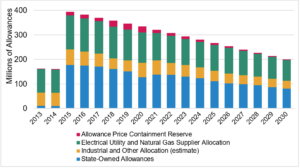
The Board further states that the updates provided the following results:
- An 11% annual cap decline through 2030 and an average 7% annual cap decline from 2031–2045.
- Removal of 118 million carbon allowances
- $10 billion for electricity bill credits and $8 billion for the Greenhouse Gas Reduction Fund.
- Manufacturing Decarbonization Incentive Fund doubled to $4 billion and $800 million in additional compliance support for industry.
- Support for industrial emissions-reduction investments.
- No additional fuel cost pass-through for consumers at the pump.
CARB Chair Lauren Sanchez remarked:
“At a moment when climate policy is under attack and global economic upheaval is creating real uncertainty, this rulemaking is critically important for California… By moving forward today, we are responding to real affordability concerns while sending a clear and unwavering signal to the world that we remain committed to long-term investment in clean energy, good jobs, and healthier communities.”
ezstandalone.cmd.push(function () { ezstandalone.showAds(131); });
Washington Hits the Brakes on Climate Disclosure
While California expanded its climate framework, the SEC moved in the opposite direction.
The agency proposed fully rescinding climate disclosure rules adopted in March 2024. The rules would make many public companies report climate risks, greenhouse gas emissions, and the impact of severe weather on their finances.
The rules never took effect because of lawsuits filed by business groups and several Republican-led states. The SEC stopped defending the rules in court in 2025 and has now formally proposed removing them.
ezstandalone.cmd.push(function () { ezstandalone.showAds(132); });
SEC Chairman Paul Atkins remarked in a statement:
“We must re-examine the costs, burdens, and benefits of disclosure mandates to make becoming and remaining a public company more attractive again. SEC disclosure obligations should comply with the Commission’s statutory authority, be guided by materiality as the North Star, avoid the practical effect of dictating corporate behavior, and be imposed only when the expected benefits justify the likely costs and burdens.”
The agency identified key policy reasons for such a decision, including:
- Misalignment with SEC policy objectives,
- High compliance costs for public companies,
- Limited additional investor benefits and potential burden on shareholders,
- Possible barrier to capital formation, and
- Reduced attractiveness of public market listings.
ezstandalone.cmd.push(function () { ezstandalone.showAds(133); });
The proposal now enters a 60-day public comment period before any final decision is made. Many large companies will still need to report on climate issues. This is true even if federal rules go away. California regulations and European sustainability disclosure requirements will still apply.
Global Carbon Trading Keeps Expanding Despite Political Headwinds
The regulatory debate comes as carbon markets remain a major part of global climate policy. According to the World Bank, carbon pricing instruments now cover nearly one-quarter of global greenhouse gas emissions. Governments worldwide operate dozens of emissions trading systems and carbon taxes.
ezstandalone.cmd.push(function () { ezstandalone.showAds(134); });
Compliance carbon markets, like California’s system and the EU Emissions Trading System, manage billions in trading each year.
At the same time, voluntary carbon markets remain important for corporations pursuing net-zero goals. In 2023, companies retired about 182 million voluntary carbon credits, per data from market registries tracked by Ecosystem Marketplace.
Data from AlliedOffsets also shows a similar volume of retired voluntary carbon credits.
ezstandalone.cmd.push(function () { ezstandalone.showAds(135); });
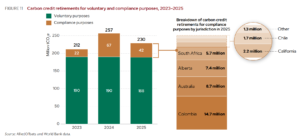
Demand is highest among technology firms, airlines, energy companies, and consumer brands. They want to offset hard-to-eliminate emissions.
Emissions Keep Rising as Climate Deadlines Get Closer
These policy shifts occur when global emissions remain near record levels. The International Energy Agency reports that energy-related carbon dioxide emissions hit about 37.8 billion metric tons in 2024. This is the highest level ever recorded worldwide.
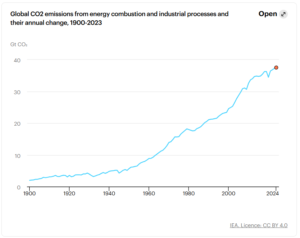
Meanwhile, the Intergovernmental Panel on Climate Change says global emissions need to drop by about 43% by 2030. This is based on 2019 levels and is necessary to stay on track for a 1.5°C warming limit.
ezstandalone.cmd.push(function () { ezstandalone.showAds(136); });
These targets are driving continued investment in clean energy, carbon markets, and emissions reporting systems.
BloombergNEF estimates global energy transition investment reached a record $2.3 trillion in 2025. Growth remains strong across renewable energy, battery storage, electric vehicles, and grid infrastructure.
As a result, many investors continue to view climate-related financial risks as increasingly relevant, regardless of shifting federal policies.
ezstandalone.cmd.push(function () { ezstandalone.showAds(137); });
A Growing Divide in Climate Regulation
The latest actions by California and the SEC show two very different approaches to climate governance.
California is expanding the use of carbon pricing as a long-term emissions reduction tool. Federal regulators, meanwhile, are reducing climate-related disclosure requirements for public companies.
Despite these differences, broader market trends continue moving toward decarbonization. Clean energy investment remains at record levels, carbon markets continue to grow, and large corporations are still pursuing net-zero targets.
ezstandalone.cmd.push(function () { ezstandalone.showAds(138); });
The result is a climate policy environment that is becoming more fragmented. States, countries, investors, and corporations are increasingly shaping their own climate strategies even as federal regulations shift direction.
For businesses, the challenge is no longer whether climate policy matters. It is learning how to operate across a growing mix of carbon markets, disclosure systems, and emissions rules that continue to evolve around the world.
- READ MORE: Carbon Markets Go Financial with Abatable Launching First Forward Pricing Curve for Carbon Credits
ezstandalone.cmd.push(function () { ezstandalone.showAds(139); });
The post Two Americas on Climate: California Tightens Carbon Rules While SEC Backs Away appeared first on Carbon Credits.


