

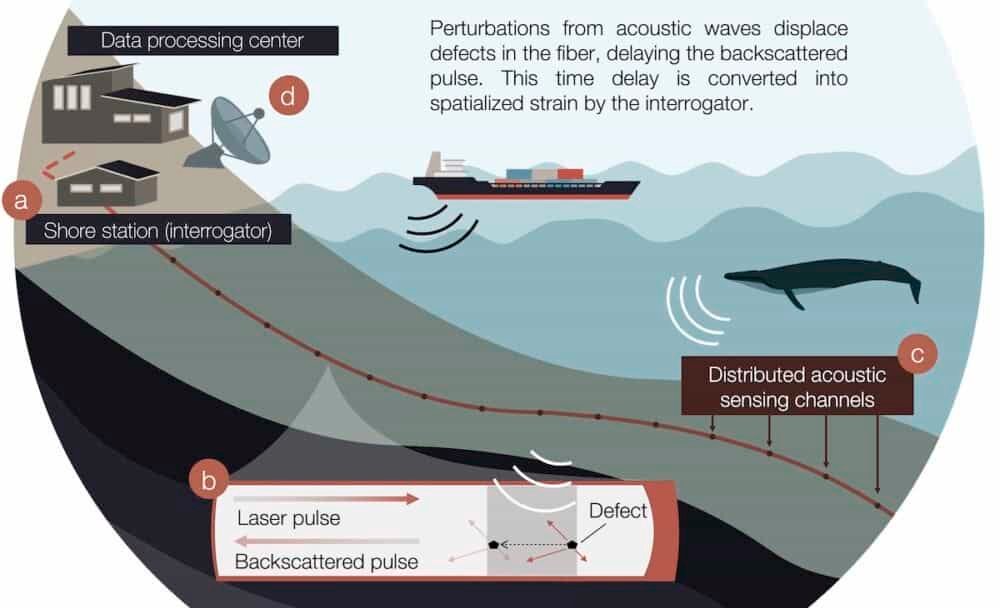
 “<strong>Detecting whale motion</strong> Graphic showing a distributed acoustic sensing system that uses fibre-optic cables to help researchers detect ships and whales in the waters near Svalbard. (Courtesy: Léa Bouffaut)”
A technique currently used to track whale vocalizations could be adapted to pick up the hydrodynamic pressure fields created as they swim, researchers in Norway have demonstrated. Through analysis of backscattered light in an undersea optical fibre, Robin Rørstadbotnen and Martin Landrø at the Norwegian University of Science and Technology (NTNU) showed how silent whales can be detected as they swim close to the fibre. The duo hopes the discovery could ultimately provide a valuable new tool for whale conservation.
With the combined disruption of climate change and human activity, whales are rapidly being forced into new habitats and migration patterns. To understand these profound shifts in behaviour, conservationists widely rely on a technique named distributed acoustic sensing (DAS), which detects acoustic waves via the strain they induce on optical fibres.
When coherent laser pulses are passed through a fibre, a small portion of laser light is inevitably scattered back to the source by small fluctuations in the fibre’s structure and density. If the fibre is strained by an acoustic wave, the oscillating pressure field imprints a phase shift on this backscattered light, which varies in proportion to the degree of strain.
So far, this approach has been used to pick up whale vocalizations: the loudest sounds produced by any animal, which can travel for thousands of kilometres through the ocean. By analysing backscattered light across the global network of undersea optical fibres, researchers have gathered valuable information about how the habitats and migration paths of these marine mammals are changing.
“At NTNU, we started activity within distributed acoustic sensing in 2016,” Rørstadbotnen describes. “When the Center for Geophysical Forecasting was launched in 2021, this technology became a key field of interest.”
Despite the value of data that can be gathered through whale vocalizations, the approach leaves conservationists with a significant blind spot for the majority of the time when whales are silent. To address this limitation, Rørstadbotnen and Landrø considered how DAS could be adapted to pick up the hydrodynamic pressure and velocity fields constantly being created by the whales moving through the water, which generates ultralow-frequency signals similar to those created by the movement of ships.
To test this idea, the duo revisited scattering data gathered from a seabed optical fibre off the coast of Svalbard in the Norwegian Arctic. After filtering the data for a selected band of frequencies, they carried out frequency–wavenumber analysis to determine how rapidly the signals varied along the length of the fibre. Just as they hoped, “we found that this new approach could be applied to detect silent whales, given that they are swimming close to the fibre optic cable,” Rørstadbotnen says.
Through this analysis, the researchers were able to identify ships crossing the fibre from depths of up to 413 m, and at a maximum distance of 550 m from the fibre. They also managed to determine the vessel speeds and roughly estimate their sizes. Crucially, they were also able to distinguish the speeds and approximate sizes of silent whales swimming less than 40 m away from the fibre, as well as estimating their depths.
“Since we also recorded the acoustic signals in the frequency range from 5 to 100 Hz, we could identify whales when they were vocalizing closer to the sea surface,” Rørstadbotnen describes. “Thereby, we could use this information as a strong indication that the low-frequency signal observed a bit later in time was most likely generated by the whale moving closer to the fibre.”
Having demonstrated this possibility, Rørstadbotnen and Landrø now hope that their technique could provide researchers with a new tool for tracking whales around the world, even when they aren’t vocalizing. “In addition, this method can potentially detect toothed whales that vocalize in the high-frequency band outside what is normally recorded for distributed acoustic sensing,” Rørstadbotnen adds.
Beyond its potential for whale conservation, the duo is also hopeful that the technique could help researchers build up a more extensive picture of marine mammals more generally, along with other vital elements of fast-changing marine ecosystems.
The research is described in Proceedings of the National Academy of Sciences.
The post Undersea optical fibres detect the motion of silent whales appeared first on Physics World.


