

What does the uptake of rooftop solar PV look like in Africa
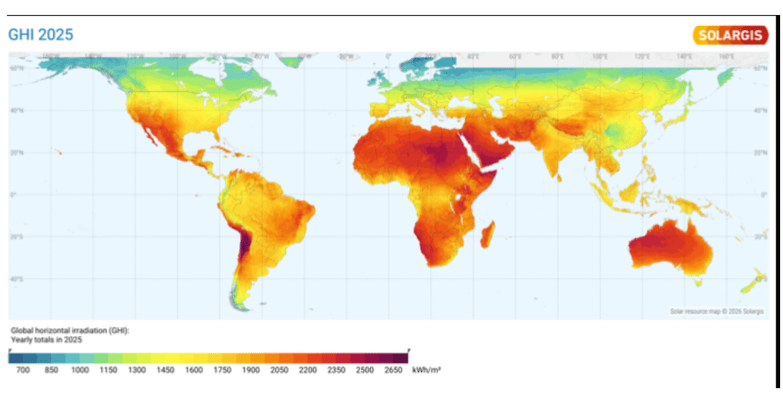
Africa has the highest average annual global horizontal irradiation (GHI) of any continent, yet it has the lowest uptake of rooftop solar PV. Solar PV has been the lowest-cost electricity generation technology for nearly a decade, and this has resulted in the fast uptake of this benign technology worldwide. A continent-wide rooftop mapping study estimated that existing rooftop solar installations in Africa represent less than 1% of the continent’s potential, with rooftop PV deployment being primarily driven by local electricity demand, and solar irradiance playing a relatively limited role. South Africa, Nigeria, Morocco, Egypt and Kenya, are the top five rooftop PV adopters in Africa, with roughly 85% of the total. The continent’s technically exploitable rooftop photovoltaics potential area is estimated at nearly 6,000 km2, which, based on average performance coefficient and solar irradiance conversion, can generate more than 2,000 TWh of electricity annually. This theoretical output is more than double Africa’s total electricity generation in 2025.
Residential electricity in Angola is among the cheapest in the world, averaging around $0.015/kWh to $0.030/kWh (approximately AOA 13/kWh to AOA 25/kWh). The most common tier for general households, are typically 50% lower. These low electricity costs are sustained by substantial government subsidies, keeping electricity highly affordable for households while reducing the economic attractiveness of rooftop solar.
Independent power producers (IPPs), many operating thermal plants that burn heavy fuel oil, have long served as Kenya’s stopgap for electricity supply. Long-term contracts with IPPs have locked the country into expensive deals, driving up consumer tariffs. Thermal IPPs supply electricity to Kenya at tariffs as high as $0.23/kWh, making them among the most expensive in the world. By contrast, Kenya buys hydropower from Ethiopia at around $0.066/kWh. But why is the uptake of rooftop PV in Kenya so small if the residential tariffs are so high?
The estimated rooftop PV installed capacity in Kenya is less than 300 MW. This amounts to 5 W per person compared with the 1000 W per person in Australia. High electricity tariffs alone don’t necessarily translate into strong rooftop-PV adoption in Kenya. Several factors work against residential rooftop solar.
1. Households facing the highest tariffs often don’t consume enough electricity; Kenya has a strongly tiered residential tariff structure. In FY2024/25, the lifeline category covered consumption up to 30 kWh/month, while ordinary domestic customers were generally in the 30–100 kWh range and above. That is important because a household consuming 50–100 kWh/month may pay a relatively high price per kWh, but its absolute monthly electricity bill is still small. For perspective, a 1 kW solar PV will produce around 1300 kWh per month.
2. Kenya’s new net-metering regime doesn’t give residential PV full retail value for exports. This is probably one of the most important structural reasons. Kenya introduced a net-metering framework in 2024. Systems can be up to 1 MW, but the initial program is capped at 100 MW over five years. For perspective, Australia has half the population of Kenya and deploys nearly 100 MW of rooftop solar every week. Exported electricity receives a credit equivalent to 50% of the exported energy, rather than the homeowner receiving the full retail electricity price.
3. The upfront capital cost is a much bigger obstacle than the tariff suggests. This is the classic emerging-market problem. A household may have a high marginal electricity tariff but still have limited access to the upfront capital investment required. Ethiopia is the only country in Africa with 100% renewable electricity production, which reflects the country’s abundant hydro resources. This underpins both the domestic affordability and the export competitiveness of Ethiopian electricity but severely limits the attractiveness of rooftop solar PV. In June 2025 Ethiopia inaugurated a 100 kW rooftop system with bidirectional smart meters, described by the government-affiliated Ethiopian News Agency as the country’s first such grid-connected rooftop solar initiative.
Ethiopia is the only country in Africa with 100% renewable electricity production, which reflects the country’s abundant hydro resources. This underpins both the domestic affordability and the export competitiveness of Ethiopian electricity but severely limits the attractiveness of rooftop solar PV. In June 2025 Ethiopia inaugurated a 100 kW rooftop system with bidirectional smart meters, described by the government-affiliated Ethiopian News Agency as the country’s first such grid-connected rooftop solar initiative.
Why is rooftop PV adoption so high in South Africa compared with other African countries?
South Africa has an unusually strong combination of a wealthy, grid-connected customer base, unreliable grid electricity, relatively high electricity prices, a high solar radiation resource availability, and a mature solar installation/finance industry. In many other African countries, the economics and customer base are different. Rooftop PV takes off when customers have both the ability to pay for a system and a strong economic reason to minimise grid electricity, on top of high solar radiation resource availability. South Africa has unusually high levels of all the above, and a large “reliability premium”: load shedding. For years, South African households and businesses experienced scheduled electricity outages. That is a very different incentive from a country where the grid is reasonably reliable. That also turned solar PV from an environmental investment into an insurance product: people were installing rooftop PV and, increasingly, batteries because they wanted electricity when Eskom could not provide it. South Africa’s rooftop PV capacity increased from about 1.2 GW in 2020 to roughly 7.3 GW by late 2025. Interestingly, this also provides a natural experiment: when load shedding largely disappeared in 2024, rooftop solar uptake slowed substantially.
The bottom line on rooftop PV adoption
Residential electricity tariffs are a key driver of rapid rooftop PV uptake, while financing conditions, regulatory frameworks, solar irradiation, and declining PV technology costs collectively shape both the pathways and pace of solar adoption across countries. Driven by Chinese panel exports, African nations are on track to install a record 17 GW of total solar in 2026, with nearly three-quarters of that growth coming from decentralized, distributed systems.
Authors: Prof. Ricardo Rüther (UFSC), Prof. Andrew Blakers (ANU)
ISES, the International Solar Energy Society is a UN-accredited membership NGO founded in 1954 working towards a world with 100% renewable energy for all, used efficiently and wisely.
The previous two articles in the series focused on Australia and South America.
The post Very low cost rooftop solar slashes domestic energy cost – Part 3: African Countries appeared first on pv magazine Global.


