
The buzz of bees is a classic summer sound.
What we hear as a bumblebee “buzz” is wind vibrations created by the bee’s rapid wingbeats. The thorax muscles used to generate those wingbeats do much more than help a bee fly. They are central to a bee’s ability to communicate, defend the nest and buzz-pollinate.
Buzz-pollination, or flower sonication, is used by bumblebees and many other bee species. Bees target plants that have evolved to respond to their buzz-pollinating ability. After landing on a flower, a bee will curl its body around the pollen-concealing anthers and contract its flight muscles (without activating its wings) at a very high frequency — up to 400 times per second, or 400 hertz — to produce the vibrations needed to shake the pollen loose.
But the relentless advance of climate change could have serious consequences for plant reproduction, biodiversity and the welfare of humans and wildlife, because increased temperatures might reduce a bee’s ability to buzz-pollinate.
READ MORE: A multitude of bees are your tireless workers
Research conducted at Uppsala University, Sweden, and Newcastle University, Newcastle Upon Tyne, U.K.,* has shown that increasing temperatures from climate change and exposure to heavy metals can interfere with the efficiency of a bumblebee’s buzz. Environmental extremes can reduce the frequency and pitch of non-flight wing vibrations threatening bees’ ability to release flower pollen.
“We want to understand how variation in these vibrations affects pollen release, to understand plant reproduction and pollinator behaviour,” says Dr. Charlie Woodrow, a post-doctoral researcher at Uppsala University. “This inspired us to research how non-flight buzzes differ within and between species, and the drivers affecting these buzzes.
“To understand this special pollination mechanism, which is required for the pollination of many crops we rely on, we need to understand how bees produce different buzzes … some buzzes are better at releasing pollen than others.”
Exactly how temperatures have an impact on the quality of a bee’s buzz is still a work in progress, but the research so far shows that hotter, ambient air temperatures change the buzz’s pitch and loudness.
Measuring the buzz
The research focused on colonies of buff-tailed bumblebees (Bombus terrestris), a common and widespread European bee species often used in studies. The team used accelerometers to measure the frequency, or audible pitch, of their buzz.
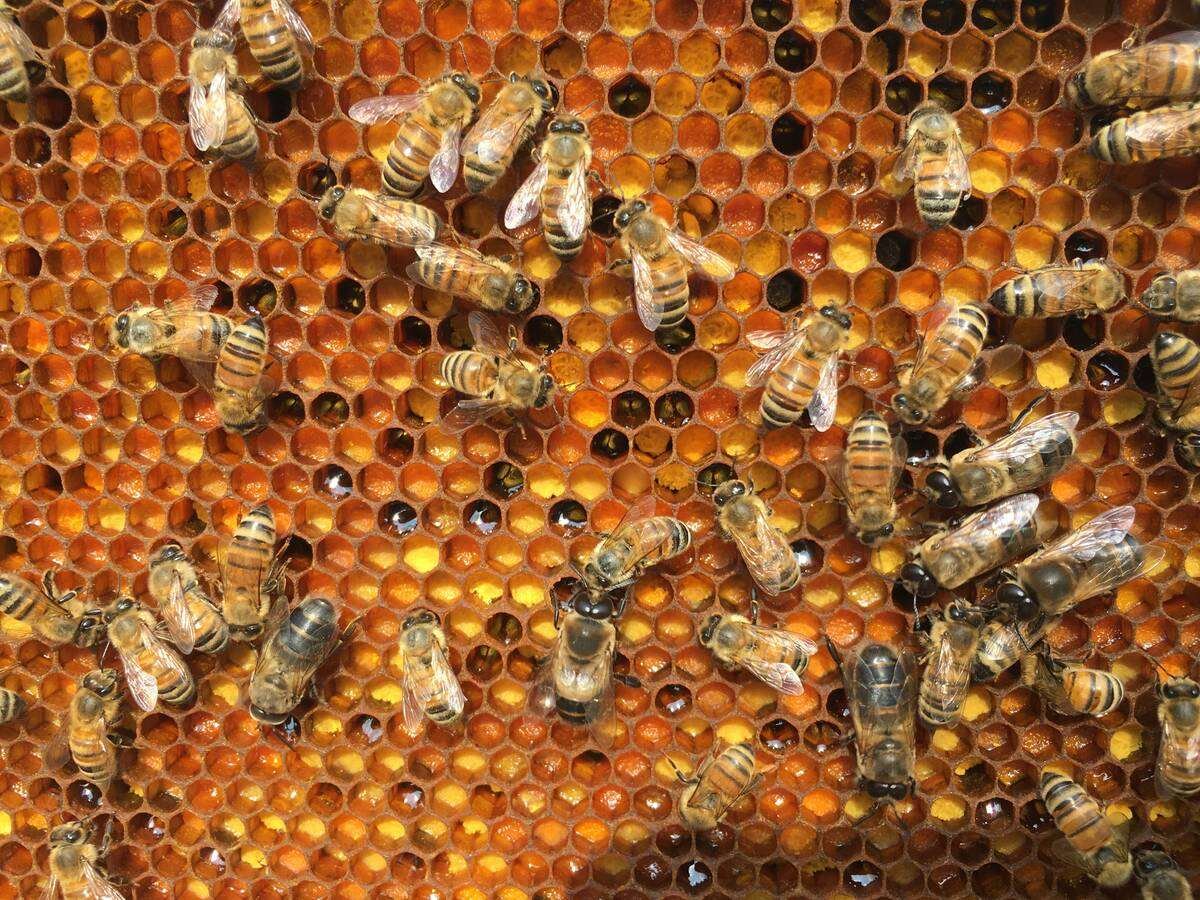
It’s known that when honeybees are exposed to metals, impaired cognition and reduced olfactory learning can result. Photo: Courtesy Steve Moore, Ontario Beekeepers Association.
Researchers can press accelerometers against the bee’s thorax, or against the flower the bee is visiting, to record the bee’s vibrations. When accelerometry is coupled with thermal imaging, researchers can discover how bees deal with the extra heat generated from their own buzz.
“We have been using high-speed filming to uncover never-before-seen behaviour,” says Woodrow. “We recently discovered that bees don’t just vibrate on flowers, but they periodically transmit these vibrations to flowers by biting. When a bee buzzes with its flight muscles, its head also moves back and forth. They essentially headbang as a result of the thorax shaking. What is cool is that this headbanging is much higher in amplitude than the thorax shaking. By biting the anthers of the flower, the bee can transmit their vibrations more efficiently and release more pollen.”
The team also sampled 15 different arctic species in the Abisko region of the Swedish Arctic.
“In the Arctic, we studied bee buzzes by inducing defensive buzzes across a range of natural (in the field) and artificial (in the lab) temperatures,” says Woodrow. “We did this across many different species of bumblebees and were surprised that the buzz response with temperature really didn’t differ much across species — or, at least, we did not detect any differences with the data we had.”
Heavy metal
In addition to the impact of increasing temperatures, exposure to heavy metals has shown a reduction in contraction frequencies of bee’s flight muscles during non-flight buzzing.
“Metals are both naturally occurring and byproducts of human activities, with both historical and contemporary sources,” says Dr. Sarah Scott, research associate, Newcastle University, Newcastle Upon Tyne, U.K., who was working with Woodrow. “For example, certain soils are naturally high in metals due to the soil’s chemistry and natural composition of the base soil.”
Scott added that human sources of metal pollution include industrial activities, mining and transportation. Residential sources include the improper use and disposal of metal-containing items, such as paint, gasoline and batteries. Lead arsenate was previously used as a pesticide, particularly in orchards, which resulted in arsenic and lead contamination.
An indicator of change
The benefits of understanding the impact of environmental change on a bee’s buzz include unique insights into its life cycle and behaviour.
READ MORE: A better way to track bee health
“Our idea here is that if increased temperature changes their buzzes, we should be able to hear the difference and then understand the air temperature. There is a similar concept with crickets whereby the rate of their chirps can be used as a biological thermometer to accurately measure air temperature. What we need for this, however, is more data and a better understanding of how different bees vary in their buzzes across contrasting temperatures.”
To counteract the danger of losing buzz-pollinating services, robotics applications are being developed.
Ongoing research includes further understanding what determines the properties of a bee’s buzz and how different-sized bees transmit their vibrations to flowers.
“Buzz-pollination is energetically expensive and causes the bee to generate metabolic heat,” says Woodrow. “If the environment gets too warm, it may simply choose to avoid buzz-pollinated flowers. “(This research) will help us achieve our overall objective to understand this unique mode of pollination, how it has evolved, and how it could change with future global climate change.”
* The research was presented at the Society for Experimental Biology Annual Conference in Antwerp, Belgium, July 2025. At the time of writing, the research team’s work is in review for publication.
The post What happens if bees’ pollinating buzz goes off-key? appeared first on Farmtario.


